Video Marketing for Small Business: Quick 2026 Guide

Discover a practical guide to video marketing for small business with authentic short-form videos that drive growth without high costs.

Mar 4, 2026

If you’ve ever thought video marketing for small business was just for the big players with bottomless budgets, it's time we talked. Video isn't some far-off luxury anymore; it's a powerful growth engine that’s more accessible than ever—and your customers are practically begging for it.

Why Video Is Now Non-Negotiable for Your Small Business

Let’s be honest. When you’re running a small business, every minute and every dollar counts. It's easy to dismiss video as too expensive or too time-consuming. But that's an outdated way of thinking. For today's SaaS startups and D2C brands, video has become a fundamental tool for building trust and driving sales.

The proof isn’t just anecdotal; the data tells a compelling story.

The State of Video Marketing for Small Business in 2026

The statistics below aren't just numbers on a page. They represent a massive shift in how customers connect with brands. For a small business, understanding these trends is the first step toward using video to punch well above your weight.

Statistic

What It Means for Your Business

91% of businesses will use video as a marketing tool.

Your competition is already there or getting there fast. Not using video means you risk becoming invisible.

84% of people want to see more video content from brands.

This is a direct request from your audience. You have a built-in demand waiting for you to meet it.

83% of marketers report video directly increased sales.

Video isn’t a vanity project. It’s a sales tool that directly impacts your revenue and bottom line.

85% of marketers saw an increase in leads from video.

Looking for more qualified leads? Video is one of the most effective channels for filling your pipeline.

These aren't fuzzy, feel-good metrics. They are hard numbers that translate into real business growth. Getting started is easier than you think.

Forget the Old Roadblocks—They’re Gone

The biggest myth I still hear from founders is that video requires a film crew and a Hollywood budget. That reality is dead and gone. The barriers that once kept small businesses on the sidelines have completely crumbled.

Think about it:

  • Cost is no longer the enemy. In 2024, nearly half of all businesses spent less than $5,000 on video for the entire year. With the camera in your pocket and smart tools, you can get started for next to nothing.

  • Time is something you can manage. The goal isn't to create a cinematic masterpiece. It’s about sharing authentic ideas, consistently. Smart workflows, like batch recording your thoughts and using an intelligent editor, can turn a single afternoon into a month's worth of content.

  • Complexity has been solved. You don't need to become a video editing wizard overnight. Services like Unfloppable were built for this very problem—taking your raw ideas and turning them into polished, ready-to-post videos without you touching a single editing timeline.

The real win is getting past the tedious production work so you can focus on what you know best: your business and your ideas. Authenticity and consistency now beat high production value, every single time.

The Clear and Measurable Payoff

So, what happens when you commit to video? You get results you can actually see and measure. This isn’t about chasing vanity metrics; it’s about moving the needle on the numbers that matter most to a growing business.

The return on investment is undeniable. An incredible 83% of marketers report a direct increase in sales thanks to their video efforts. But it doesn't stop there. Video is a lead-generation powerhouse, with 85% seeing a boost in leads and 82% noticing more website traffic.

These are the numbers that keep a small business thriving. By making video a core part of your outreach, you're building a direct line to your audience that drives engagement, builds genuine trust, and grows your bottom line.

If you’re ready to move from theory to action, our guide on building a solid video content marketing strategy is the perfect place to start.

Building Your Content Engine Without the Overwhelm

Let's be honest. The biggest hurdle in video marketing for most small businesses isn't the gear or the budget. It’s the dreaded content calendar, staring back at you, completely blank. That feeling of "what on earth do I post today?" is what really grinds things to a halt.

But what if you never had to start from scratch again? The secret isn't to frantically brainstorm more ideas—it's to build a reliable content engine. Think of it as a system built on four strategic pillars. These aren’t just random topics; they’re core themes tied directly to your business goals, making sure every single video has a job to do.

Your Four Foundational Content Pillars

Instead of chasing trends that die in a week, you'll anchor your strategy in these proven concepts. This approach is all about building real trust, showing off what you know, and naturally guiding viewers from curious followers to happy customers.

  • The Founder's Journal: This is your story. Share the journey—the wins, the setbacks, and the hard-won lessons from building your business. It’s not about bragging; it’s about being human. People connect with people, and this is how they get to know, like, and trust you.

  • Problem and Solution: Zero in on a specific pain point your audience struggles with and show, don't just tell, how you solve it. These videos are gold because they deliver instant value and immediately position you as the expert who gets it.

  • Behind the Scenes: Pull back the curtain. Show people the real magic behind your business, whether it's how you pack an order with care, a glimpse of your workspace, or the messy process of developing a new product. That kind of transparency builds a powerful connection.

  • Quick-Win Education: Offer up a genuinely useful, bite-sized tip or a mini-tutorial your audience can apply right away. This builds your authority and generates massive goodwill. You become their go-to resource, not just another brand trying to sell them something.

Suddenly, the question isn't, "What should I post?" It’s, "Which pillar am I pulling from this week?" It’s a game-changer.

My Two Cents: A system is your best defense against burnout. When you define your content pillars, video marketing stops being a creative chore and becomes a repeatable, manageable business process.

Pillar-Based Content in Action

Here’s how this simple framework translates into actual video ideas for two very different businesses.

A B2B SaaS Founder's Videos:

  • Founder's Journal: A 60-second clip on the "biggest mistake I made in our first year of business."

  • Problem/Solution: A quick screen recording showing how the software automates a mind-numbing task in under 30 seconds.

  • Behind the Scenes: A quick tour of the team's virtual stand-up on Slack, showing how they prioritize new features.

  • Quick-Win Education: A video sharing "three non-obvious ways to use our dashboard to find more leads."

A D2C Skincare Brand's Videos:

  • Founder's Journal: A personal story about why she started the brand after her own frustrating struggles with skin issues.

  • Problem/Solution: A simple before-and-after video showing how a serum calms redness—a major customer pain point.

  • Behind the Scenes: A shot of the high-quality, natural ingredients being mixed, showcasing the care that goes into each batch.

  • Quick-Win Education: A tutorial on "the right way to layer your skincare products for maximum absorption."

This approach systematically moves your audience from awareness to action. It’s a process.

A video marketing process flow diagram showing three sequential steps: build trust, generate leads, and boost sales.

As you can see, it all starts with authentic content. That content builds the trust you need to generate leads and, ultimately, boost your sales.

Create Once, Distribute Forever

Here’s where the real magic happens. This pillar system doesn't just give you video ideas; it gives you a library of evergreen assets. A single "Founder's Journal" video can be chopped up into a dozen other pieces of content.

That one video can become:

  • A powerful quote graphic for Instagram.

  • A short, insightful clip for an email newsletter.

  • A key talking point for a podcast interview.

For small teams, having a solid content repurposing workflow for small teams is a necessity. This is how you multiply your efforts and get the absolute most out of every minute you spend on camera. Your content engine will ensure you always have something valuable to share, keeping your brand top-of-mind without the constant, exhausting scramble for new ideas.

Your Simple Workflow for Recording High-Impact Videos

Smartphone on tripod recording a person on a screen, with a camera, headphones, and 'BATCH RECORDING' text on a table.

Let's get one thing straight right away: you do not need a fancy camera, a professional studio, or a film crew to make video work for your business. That’s a myth that holds too many people back.

The truth? Your smartphone is more than enough. And authenticity—your real personality and expertise—will always beat slick, over-produced videos that feel cold and corporate.

The goal isn't to win an Oscar. It's to share your ideas and build a real connection with the people you want to help. This workflow is designed to be lean, fast, and effective, removing all the friction that stops most founders from ever hitting "record."

Setting Up Your Shot in Minutes

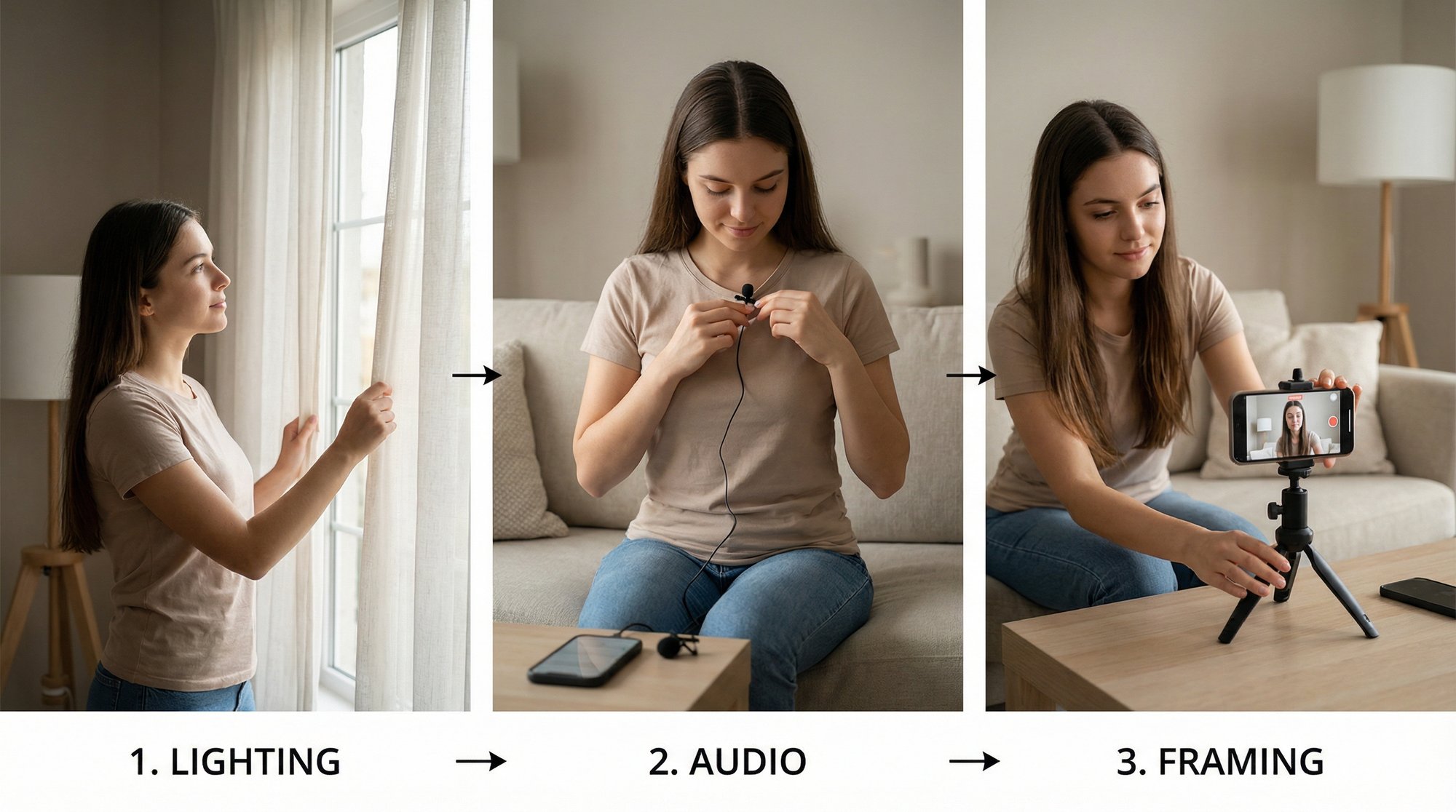
Perfectionism is the biggest killer of video content. Forget about complex lighting rigs and camera settings. All you need is a clean shot, clear audio, and decent light, and you can get there in under five minutes. Seriously.

Here’s your entire no-fuss toolkit:

  • Your Smartphone: Just use the phone in your pocket. Set it to the highest resolution you can (4K is great, but 1080p is perfectly fine).

  • A Simple Tripod: Shaky footage is the #1 giveaway of an amateur video. A cheap, basic tripod makes you look like a pro instantly.

  • A Light Source: Natural light is your best friend. Just sit facing a window. If you can’t, a simple ring light gets the job done.

Position your phone at eye level or just a bit higher—it's the most flattering angle and helps you look directly at your viewer. Audio is just as crucial as video, so find a quiet spot. A room with a rug or curtains is great because it soaks up that echo.

And that's it. You're ready to go.

How to Speak Naturally on Camera

Staring into a tiny black lens feels weird. I get it. The secret to sounding natural is to stop trying to "perform" and start having a conversation.

I call it the "talk to a friend" method. Don't memorize a script word-for-word—that’s a surefire way to sound robotic. Instead, jot down your main talking points on a sticky note and place it right next to your camera lens.

Then, just imagine you're explaining your idea to a friend over coffee.

Key Insight: The point is to capture your actual thoughts, not a perfect delivery. Speak in your normal voice, stumbles and all. Raw, authentic footage is what you want. Smart editing tools like Unfloppable can easily polish it later. Your job is to bring the ideas; the tech will handle the cleanup.

This simple mind shift turns a high-pressure event into a casual chat. It feels less intimidating, and the final video comes across as genuine and relatable, which is exactly what audiences want. In fact, one study found that 82% of consumers were influenced by a brand's video—that’s the power of personal connection at work.

The Power of Batch Recording Your Content

If you want to stay consistent without burning out, batch recording is the single best strategy you can adopt. Instead of scrambling to make a video every day, you block off one afternoon—maybe two or three hours—and record a month's worth of content all at once.

Here’s what that actually looks like:

  1. Plan Your Topics: Using your content pillars, quickly outline 8-10 video ideas. These are just bullet points, not full scripts.

  2. Set Up Once: Get your simple phone-and-tripod setup ready. You only have to do this once for the entire batch.

  3. Record Back-to-Back: Go down your list and record one video after another. Don't stress about changing your shirt for each one—nobody cares.

  4. Build Your Raw Footage Library: By the end of the session, you'll have a folder full of raw video files—a goldmine of content ready for editing.

This approach is an absolute game-changer. It separates the creative work from the logistical work. By dedicating a specific time block, you get into a rhythm, your on-camera confidence grows, and the whole process becomes incredibly efficient. You’re no longer a daily content creator chasing the algorithm; you're a strategic business owner building a library of valuable assets.

Turning Raw Footage into Polished Posts with Smart Editing

You’ve done it. You’ve recorded your authentic ideas and started building a library of raw footage. But for most small business owners, this is exactly where the momentum dies. I've seen it a hundred times: the single biggest bottleneck in the entire video marketing process isn't hitting record—it's editing.

Let's be honest, traditional editing software is a beast. It's complex, time-consuming, and has a learning curve that feels more like a learning cliff. The alternative? Hiring a freelance editor can get expensive fast, and the back-and-forth often creates frustrating delays between having a great idea and actually sharing it. This friction is what leads to inconsistent posting and, eventually, total burnout.

What if you could just… skip that whole step? This is where intelligent editing tools are completely changing the game for small businesses.

The Problem with Old-School Editing

Manual video editing is a productivity black hole. You have to import your clips, scrub through the timeline to find the good takes, meticulously cut out every "um" and "ah," and then begin the real work of making the video engaging.

This usually means you're stuck:

  • Searching for relevant stock footage (B-roll) to visually explain what you’re saying.

  • Manually typing out and timing every single caption, word by word.

  • Fiddling with brand colors, logos, and simple graphics to make it look on-brand.

  • Exporting the video in the right format for TikTok, Reels, and Shorts.

For a busy founder, this can easily devour hours for a single 60-second video. When you have a business to run, it’s almost impossible to justify that kind of time investment.

The Rise of the Intelligent Editor

This is where smart, AI-assisted editing platforms like Unfloppable come in. And let's be clear: this isn't about creating soulless, fully synthetic AI videos with robotic avatars and fake voices. It's about taking your authentic footage and using technology to handle the entire post-production grind for you.

Imagine this workflow instead:

  1. You upload your raw, talking-head video.

  2. The software instantly transcribes your words and actually understands the context.

  3. It automatically finds and adds relevant B-roll, images, and on-screen text based on what you’re saying.

  4. It generates dynamic, perfectly timed captions to grab and hold attention.

This approach completely bridges the gap between recording and publishing. It doesn't replace your voice; it amplifies it by offloading all the technical work that slows you down.

Key Takeaway: The goal isn't to automate your personality. It's to automate the production process. You provide the authentic ideas and the face of your brand, and the smart editor acts as your instant, on-demand production team.

For instance, if you're a SaaS founder explaining a new feature, the tool can automatically show screen recordings of that feature the moment you mention it. If you're a D2C brand owner talking about your natural ingredients, it can overlay beautiful stock footage of those ingredients. Your video becomes far more dynamic and professional, and you never have to touch a complex editing timeline.

Of course, if you still want some level of human touch or have very specific creative needs, you can also learn how to outsource video editing services effectively to find the right partner.

Authenticity Meets Efficiency

The real beauty of this model is that it preserves the one thing that makes your videos work: your genuine voice and expertise. Consumers are exhausted by overly polished corporate content and can spot inauthentic AI videos from a mile away. In fact, research shows that 82% of consumers say a video has influenced their buying decision—and that connection is built on trust, not perfect production.

By using an intelligent editor, you keep that crucial authenticity while unlocking massive efficiency.

Comparing the Approaches

Aspect

Manual DIY Editing

Pure AI Video Generation

Intelligent Editing (Unfloppable)

Authenticity

High (It's you)

Very Low (It's a robot)

High (It's you, enhanced)

Time Investment

Very High

Low

Very Low

Skill Required

High

Low

None

End Result

Good, but slow to create

Inauthentic, often unrelatable

Professional and authentic

This smart approach finally makes a consistent posting schedule achievable for a busy small business owner. Instead of burning a whole day to produce one video, you can have a week's worth of content edited and ready to publish in a fraction of the time. This frees you up to focus on what really moves the needle: developing great ideas and running your business.

You've shot a fantastic video. That's a huge win. But here's the hard truth I've learned from years in the trenches: if nobody sees it, it might as well not exist.

A smart distribution strategy is what turns your hard work into actual business results. It’s not about just throwing your video out there and hoping for the best. It’s about being intentional and placing your content right in the path of your ideal customers.

Laptop and smartphone displaying a visual content calendar on a wooden desk with coffee.

For most small businesses, the magic is happening in short-form video on platforms like Instagram Reels, TikTok, and YouTube Shorts. These platforms are built for discovery, giving your content a fighting chance to reach people far beyond your current follower list.

Build Momentum With a Consistent Cadence

Think of your posting schedule as a conversation. If you only show up sporadically, you get ignored. But when you show up consistently, you build trust—not just with your audience, but with the platform's algorithm. It starts to see you as a reliable source of good content and rewards you for it.

Try to hit a rhythm of 3-5 short videos per week. This is the sweet spot. It keeps your brand visible without burning you out. And if you’re thinking, “How could I possibly create that much?”—remember the batch-recording workflow. You’re not creating 5 videos every week; you’re just dripping out the content you already filmed in a single session.

The numbers back this up. Nearly 30% of marketers are now all-in on formats like TikTok and Reels. When you look at performance, the potential is clear; YouTube Shorts, for example, saw an impressive 5.91% engagement rate in Q1 2024. For small businesses like yours, the payoff is real: 87% report a boost in sales and 88% see more leads thanks to video. And with videos under 90 seconds having a 50% repeat view rate, consistency really pays off.

My Personal Tip: When you're just starting, don't get hung up on posting at the "perfect" time. The single most important growth hack is just hitting "publish" consistently. The algorithm will figure out when your audience is online, and you can fine-tune your timing later on.

Work Smarter With Content Atomization

Here’s a secret that the most successful creators live by: they don't necessarily create more content. They get more from their content. This is a powerful concept called content atomization, and it’s a total game-changer for a busy small business owner.

The idea is simple. You take one bigger piece of content—let's say a 10-minute "Founder's Journal" video where you talk about a recent business challenge—and you smash it into smaller "atoms."

That one recording session can become:

  • 5-7 Short-Form Clips: Pull out each key insight or a-ha moment as a standalone clip for Reels or Shorts. Our guide on how to post a Short on YouTube breaks down the technical side of this.

  • 3-4 Quote Graphics: Grab the most powerful sentences you said and turn them into simple, shareable images for Instagram or LinkedIn.

  • A Blog Post Snippet: Transcribe a compelling 2-minute section and use it as the heart of a quick article for your website.

  • An Email Newsletter: Embed one of your short clips into your next newsletter to grab your subscribers' attention.

This is how you maximize the return on every single minute you spend in front of the camera. To take this even further, look into automated tools like content syndication platforms, which can help push your video out to more places and give it a longer life.

Focus on Metrics That Matter

Finally, let's talk about numbers. It’s easy to get mesmerized by views, but a video with 100,000 views that brings in zero customers is a failure. I'd much rather have a video with 1,000 views that brings in three new clients.

You need to track the metrics that signal real interest and lead to actual business.

Focus on these:

  • Saves: This is gold. Someone found your content so valuable they want to come back to it later. The algorithms love this.

  • Shares: This is a personal endorsement. Someone is putting their own reputation on the line to recommend your content to their network.

  • Comments & DMs: This is where the magic happens. It’s where conversations begin and relationships are built.

  • Profile/Website Clicks: Ultimately, the goal is to drive people back to your turf—your website, your contact form, your product page.

These are the numbers that prove your video marketing for small business isn't just getting seen—it's getting results.

Your Top Video Marketing Questions, Answered

Even with a solid playbook in hand, it's totally normal to have a few nagging questions. Putting yourself out there with video can feel like a big step, so let's clear up some of the most common sticking points.

Think of this as our final chat before you hit record. My goal here is to give you direct, practical answers that cut through the noise. We're focused on what actually works: being real, using smart tools to save time, and building genuine connections.

How Much Should a Small Business Really Budget for Video?

This is always the first question, and the answer I give people tends to surprise them: you can get started with a budget of virtually zero. The biggest myth holding small businesses back is the idea that you need a pile of cash to make video work. You don't.

Your most valuable piece of gear is probably in your pocket right now. Seriously. Your smartphone, a cheap tripod from Amazon, and a window for some nice natural light is all you need for your "studio." The real investment at the start is your time, not your money. And by using the batch-recording workflow we talked about, you can shrink that time commitment down to a single afternoon.

Before you spend a dime, focus on these fundamentals:

  • Your phone is your camera. Its quality is more than good enough for social media.

  • Record in batches. This is the secret to turning one block of time into a month of content.

  • Outsource the tedious stuff. Let smart tools handle the time-sucking editing work.

Don't even think about a bigger budget until you've proven the concept with your scrappy, low-cost efforts and are starting to see a real return.

Do I Have to Be on TikTok, Reels, and Everywhere Else?

No! Please, don't. Trying to be everywhere at once is a classic rookie mistake that guarantees one thing: burnout with mediocre results. It is so much more powerful to own one channel than to be a faint, inconsistent whisper across five.

The real strategy is to go where your ideal customers already are. If you’re a B2B consultant, LinkedIn is probably your best bet. Selling a cool product to Gen Z? Then yeah, TikTok and Instagram Reels are where you need to live.

Start small, and get it right. Pick one platform and master it. Learn its quirks, figure out what your audience there loves, and build a dedicated little community. Once you have a system that's humming along, then you can think about strategically expanding.

What Metrics Actually Matter for Measuring Success?

It's so easy to get distracted by flashy view counts. But for a small business, views are just a vanity metric. A video with 100,000 views that drives zero business is a complete waste of time. You have to track the numbers that show people are genuinely interested in what you offer.

Instead of chasing views, obsess over these metrics:

  • Saves: When someone saves your video, they're telling the algorithm (and you) that it's valuable enough to return to. This is a massive signal of quality content.

  • Shares: A share is a personal endorsement. Someone is literally vouching for you to their own network. This is how you reach new, perfectly-matched audiences for free.

  • Comments & DMs: This is where the magic happens. A real conversation in the DMs is worth a thousand silent views because it’s the start of a real business relationship.

At the end of the day, the only numbers that truly move the needle are the ones tied to your bottom line: website clicks from your bio, inbound messages from potential clients, and a clear, trackable lift in leads and sales from your video efforts.

How Can I Make Engaging Videos if My Business Is "Boring"?

I’ve heard this one a lot, and I'll tell you what I tell everyone else: no business is boring. It's all about the story you decide to tell. People don’t buy technical specs; they buy solutions, they buy from people they trust, and they buy into a better version of their future. Your business, no matter how niche, provides that for someone. That’s your story.

Forget trying to be flashy or funny if that's not you. The most engaging content is almost always the most helpful and authentic. Just lean into the content pillars we covered.

For example, you could:

  • Share your founder's journey: Talk about a big mistake you made early on and what you learned from it. People connect with vulnerability.

  • Teach something valuable: Give away a single, powerful tip related to your expertise. Prove you know your stuff.

  • Show the "how": Take people behind the scenes of a process they've never seen before. Curiosity is a powerful hook.

Authenticity and a genuine desire to help will always be more compelling than a big budget. Your expertise is your most interesting asset.

Ready to stop worrying about editing and just start talking? Unfloppable takes your raw, unedited ideas and transforms them into polished, ready-to-post videos—no technical skills needed. Get your first three videos for free and see just how simple this can be.

If you’ve ever thought video marketing for small business was just for the big players with bottomless budgets, it's time we talked. Video isn't some far-off luxury anymore; it's a powerful growth engine that’s more accessible than ever—and your customers are practically begging for it.

Why Video Is Now Non-Negotiable for Your Small Business

Let’s be honest. When you’re running a small business, every minute and every dollar counts. It's easy to dismiss video as too expensive or too time-consuming. But that's an outdated way of thinking. For today's SaaS startups and D2C brands, video has become a fundamental tool for building trust and driving sales.

The proof isn’t just anecdotal; the data tells a compelling story.

The State of Video Marketing for Small Business in 2026

The statistics below aren't just numbers on a page. They represent a massive shift in how customers connect with brands. For a small business, understanding these trends is the first step toward using video to punch well above your weight.

Statistic

What It Means for Your Business

91% of businesses will use video as a marketing tool.

Your competition is already there or getting there fast. Not using video means you risk becoming invisible.

84% of people want to see more video content from brands.

This is a direct request from your audience. You have a built-in demand waiting for you to meet it.

83% of marketers report video directly increased sales.

Video isn’t a vanity project. It’s a sales tool that directly impacts your revenue and bottom line.

85% of marketers saw an increase in leads from video.

Looking for more qualified leads? Video is one of the most effective channels for filling your pipeline.

These aren't fuzzy, feel-good metrics. They are hard numbers that translate into real business growth. Getting started is easier than you think.

Forget the Old Roadblocks—They’re Gone

The biggest myth I still hear from founders is that video requires a film crew and a Hollywood budget. That reality is dead and gone. The barriers that once kept small businesses on the sidelines have completely crumbled.

Think about it:

  • Cost is no longer the enemy. In 2024, nearly half of all businesses spent less than $5,000 on video for the entire year. With the camera in your pocket and smart tools, you can get started for next to nothing.

  • Time is something you can manage. The goal isn't to create a cinematic masterpiece. It’s about sharing authentic ideas, consistently. Smart workflows, like batch recording your thoughts and using an intelligent editor, can turn a single afternoon into a month's worth of content.

  • Complexity has been solved. You don't need to become a video editing wizard overnight. Services like Unfloppable were built for this very problem—taking your raw ideas and turning them into polished, ready-to-post videos without you touching a single editing timeline.

The real win is getting past the tedious production work so you can focus on what you know best: your business and your ideas. Authenticity and consistency now beat high production value, every single time.

The Clear and Measurable Payoff

So, what happens when you commit to video? You get results you can actually see and measure. This isn’t about chasing vanity metrics; it’s about moving the needle on the numbers that matter most to a growing business.

The return on investment is undeniable. An incredible 83% of marketers report a direct increase in sales thanks to their video efforts. But it doesn't stop there. Video is a lead-generation powerhouse, with 85% seeing a boost in leads and 82% noticing more website traffic.

These are the numbers that keep a small business thriving. By making video a core part of your outreach, you're building a direct line to your audience that drives engagement, builds genuine trust, and grows your bottom line.

If you’re ready to move from theory to action, our guide on building a solid video content marketing strategy is the perfect place to start.

Building Your Content Engine Without the Overwhelm

Let's be honest. The biggest hurdle in video marketing for most small businesses isn't the gear or the budget. It’s the dreaded content calendar, staring back at you, completely blank. That feeling of "what on earth do I post today?" is what really grinds things to a halt.

But what if you never had to start from scratch again? The secret isn't to frantically brainstorm more ideas—it's to build a reliable content engine. Think of it as a system built on four strategic pillars. These aren’t just random topics; they’re core themes tied directly to your business goals, making sure every single video has a job to do.

Your Four Foundational Content Pillars

Instead of chasing trends that die in a week, you'll anchor your strategy in these proven concepts. This approach is all about building real trust, showing off what you know, and naturally guiding viewers from curious followers to happy customers.

  • The Founder's Journal: This is your story. Share the journey—the wins, the setbacks, and the hard-won lessons from building your business. It’s not about bragging; it’s about being human. People connect with people, and this is how they get to know, like, and trust you.

  • Problem and Solution: Zero in on a specific pain point your audience struggles with and show, don't just tell, how you solve it. These videos are gold because they deliver instant value and immediately position you as the expert who gets it.

  • Behind the Scenes: Pull back the curtain. Show people the real magic behind your business, whether it's how you pack an order with care, a glimpse of your workspace, or the messy process of developing a new product. That kind of transparency builds a powerful connection.

  • Quick-Win Education: Offer up a genuinely useful, bite-sized tip or a mini-tutorial your audience can apply right away. This builds your authority and generates massive goodwill. You become their go-to resource, not just another brand trying to sell them something.

Suddenly, the question isn't, "What should I post?" It’s, "Which pillar am I pulling from this week?" It’s a game-changer.

My Two Cents: A system is your best defense against burnout. When you define your content pillars, video marketing stops being a creative chore and becomes a repeatable, manageable business process.

Pillar-Based Content in Action

Here’s how this simple framework translates into actual video ideas for two very different businesses.

A B2B SaaS Founder's Videos:

  • Founder's Journal: A 60-second clip on the "biggest mistake I made in our first year of business."

  • Problem/Solution: A quick screen recording showing how the software automates a mind-numbing task in under 30 seconds.

  • Behind the Scenes: A quick tour of the team's virtual stand-up on Slack, showing how they prioritize new features.

  • Quick-Win Education: A video sharing "three non-obvious ways to use our dashboard to find more leads."

A D2C Skincare Brand's Videos:

  • Founder's Journal: A personal story about why she started the brand after her own frustrating struggles with skin issues.

  • Problem/Solution: A simple before-and-after video showing how a serum calms redness—a major customer pain point.

  • Behind the Scenes: A shot of the high-quality, natural ingredients being mixed, showcasing the care that goes into each batch.

  • Quick-Win Education: A tutorial on "the right way to layer your skincare products for maximum absorption."

This approach systematically moves your audience from awareness to action. It’s a process.

A video marketing process flow diagram showing three sequential steps: build trust, generate leads, and boost sales.

As you can see, it all starts with authentic content. That content builds the trust you need to generate leads and, ultimately, boost your sales.

Create Once, Distribute Forever

Here’s where the real magic happens. This pillar system doesn't just give you video ideas; it gives you a library of evergreen assets. A single "Founder's Journal" video can be chopped up into a dozen other pieces of content.

That one video can become:

  • A powerful quote graphic for Instagram.

  • A short, insightful clip for an email newsletter.

  • A key talking point for a podcast interview.

For small teams, having a solid content repurposing workflow for small teams is a necessity. This is how you multiply your efforts and get the absolute most out of every minute you spend on camera. Your content engine will ensure you always have something valuable to share, keeping your brand top-of-mind without the constant, exhausting scramble for new ideas.

Your Simple Workflow for Recording High-Impact Videos

Smartphone on tripod recording a person on a screen, with a camera, headphones, and 'BATCH RECORDING' text on a table.

Let's get one thing straight right away: you do not need a fancy camera, a professional studio, or a film crew to make video work for your business. That’s a myth that holds too many people back.

The truth? Your smartphone is more than enough. And authenticity—your real personality and expertise—will always beat slick, over-produced videos that feel cold and corporate.

The goal isn't to win an Oscar. It's to share your ideas and build a real connection with the people you want to help. This workflow is designed to be lean, fast, and effective, removing all the friction that stops most founders from ever hitting "record."

Setting Up Your Shot in Minutes

Perfectionism is the biggest killer of video content. Forget about complex lighting rigs and camera settings. All you need is a clean shot, clear audio, and decent light, and you can get there in under five minutes. Seriously.

Here’s your entire no-fuss toolkit:

  • Your Smartphone: Just use the phone in your pocket. Set it to the highest resolution you can (4K is great, but 1080p is perfectly fine).

  • A Simple Tripod: Shaky footage is the #1 giveaway of an amateur video. A cheap, basic tripod makes you look like a pro instantly.

  • A Light Source: Natural light is your best friend. Just sit facing a window. If you can’t, a simple ring light gets the job done.

Position your phone at eye level or just a bit higher—it's the most flattering angle and helps you look directly at your viewer. Audio is just as crucial as video, so find a quiet spot. A room with a rug or curtains is great because it soaks up that echo.

And that's it. You're ready to go.

How to Speak Naturally on Camera

Staring into a tiny black lens feels weird. I get it. The secret to sounding natural is to stop trying to "perform" and start having a conversation.

I call it the "talk to a friend" method. Don't memorize a script word-for-word—that’s a surefire way to sound robotic. Instead, jot down your main talking points on a sticky note and place it right next to your camera lens.

Then, just imagine you're explaining your idea to a friend over coffee.

Key Insight: The point is to capture your actual thoughts, not a perfect delivery. Speak in your normal voice, stumbles and all. Raw, authentic footage is what you want. Smart editing tools like Unfloppable can easily polish it later. Your job is to bring the ideas; the tech will handle the cleanup.

This simple mind shift turns a high-pressure event into a casual chat. It feels less intimidating, and the final video comes across as genuine and relatable, which is exactly what audiences want. In fact, one study found that 82% of consumers were influenced by a brand's video—that’s the power of personal connection at work.

The Power of Batch Recording Your Content

If you want to stay consistent without burning out, batch recording is the single best strategy you can adopt. Instead of scrambling to make a video every day, you block off one afternoon—maybe two or three hours—and record a month's worth of content all at once.

Here’s what that actually looks like:

  1. Plan Your Topics: Using your content pillars, quickly outline 8-10 video ideas. These are just bullet points, not full scripts.

  2. Set Up Once: Get your simple phone-and-tripod setup ready. You only have to do this once for the entire batch.

  3. Record Back-to-Back: Go down your list and record one video after another. Don't stress about changing your shirt for each one—nobody cares.

  4. Build Your Raw Footage Library: By the end of the session, you'll have a folder full of raw video files—a goldmine of content ready for editing.

This approach is an absolute game-changer. It separates the creative work from the logistical work. By dedicating a specific time block, you get into a rhythm, your on-camera confidence grows, and the whole process becomes incredibly efficient. You’re no longer a daily content creator chasing the algorithm; you're a strategic business owner building a library of valuable assets.

Turning Raw Footage into Polished Posts with Smart Editing

You’ve done it. You’ve recorded your authentic ideas and started building a library of raw footage. But for most small business owners, this is exactly where the momentum dies. I've seen it a hundred times: the single biggest bottleneck in the entire video marketing process isn't hitting record—it's editing.

Let's be honest, traditional editing software is a beast. It's complex, time-consuming, and has a learning curve that feels more like a learning cliff. The alternative? Hiring a freelance editor can get expensive fast, and the back-and-forth often creates frustrating delays between having a great idea and actually sharing it. This friction is what leads to inconsistent posting and, eventually, total burnout.

What if you could just… skip that whole step? This is where intelligent editing tools are completely changing the game for small businesses.

The Problem with Old-School Editing

Manual video editing is a productivity black hole. You have to import your clips, scrub through the timeline to find the good takes, meticulously cut out every "um" and "ah," and then begin the real work of making the video engaging.

This usually means you're stuck:

  • Searching for relevant stock footage (B-roll) to visually explain what you’re saying.

  • Manually typing out and timing every single caption, word by word.

  • Fiddling with brand colors, logos, and simple graphics to make it look on-brand.

  • Exporting the video in the right format for TikTok, Reels, and Shorts.

For a busy founder, this can easily devour hours for a single 60-second video. When you have a business to run, it’s almost impossible to justify that kind of time investment.

The Rise of the Intelligent Editor

This is where smart, AI-assisted editing platforms like Unfloppable come in. And let's be clear: this isn't about creating soulless, fully synthetic AI videos with robotic avatars and fake voices. It's about taking your authentic footage and using technology to handle the entire post-production grind for you.

Imagine this workflow instead:

  1. You upload your raw, talking-head video.

  2. The software instantly transcribes your words and actually understands the context.

  3. It automatically finds and adds relevant B-roll, images, and on-screen text based on what you’re saying.

  4. It generates dynamic, perfectly timed captions to grab and hold attention.

This approach completely bridges the gap between recording and publishing. It doesn't replace your voice; it amplifies it by offloading all the technical work that slows you down.

Key Takeaway: The goal isn't to automate your personality. It's to automate the production process. You provide the authentic ideas and the face of your brand, and the smart editor acts as your instant, on-demand production team.

For instance, if you're a SaaS founder explaining a new feature, the tool can automatically show screen recordings of that feature the moment you mention it. If you're a D2C brand owner talking about your natural ingredients, it can overlay beautiful stock footage of those ingredients. Your video becomes far more dynamic and professional, and you never have to touch a complex editing timeline.

Of course, if you still want some level of human touch or have very specific creative needs, you can also learn how to outsource video editing services effectively to find the right partner.

Authenticity Meets Efficiency

The real beauty of this model is that it preserves the one thing that makes your videos work: your genuine voice and expertise. Consumers are exhausted by overly polished corporate content and can spot inauthentic AI videos from a mile away. In fact, research shows that 82% of consumers say a video has influenced their buying decision—and that connection is built on trust, not perfect production.

By using an intelligent editor, you keep that crucial authenticity while unlocking massive efficiency.

Comparing the Approaches

Aspect

Manual DIY Editing

Pure AI Video Generation

Intelligent Editing (Unfloppable)

Authenticity

High (It's you)

Very Low (It's a robot)

High (It's you, enhanced)

Time Investment

Very High

Low

Very Low

Skill Required

High

Low

None

End Result

Good, but slow to create

Inauthentic, often unrelatable

Professional and authentic

This smart approach finally makes a consistent posting schedule achievable for a busy small business owner. Instead of burning a whole day to produce one video, you can have a week's worth of content edited and ready to publish in a fraction of the time. This frees you up to focus on what really moves the needle: developing great ideas and running your business.

You've shot a fantastic video. That's a huge win. But here's the hard truth I've learned from years in the trenches: if nobody sees it, it might as well not exist.

A smart distribution strategy is what turns your hard work into actual business results. It’s not about just throwing your video out there and hoping for the best. It’s about being intentional and placing your content right in the path of your ideal customers.

Laptop and smartphone displaying a visual content calendar on a wooden desk with coffee.

For most small businesses, the magic is happening in short-form video on platforms like Instagram Reels, TikTok, and YouTube Shorts. These platforms are built for discovery, giving your content a fighting chance to reach people far beyond your current follower list.

Build Momentum With a Consistent Cadence

Think of your posting schedule as a conversation. If you only show up sporadically, you get ignored. But when you show up consistently, you build trust—not just with your audience, but with the platform's algorithm. It starts to see you as a reliable source of good content and rewards you for it.

Try to hit a rhythm of 3-5 short videos per week. This is the sweet spot. It keeps your brand visible without burning you out. And if you’re thinking, “How could I possibly create that much?”—remember the batch-recording workflow. You’re not creating 5 videos every week; you’re just dripping out the content you already filmed in a single session.

The numbers back this up. Nearly 30% of marketers are now all-in on formats like TikTok and Reels. When you look at performance, the potential is clear; YouTube Shorts, for example, saw an impressive 5.91% engagement rate in Q1 2024. For small businesses like yours, the payoff is real: 87% report a boost in sales and 88% see more leads thanks to video. And with videos under 90 seconds having a 50% repeat view rate, consistency really pays off.

My Personal Tip: When you're just starting, don't get hung up on posting at the "perfect" time. The single most important growth hack is just hitting "publish" consistently. The algorithm will figure out when your audience is online, and you can fine-tune your timing later on.

Work Smarter With Content Atomization

Here’s a secret that the most successful creators live by: they don't necessarily create more content. They get more from their content. This is a powerful concept called content atomization, and it’s a total game-changer for a busy small business owner.

The idea is simple. You take one bigger piece of content—let's say a 10-minute "Founder's Journal" video where you talk about a recent business challenge—and you smash it into smaller "atoms."

That one recording session can become:

  • 5-7 Short-Form Clips: Pull out each key insight or a-ha moment as a standalone clip for Reels or Shorts. Our guide on how to post a Short on YouTube breaks down the technical side of this.

  • 3-4 Quote Graphics: Grab the most powerful sentences you said and turn them into simple, shareable images for Instagram or LinkedIn.

  • A Blog Post Snippet: Transcribe a compelling 2-minute section and use it as the heart of a quick article for your website.

  • An Email Newsletter: Embed one of your short clips into your next newsletter to grab your subscribers' attention.

This is how you maximize the return on every single minute you spend in front of the camera. To take this even further, look into automated tools like content syndication platforms, which can help push your video out to more places and give it a longer life.

Focus on Metrics That Matter

Finally, let's talk about numbers. It’s easy to get mesmerized by views, but a video with 100,000 views that brings in zero customers is a failure. I'd much rather have a video with 1,000 views that brings in three new clients.

You need to track the metrics that signal real interest and lead to actual business.

Focus on these:

  • Saves: This is gold. Someone found your content so valuable they want to come back to it later. The algorithms love this.

  • Shares: This is a personal endorsement. Someone is putting their own reputation on the line to recommend your content to their network.

  • Comments & DMs: This is where the magic happens. It’s where conversations begin and relationships are built.

  • Profile/Website Clicks: Ultimately, the goal is to drive people back to your turf—your website, your contact form, your product page.

These are the numbers that prove your video marketing for small business isn't just getting seen—it's getting results.

Your Top Video Marketing Questions, Answered

Even with a solid playbook in hand, it's totally normal to have a few nagging questions. Putting yourself out there with video can feel like a big step, so let's clear up some of the most common sticking points.

Think of this as our final chat before you hit record. My goal here is to give you direct, practical answers that cut through the noise. We're focused on what actually works: being real, using smart tools to save time, and building genuine connections.

How Much Should a Small Business Really Budget for Video?

This is always the first question, and the answer I give people tends to surprise them: you can get started with a budget of virtually zero. The biggest myth holding small businesses back is the idea that you need a pile of cash to make video work. You don't.

Your most valuable piece of gear is probably in your pocket right now. Seriously. Your smartphone, a cheap tripod from Amazon, and a window for some nice natural light is all you need for your "studio." The real investment at the start is your time, not your money. And by using the batch-recording workflow we talked about, you can shrink that time commitment down to a single afternoon.

Before you spend a dime, focus on these fundamentals:

  • Your phone is your camera. Its quality is more than good enough for social media.

  • Record in batches. This is the secret to turning one block of time into a month of content.

  • Outsource the tedious stuff. Let smart tools handle the time-sucking editing work.

Don't even think about a bigger budget until you've proven the concept with your scrappy, low-cost efforts and are starting to see a real return.

Do I Have to Be on TikTok, Reels, and Everywhere Else?

No! Please, don't. Trying to be everywhere at once is a classic rookie mistake that guarantees one thing: burnout with mediocre results. It is so much more powerful to own one channel than to be a faint, inconsistent whisper across five.

The real strategy is to go where your ideal customers already are. If you’re a B2B consultant, LinkedIn is probably your best bet. Selling a cool product to Gen Z? Then yeah, TikTok and Instagram Reels are where you need to live.

Start small, and get it right. Pick one platform and master it. Learn its quirks, figure out what your audience there loves, and build a dedicated little community. Once you have a system that's humming along, then you can think about strategically expanding.

What Metrics Actually Matter for Measuring Success?

It's so easy to get distracted by flashy view counts. But for a small business, views are just a vanity metric. A video with 100,000 views that drives zero business is a complete waste of time. You have to track the numbers that show people are genuinely interested in what you offer.

Instead of chasing views, obsess over these metrics:

  • Saves: When someone saves your video, they're telling the algorithm (and you) that it's valuable enough to return to. This is a massive signal of quality content.

  • Shares: A share is a personal endorsement. Someone is literally vouching for you to their own network. This is how you reach new, perfectly-matched audiences for free.

  • Comments & DMs: This is where the magic happens. A real conversation in the DMs is worth a thousand silent views because it’s the start of a real business relationship.

At the end of the day, the only numbers that truly move the needle are the ones tied to your bottom line: website clicks from your bio, inbound messages from potential clients, and a clear, trackable lift in leads and sales from your video efforts.

How Can I Make Engaging Videos if My Business Is "Boring"?

I’ve heard this one a lot, and I'll tell you what I tell everyone else: no business is boring. It's all about the story you decide to tell. People don’t buy technical specs; they buy solutions, they buy from people they trust, and they buy into a better version of their future. Your business, no matter how niche, provides that for someone. That’s your story.

Forget trying to be flashy or funny if that's not you. The most engaging content is almost always the most helpful and authentic. Just lean into the content pillars we covered.

For example, you could:

  • Share your founder's journey: Talk about a big mistake you made early on and what you learned from it. People connect with vulnerability.

  • Teach something valuable: Give away a single, powerful tip related to your expertise. Prove you know your stuff.

  • Show the "how": Take people behind the scenes of a process they've never seen before. Curiosity is a powerful hook.

Authenticity and a genuine desire to help will always be more compelling than a big budget. Your expertise is your most interesting asset.

Ready to stop worrying about editing and just start talking? Unfloppable takes your raw, unedited ideas and transforms them into polished, ready-to-post videos—no technical skills needed. Get your first three videos for free and see just how simple this can be.