Video content marketing strategy: Master a Winning Plan

Learn a proven video content marketing strategy to plan, produce, and scale videos that grow your brand and deliver results.

Feb 8, 2026

A video content marketing strategy isn't about chasing viral trends or pumping out random videos. It's a repeatable system you build to turn your unique expertise into authentic, high-impact content that actually drives business growth. It’s how you connect with the right people and hit measurable goals, time and time again.

Why Your Business Needs a Video Strategy Now

Let's cut right to it: video isn't just "another channel" anymore. It's quickly becoming the primary way people connect with and trust brands. For founders and marketers, this is a massive opportunity. A smart, structured video plan is one of the most powerful levers you have for building authority and demonstrating your expertise at scale.

Forget the idea that you need a huge production budget or fancy equipment. The real win is in building a sustainable system that transforms what you already know into a steady stream of genuine, helpful content. This guide is your playbook for doing just that—creating quality videos consistently, without all the usual stress.

The Undeniable Rise of Video Content

The numbers don't lie. By the end of 2025, it's predicted that video will make up a staggering 82% of all global internet traffic. What’s driving this? An insatiable appetite for quick, engaging visuals on platforms like Instagram Reels, TikTok, and YouTube Shorts.

This is fantastic news for startup founders and SaaS marketers. It means your simple, authentic talking-head videos can catch this wave and get serious traction. You can dig deeper into these kinds of video marketing statistics from The Desire Company.

To put this into perspective, let's break down why this shift matters so much.

The Shift to Video A Quick Snapshot

Statistic

Implication for Your Business

Where to Focus

82% of internet traffic will be video by 2025.

Your audience expects to see you on video. If you're not there, your competitors will be.

Creating a consistent presence on at least one short-form video platform.

92% of mobile video viewers share videos with others.

Video is inherently shareable, giving your content an organic reach that text and images can't match.

Crafting valuable, "I have to send this to a friend" type of content.

78% of people watch online videos every week.

Video consumption is a regular habit, not a novelty. You can become part of your audience's weekly routine.

Developing a reliable posting schedule and content pillars to build viewer loyalty.

The takeaway here is simple: a video-first approach isn't a "nice-to-have." It's essential for staying relevant and connecting with a modern audience.

This simple diagram breaks down the entire process into three core phases: harnessing your expertise, recording it efficiently, and distributing it consistently.

A visual diagram outlining a video content marketing strategy: Expertise, Record, and Distribute.

As you can see, a powerful strategy always starts with what you know best. From there, it’s all about creating an efficient workflow for getting it on camera and out into the world.

The goal is to move from sporadic, one-off video efforts to a repeatable engine. By focusing on your core knowledge and streamlining production, you make consistency achievable, turning video into a reliable asset instead of a dreaded task.

And the best part? Smart services and tools have emerged that completely remove the biggest bottleneck—editing. This means powerful, professional video is no longer just for companies with huge creative teams; it's accessible to everyone.

Defining Your Audience and Core Mission

A man speaks into a microphone, being recorded by a smartphone on a tripod for a video strategy presentation.

Let's be honest. Before you ever hit that big red record button, the most critical work of your entire video content marketing strategy is already happening. It all boils down to two simple, but powerful, questions: who are you really talking to, and what do you want them to do next?

This is the foundation. It's also where I see most strategies fall apart, because this step gets rushed—or worse, skipped entirely.

Jumping into production without this clarity is like trying to build a house without a blueprint. Sure, you might end up with four walls and a roof, but it won't be a home that actually works for anyone. Every single video has to be a direct line to a specific person wrestling with a specific problem.

Crafting Your Video Ideal Customer Profile

Your standard, company-wide Ideal Customer Profile (ICP) is too broad for effective video. We need to get way more specific. Think of it as creating a persona that’s laser-focused on their content consumption habits. This means going deeper than just demographics and digging into how they behave online.

To get there, you have to ask the right questions about their digital life:

  • Where do they hang out online? Are they career-driven folks scrolling LinkedIn? Are they on Instagram looking for visual inspiration? Or are they part of a niche community on X (formerly Twitter)? Pinpointing the platform is the first domino to fall.

  • What kind of video do they trust? Do they vibe with quick, high-energy Reels packed with trending audio? Or do they need a more polished, educational talking-head video to take you seriously?

  • What are their real-world pain points? Don't settle for surface-level business problems. A SaaS founder's pain isn’t just "low MRR." It's the gut-wrenching stress of an upcoming board meeting or the quiet frustration of watching a competitor get all the press. Your video has to speak directly to that feeling.

  • Who are they already watching? Go analyze the accounts they follow and engage with. This is your cheat sheet—it shows you the exact tone, style, and topics that already have their attention.

Getting this granular ensures you're not just making noise. You're creating content your ideal customer will actually stop their scroll to watch.

The goal isn't to reach everyone; it's to become unmissable to the right people. A deeply understood audience allows you to create content that feels like a personal conversation, not a broadcast.

Connecting Audience to Concrete Business Goals

Okay, so you know exactly who you're talking to. Now, what does winning actually look like? Vague goals like "increase brand awareness" are basically useless. Why? Because you can't measure them effectively, which means you can't improve them. A real video strategy is built on sharp, actionable goals.

Your video efforts have to be directly tethered to tangible business outcomes. This connection is what justifies the time, money, and energy you're about to pour into creating all this content.

So, instead of those fuzzy targets, let's get specific with Key Performance Indicators (KPIs) that tell a clear story. Here’s what that looks like in the real world:

  • Instead of: "Get more leads."

  • Try: "Increase demo requests that came directly from our LinkedIn video CTAs by 15% this quarter."

  • Instead of: "Grow our email list."

  • Try: "Generate 200 new email subscribers per month from the lead magnet we link to in our YouTube Shorts."

  • Instead of: "Build our community."

  • Try: "Drive a 25% jump in comments and shares on Instagram Reels that break down our core product features."

When you set these kinds of specific, measurable goals from the get-go, every video you make has a clear job to do. This disciplined approach is what turns your content from a fun creative project into a predictable growth engine. You're creating a straight line from a single view to a measurable business result, ensuring your video strategy is always working for you.

Building Your Content Pillars and a No-Fuss Scripting Workflow

Ever get that sinking feeling staring at your phone, knowing you should film something but having zero clue what to talk about? That’s the exact moment most video strategies die a quiet death.

The secret to a killer video strategy isn’t about being a bottomless well of creativity. It’s about building a reliable framework. This is how you stop chasing random ideas and start creating a structured, repeatable engine that churns out content that actually works.

A truly solid video strategy rests on what I call content pillars. Think of these as the 3 to 5 core topics your brand will absolutely own—the stuff you can talk about with genuine authority and passion, even on a Tuesday afternoon with no coffee. These pillars are your north star, making sure every single video you create reinforces your expertise and speaks directly to the people you want to reach.

Nailing Down Your Core Content Pillars

Content pillars are your focus. They’re the guardrails that keep you from getting distracted by shiny, new trends that have nothing to do with your business. Instead, you're methodically building a library of content around themes that matter to your audience. That repetition is incredibly powerful; it’s how you become the go-to person in your space.

Let's imagine you're a SaaS founder targeting other early-stage startups. Your pillars might look something like this:

  • Bootstrapping Grinds: Sharing the raw, unfiltered lessons on how you grew your business without a cent of VC money. This builds instant trust and relatability.

  • Product-Led Growth Plays: Giving away actionable tactics for getting users through the product itself. This proves you know their world inside and out.

  • Real Customer Wins: Telling the stories of how your tool solved a very specific, painful problem for a real customer. This is social proof on steroids.

See? These aren't just random topics. They're a promise to your audience about the kind of value you'll deliver every time they hit play.

Your content pillars aren’t just what you talk about; they’re how you systematically build authority. They keep you focused and ensure every video is another brick in the foundation of your expertise.

My Go-To Scripting Method for Experts (Who Hate Scripts)

Okay, let's talk about scripting. I know, the word itself can make you cringe. It brings to mind stiff, rehearsed lines that sound anything but authentic. The best videos from founders and experts never sound scripted because, well, they aren't—not in the traditional sense.

Forget word-for-word scripts. Instead, I want you to try a simple but powerful structure I call the "Hook-Point-Example" method. It’s designed for busy people who know their stuff, not for professional actors. It gives you just enough structure to be clear without sounding like a robot.

Here’s the breakdown:

  1. The Hook: You have three seconds. That’s it. Your hook has to jolt them out of their scroll. Ask a provocative question, state a surprising statistic, or call out a pain point directly. Something like, "Stop trying to find your first 100 customers. You're doing it wrong."

  2. The Point: Get straight to it. What’s the one core insight you want to share? Boil it down to one or two crystal-clear sentences. For instance, "Your first 10 customers are a thousand times more valuable because they’ll give you the brutal feedback you need to actually validate your product."

  3. The Example: This is where you make it real. Tell a quick story or use an analogy to bring your point to life. "With our first product, we literally sat with five users and just watched them. The insights from that one afternoon were worth more than 100 survey responses and led to the one feature that became our biggest selling point."

This framework is your safety net. It keeps you on track and ensures you deliver value, all while letting your genuine voice and expertise shine through.

How to Create a Hyper-Efficient Content Engine

The most prolific creators aren't coming up with dozens of new ideas every month. They have a smarter system. They take one big idea and smash it into a million little pieces. This is the single biggest "hack" for creating a massive amount of content without burning out.

Start with one piece of long-form content you've already created—a webinar, a keynote speech, a podcast interview, or even a deep-dive blog post. That one asset is a goldmine.

Seriously, go through it and pull out every single distinct idea, key takeaway, or interesting story. Each one of those is a short-form video just waiting to be filmed using the Hook-Point-Example method. A 45-minute webinar can easily give you 15-20 unique video scripts. Just like that, you have an entire month's worth of content planned out.

This one shift transforms content creation from a constant, nagging task into a single, strategic planning session. You're no longer just making videos; you're building a true content engine.

How to Batch and Film Your Content Without Losing Your Mind

Let’s be honest, the biggest thing stopping most people from making videos consistently isn't a lack of ideas—it's the sheer thought of doing it all. The filming, the editing, the constant pressure. It feels complicated, expensive, and frankly, exhausting.

But here’s the secret I’ve learned from years in the trenches: you don't need a film crew or a five-figure studio. The entire game changes when you stop thinking about production as a daily chore and start treating it like a strategic project. And for that, the most powerful tool isn't a camera—it's your calendar.

The real magic is content batching. This is the system that separates the creators who show up week after week from those who flame out and disappear. It’s less about fancy gear and more about a smarter workflow.

Your Simple Smartphone Studio Setup

Forget what you think you need. Modern smartphones shoot incredible video, so your energy is better spent on a few simple things that make a huge difference in how professional your content looks and sounds.

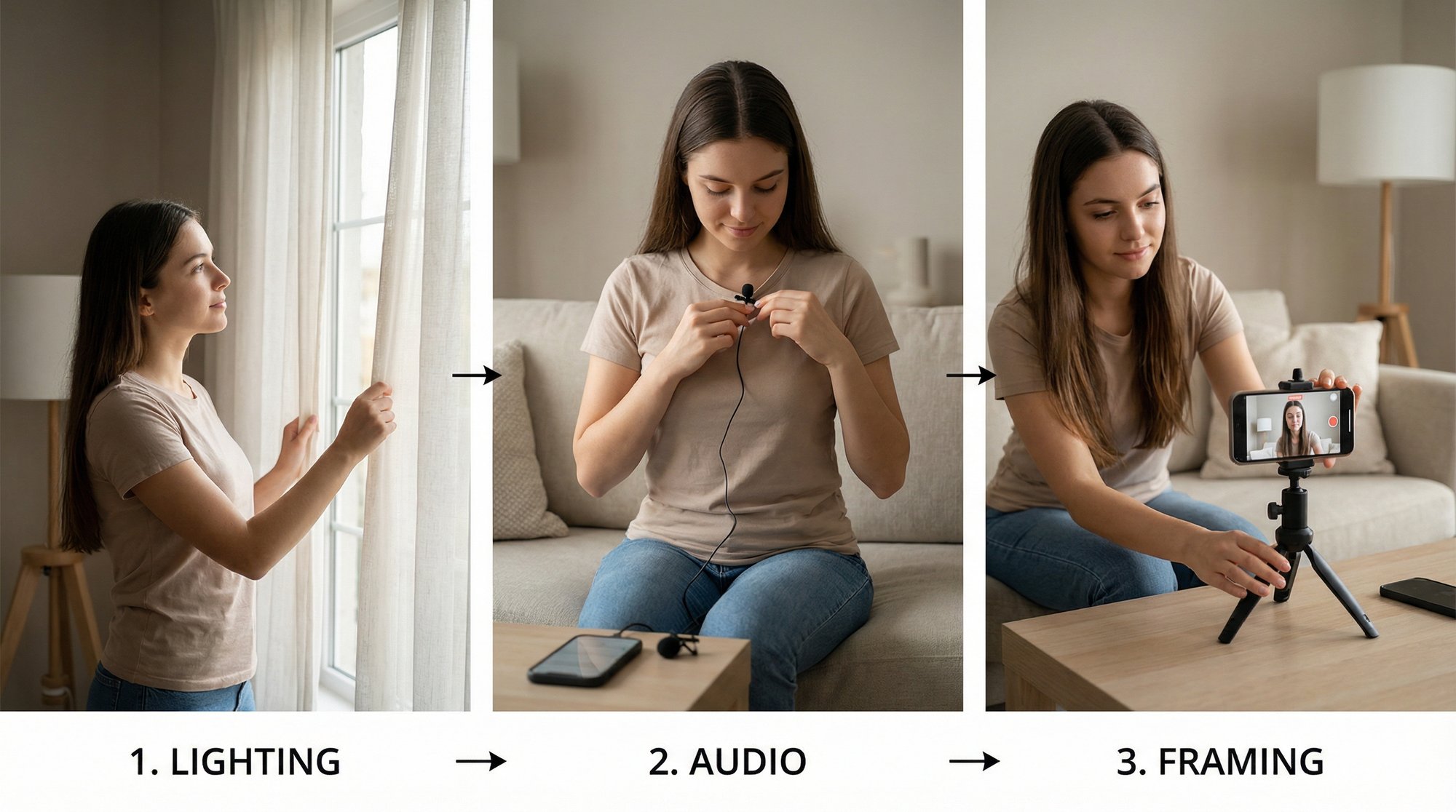
Here's my bare-bones checklist for a great-looking shot:

  • A Solid Tripod: Shaky footage screams amateur. A cheap smartphone tripod is the easiest win for instant stability. It also frees up your hands so you can talk and gesture naturally, not like you're holding a selfie stick.

  • Good Lighting: This is everything. Seriously. The best and cheapest option is to just face a window. Natural light is incredibly forgiving. If you can't do that, a simple ring light is a game-changing investment.

  • Clear Audio: Your phone’s mic is okay in a pinch, but a small clip-on lavalier mic is a tiny upgrade that makes you sound 10x more professional. Bad audio gets people to swipe away faster than anything else.

  • A Clutter-Free Background: You don't need a designer office. Just make sure the pile of laundry or last night's coffee mug isn't in the shot. A clean, simple background keeps the focus on you.

That’s it. This setup takes maybe five minutes to get right, and it’s all you need to create footage that looks sharp and commands attention.

The Power of Batching: A Real-World Scenario

So, what does batching actually look like?

It’s the simple art of filming everything for a set period—say, a week or even a full month—in one dedicated session. You shift from being a frantic, just-in-time creator to an organized, ahead-of-the-game strategist.

Imagine you're a busy founder who has scripted 12 short videos. Instead of trying to squeeze in filming three times a week between meetings, you block off a single two-hour slot on your calendar. Tuesday morning, 9-11 AM. That's it.

By dedicating one focused block of time to filming, you kill the daily "what-do-I-post" anxiety. You transform video from a relentless chore into a single, manageable task. This is the only way to stay consistent long-term.

During that two-hour session, you set up your simple studio, get in the zone, and just record. You can bring a couple of different shirts to change halfway through for some visual variety, but your only job is to deliver your message to the camera.

When those two hours are up, you have a folder full of raw footage. An entire month's worth of content is in the can, ready to go. You’ve successfully separated the creative part (speaking your mind) from all the tedious production work. If you want to dive deeper into platform specifics, our guide on how to create Instagram Reels has some extra tips.

This system is designed to get you out of the production weeds completely. Once you have that raw footage, your job is basically done. You can hand off those files to a smart service like Unfloppable, and we’ll turn them into polished, ready-to-post videos. This frees you up to get back to what you actually do best: running your business.

Let Smart Tools Handle the Editing and Repurposing

This is where so many great video strategies fall apart: the editing room. For most people, it's a soul-crushing time-suck. Editing is a highly specialized skill, and the hours it takes can bring your entire content machine to a grinding halt. But that's the old way of thinking. Modern tools and services have completely torn down this wall, turning what was once a week-long headache into a smooth, automated workflow.

Forget just cutting clips together. Imagine a smart editor that takes your raw footage—your simple talking-head video—and instantly makes it better. It can find and drop in relevant B-roll to keep things interesting, add eye-catching text overlays to highlight your main points, and even create unique AI visuals that bring your story to life.

This isn't about pumping out robotic, AI-generated videos that feel hollow. The real magic happens when your authentic, human delivery is at the center of it all. You're still the expert on camera. These tools simply act as your super-efficient production team, amplifying your message without stripping away its personality.

A desk setup featuring a 'BATCH FILMING' sign, a smartphone on a tripod, a calendar, and potted plants.

Go from One Video to an Entire Content Library

The real power here isn't just making one video look polished; it's about multiplying your content with almost zero extra effort. This is how you start repurposing at a scale that was previously unimaginable, squeezing every last drop of value from a single recording session.

Think about a 10-minute deep-dive video you filmed. In the past, chopping that up into social media clips was a manual, painstaking job that could take hours. Not anymore. A smart service can analyze that long video, pinpoint the most potent micro-moments, and pull them out for you.

This shift from manual editing to smart assistance is the secret to staying consistent. It eliminates the single biggest bottleneck in the entire video creation process, freeing you up to focus on your ideas while the system handles the tedious production work.

You can feed it one video and get back a dozen high-impact assets, all formatted and optimized for different platforms. This is how you build a real content engine without ever having to open an editing app. By removing this roadblock, you can finally see how services like Unfloppable can automate your video production.

How One Video Fills Your Content Calendar

Let's make this tangible. Say you record a 10-minute video on "Five Common Mistakes in Early-Stage SaaS Pricing." A smart editing service can take that one file and spit out a whole content campaign:

  • Five 60-Second Reels or Shorts: Each video isolates one of the five mistakes, complete with dynamic captions and a punchy call-to-action.

  • Three 90-Second LinkedIn Videos: These clips can have a more polished, professional feel, maybe using a key quote as a headline with corporate-style visuals.

  • Two Carousel Posts for Instagram: Key stats or powerful quotes from your video are transformed into sleek, shareable graphics.

  • One Audiogram for a Podcast Teaser: Your best audio snippet is laid over a branded visual, perfect for promoting your ideas on audio-first platforms.

This kind of efficiency changes everything. All of a sudden, that one filming session you did on Tuesday afternoon is fueling your social media calendar for the next two weeks. It's no wonder that 93% of businesses are now all-in on video marketing. The demand is there—89% of consumers say a video convinced them to buy something, and social videos rack up 1200% more shares than text and images combined. You can explore more compelling video marketing statistics for the full story. With the right tools, you can finally meet this demand without burning out.

Getting Your Videos Seen and Measuring Real Impact

A laptop with video editing software on a desk next to headphones, coffee, and a notebook, highlighting smart editing.

You can create the most incredible video in the world, but it's a complete waste of time if nobody ever sees it. Once your content is polished and ready to go, the real work begins: getting it in front of the right eyeballs and figuring out if it’s actually moving the needle for your business.

Creating a great video is only half the battle. Distribution isn’t just about spamming the “publish” button everywhere. It’s about being smart and strategic. Each platform has its own algorithm, its own audience quirks, and its own unwritten rules. A one-size-fits-all approach is a surefire way to get your content buried.

This is why you need a specific playbook for each channel you’re on. The exact same video that blows up on LinkedIn could fall completely flat on Instagram Reels if you don't tweak your approach.

The Short-Form Video Platform Playbook

To give you a head start, here's a quick-reference guide for tailoring your video distribution. Think of this as your cheat sheet for understanding the nuances of each major platform instead of just posting and praying.

Platform

Optimal Format & Length

Key Focus for Captions/Hashtags

Primary KPI to Track

Instagram Reels

Vertical 9:16. Aim for 15-30 seconds.

Punchy, short captions. Use trending audio. Focus on 3-5 highly relevant, high-volume hashtags.

Shares & Saves

YouTube Shorts

Vertical 9:16. Under 60 seconds.

Search-focused titles. Use keywords in the description. Treat it like mini-SEO.

Audience Retention

LinkedIn Video

Vertical 9:16 or Square 1:1. 30-90 seconds.

Storytelling captions. Tag relevant people/companies. Use niche, professional hashtags.

Comments & CTR

Simply put, you have to play by the rules of the platform you're on. A little bit of customization in your captions, on-screen text, and calls to action can make a world of difference.

A winning video content marketing strategy isn't just about what you create; it's about how and where you share it. Treat each platform as a unique conversation with a specific audience.

Measuring What Actually Matters (Hint: It’s Not Just Views)

Vanity metrics like views and likes feel good, but they don't pay the bills. The true test of your video strategy is how it ties back to those business goals you set way back at the beginning. This is where you close the loop and start getting smarter with every single video you post.

To do that, you have to get obsessed with the metrics that show real engagement and intent. These are the numbers that tell you if your videos are actually working.

Here’s what you should really be tracking:

  • Audience Retention: This is probably the most important metric of them all. Where are people dropping off? If you’re losing most of your viewers in the first 3 seconds, your hook is broken. High retention is the clearest signal that your content is hitting the mark.

  • Click-Through Rate (CTR): If your video has a call-to-action—like a link in your bio or a button on an ad—how many people are actually clicking it? This is a direct measure of how well your video inspires people to take the next step.

  • Lead Conversions: This is the bottom line. For any video promoting a lead magnet, a webinar, or a demo, you need to know how many new leads it generated. This draws a straight line from a video view to real business growth.

When you track these deeper metrics, you stop guessing and start making data-driven decisions. You’ll learn exactly which hooks grab attention, what topics drive action, and how to pour gas on what's already working. Every video becomes an investment, not just an expense.

Got Questions? We've Got Answers

Diving into video always brings up a few "what ifs" and "how tos." It's completely normal. Let's tackle some of the most common questions we hear from founders and marketers who are ready to make video a real growth engine.

How Much Time Does This Really Take Each Week?

Believe it or not, with a smart system, you can pull this off in just 2-3 hours a week. The trick isn't working harder; it's working smarter by batching your content.

You dedicate one solid two-hour block per month to film all your raw footage. That’s it. You get the most demanding part out of the way in a single, focused session.

From there, it's just a little upkeep—maybe 30 minutes a week to look over the final edits and jot down some captions. When you have a service handling the editing, which is the biggest time-drain, staying consistent becomes incredibly manageable.

What if I’m Awkward or Just Not Confident on Camera?

Welcome to the club! This is hands-down the biggest hurdle for almost everyone, and it's perfectly okay. The secret is to reframe how you think about it. You're not "performing" for an audience; you're "helping" one person.

Just talk about what you know inside and out. Your passion and expertise will shine through and build a much stronger connection than a flawless delivery ever could. Try using bullet points from your script instead of reading word-for-word—it helps you sound more like yourself.

Remember, people follow you for your insights, not for a Hollywood production. Your first videos probably won't be your best, and that's a good thing. It’s proof that you’re growing.

How Do I Actually Measure the ROI of All This?

This is where the rubber meets the road. You absolutely have to connect your video metrics to real business goals. Forget getting hung up on vanity metrics like views and likes; focus on the numbers that actually impact your bottom line.

Here’s how to do it:

  • Generating Leads? Keep a close eye on the click-through rates from your video posts and track the conversion rates on your landing pages.

  • Building Brand Awareness? Your key metrics are share rate, overall reach, and the follower growth that comes directly from your video efforts.

  • Driving Sales? Use unique discount codes you only mention in your videos or track referral traffic from social platforms in your analytics.

Tying your efforts to these outcomes is how you prove, without a doubt, that your video strategy is working.

Stop letting video editing kill your momentum. With Unfloppable, you just talk, and we handle the rest—turning your expertise into a library of polished, ready-to-post videos.

Create your first three videos for free with Unfloppable and see how easy consistency can be.

A video content marketing strategy isn't about chasing viral trends or pumping out random videos. It's a repeatable system you build to turn your unique expertise into authentic, high-impact content that actually drives business growth. It’s how you connect with the right people and hit measurable goals, time and time again.

Why Your Business Needs a Video Strategy Now

Let's cut right to it: video isn't just "another channel" anymore. It's quickly becoming the primary way people connect with and trust brands. For founders and marketers, this is a massive opportunity. A smart, structured video plan is one of the most powerful levers you have for building authority and demonstrating your expertise at scale.

Forget the idea that you need a huge production budget or fancy equipment. The real win is in building a sustainable system that transforms what you already know into a steady stream of genuine, helpful content. This guide is your playbook for doing just that—creating quality videos consistently, without all the usual stress.

The Undeniable Rise of Video Content

The numbers don't lie. By the end of 2025, it's predicted that video will make up a staggering 82% of all global internet traffic. What’s driving this? An insatiable appetite for quick, engaging visuals on platforms like Instagram Reels, TikTok, and YouTube Shorts.

This is fantastic news for startup founders and SaaS marketers. It means your simple, authentic talking-head videos can catch this wave and get serious traction. You can dig deeper into these kinds of video marketing statistics from The Desire Company.

To put this into perspective, let's break down why this shift matters so much.

The Shift to Video A Quick Snapshot

Statistic

Implication for Your Business

Where to Focus

82% of internet traffic will be video by 2025.

Your audience expects to see you on video. If you're not there, your competitors will be.

Creating a consistent presence on at least one short-form video platform.

92% of mobile video viewers share videos with others.

Video is inherently shareable, giving your content an organic reach that text and images can't match.

Crafting valuable, "I have to send this to a friend" type of content.

78% of people watch online videos every week.

Video consumption is a regular habit, not a novelty. You can become part of your audience's weekly routine.

Developing a reliable posting schedule and content pillars to build viewer loyalty.

The takeaway here is simple: a video-first approach isn't a "nice-to-have." It's essential for staying relevant and connecting with a modern audience.

This simple diagram breaks down the entire process into three core phases: harnessing your expertise, recording it efficiently, and distributing it consistently.

A visual diagram outlining a video content marketing strategy: Expertise, Record, and Distribute.

As you can see, a powerful strategy always starts with what you know best. From there, it’s all about creating an efficient workflow for getting it on camera and out into the world.

The goal is to move from sporadic, one-off video efforts to a repeatable engine. By focusing on your core knowledge and streamlining production, you make consistency achievable, turning video into a reliable asset instead of a dreaded task.

And the best part? Smart services and tools have emerged that completely remove the biggest bottleneck—editing. This means powerful, professional video is no longer just for companies with huge creative teams; it's accessible to everyone.

Defining Your Audience and Core Mission

A man speaks into a microphone, being recorded by a smartphone on a tripod for a video strategy presentation.

Let's be honest. Before you ever hit that big red record button, the most critical work of your entire video content marketing strategy is already happening. It all boils down to two simple, but powerful, questions: who are you really talking to, and what do you want them to do next?

This is the foundation. It's also where I see most strategies fall apart, because this step gets rushed—or worse, skipped entirely.

Jumping into production without this clarity is like trying to build a house without a blueprint. Sure, you might end up with four walls and a roof, but it won't be a home that actually works for anyone. Every single video has to be a direct line to a specific person wrestling with a specific problem.

Crafting Your Video Ideal Customer Profile

Your standard, company-wide Ideal Customer Profile (ICP) is too broad for effective video. We need to get way more specific. Think of it as creating a persona that’s laser-focused on their content consumption habits. This means going deeper than just demographics and digging into how they behave online.

To get there, you have to ask the right questions about their digital life:

  • Where do they hang out online? Are they career-driven folks scrolling LinkedIn? Are they on Instagram looking for visual inspiration? Or are they part of a niche community on X (formerly Twitter)? Pinpointing the platform is the first domino to fall.

  • What kind of video do they trust? Do they vibe with quick, high-energy Reels packed with trending audio? Or do they need a more polished, educational talking-head video to take you seriously?

  • What are their real-world pain points? Don't settle for surface-level business problems. A SaaS founder's pain isn’t just "low MRR." It's the gut-wrenching stress of an upcoming board meeting or the quiet frustration of watching a competitor get all the press. Your video has to speak directly to that feeling.

  • Who are they already watching? Go analyze the accounts they follow and engage with. This is your cheat sheet—it shows you the exact tone, style, and topics that already have their attention.

Getting this granular ensures you're not just making noise. You're creating content your ideal customer will actually stop their scroll to watch.

The goal isn't to reach everyone; it's to become unmissable to the right people. A deeply understood audience allows you to create content that feels like a personal conversation, not a broadcast.

Connecting Audience to Concrete Business Goals

Okay, so you know exactly who you're talking to. Now, what does winning actually look like? Vague goals like "increase brand awareness" are basically useless. Why? Because you can't measure them effectively, which means you can't improve them. A real video strategy is built on sharp, actionable goals.

Your video efforts have to be directly tethered to tangible business outcomes. This connection is what justifies the time, money, and energy you're about to pour into creating all this content.

So, instead of those fuzzy targets, let's get specific with Key Performance Indicators (KPIs) that tell a clear story. Here’s what that looks like in the real world:

  • Instead of: "Get more leads."

  • Try: "Increase demo requests that came directly from our LinkedIn video CTAs by 15% this quarter."

  • Instead of: "Grow our email list."

  • Try: "Generate 200 new email subscribers per month from the lead magnet we link to in our YouTube Shorts."

  • Instead of: "Build our community."

  • Try: "Drive a 25% jump in comments and shares on Instagram Reels that break down our core product features."

When you set these kinds of specific, measurable goals from the get-go, every video you make has a clear job to do. This disciplined approach is what turns your content from a fun creative project into a predictable growth engine. You're creating a straight line from a single view to a measurable business result, ensuring your video strategy is always working for you.

Building Your Content Pillars and a No-Fuss Scripting Workflow

Ever get that sinking feeling staring at your phone, knowing you should film something but having zero clue what to talk about? That’s the exact moment most video strategies die a quiet death.

The secret to a killer video strategy isn’t about being a bottomless well of creativity. It’s about building a reliable framework. This is how you stop chasing random ideas and start creating a structured, repeatable engine that churns out content that actually works.

A truly solid video strategy rests on what I call content pillars. Think of these as the 3 to 5 core topics your brand will absolutely own—the stuff you can talk about with genuine authority and passion, even on a Tuesday afternoon with no coffee. These pillars are your north star, making sure every single video you create reinforces your expertise and speaks directly to the people you want to reach.

Nailing Down Your Core Content Pillars

Content pillars are your focus. They’re the guardrails that keep you from getting distracted by shiny, new trends that have nothing to do with your business. Instead, you're methodically building a library of content around themes that matter to your audience. That repetition is incredibly powerful; it’s how you become the go-to person in your space.

Let's imagine you're a SaaS founder targeting other early-stage startups. Your pillars might look something like this:

  • Bootstrapping Grinds: Sharing the raw, unfiltered lessons on how you grew your business without a cent of VC money. This builds instant trust and relatability.

  • Product-Led Growth Plays: Giving away actionable tactics for getting users through the product itself. This proves you know their world inside and out.

  • Real Customer Wins: Telling the stories of how your tool solved a very specific, painful problem for a real customer. This is social proof on steroids.

See? These aren't just random topics. They're a promise to your audience about the kind of value you'll deliver every time they hit play.

Your content pillars aren’t just what you talk about; they’re how you systematically build authority. They keep you focused and ensure every video is another brick in the foundation of your expertise.

My Go-To Scripting Method for Experts (Who Hate Scripts)

Okay, let's talk about scripting. I know, the word itself can make you cringe. It brings to mind stiff, rehearsed lines that sound anything but authentic. The best videos from founders and experts never sound scripted because, well, they aren't—not in the traditional sense.

Forget word-for-word scripts. Instead, I want you to try a simple but powerful structure I call the "Hook-Point-Example" method. It’s designed for busy people who know their stuff, not for professional actors. It gives you just enough structure to be clear without sounding like a robot.

Here’s the breakdown:

  1. The Hook: You have three seconds. That’s it. Your hook has to jolt them out of their scroll. Ask a provocative question, state a surprising statistic, or call out a pain point directly. Something like, "Stop trying to find your first 100 customers. You're doing it wrong."

  2. The Point: Get straight to it. What’s the one core insight you want to share? Boil it down to one or two crystal-clear sentences. For instance, "Your first 10 customers are a thousand times more valuable because they’ll give you the brutal feedback you need to actually validate your product."

  3. The Example: This is where you make it real. Tell a quick story or use an analogy to bring your point to life. "With our first product, we literally sat with five users and just watched them. The insights from that one afternoon were worth more than 100 survey responses and led to the one feature that became our biggest selling point."

This framework is your safety net. It keeps you on track and ensures you deliver value, all while letting your genuine voice and expertise shine through.

How to Create a Hyper-Efficient Content Engine

The most prolific creators aren't coming up with dozens of new ideas every month. They have a smarter system. They take one big idea and smash it into a million little pieces. This is the single biggest "hack" for creating a massive amount of content without burning out.

Start with one piece of long-form content you've already created—a webinar, a keynote speech, a podcast interview, or even a deep-dive blog post. That one asset is a goldmine.

Seriously, go through it and pull out every single distinct idea, key takeaway, or interesting story. Each one of those is a short-form video just waiting to be filmed using the Hook-Point-Example method. A 45-minute webinar can easily give you 15-20 unique video scripts. Just like that, you have an entire month's worth of content planned out.

This one shift transforms content creation from a constant, nagging task into a single, strategic planning session. You're no longer just making videos; you're building a true content engine.

How to Batch and Film Your Content Without Losing Your Mind

Let’s be honest, the biggest thing stopping most people from making videos consistently isn't a lack of ideas—it's the sheer thought of doing it all. The filming, the editing, the constant pressure. It feels complicated, expensive, and frankly, exhausting.

But here’s the secret I’ve learned from years in the trenches: you don't need a film crew or a five-figure studio. The entire game changes when you stop thinking about production as a daily chore and start treating it like a strategic project. And for that, the most powerful tool isn't a camera—it's your calendar.

The real magic is content batching. This is the system that separates the creators who show up week after week from those who flame out and disappear. It’s less about fancy gear and more about a smarter workflow.

Your Simple Smartphone Studio Setup

Forget what you think you need. Modern smartphones shoot incredible video, so your energy is better spent on a few simple things that make a huge difference in how professional your content looks and sounds.

Here's my bare-bones checklist for a great-looking shot:

  • A Solid Tripod: Shaky footage screams amateur. A cheap smartphone tripod is the easiest win for instant stability. It also frees up your hands so you can talk and gesture naturally, not like you're holding a selfie stick.

  • Good Lighting: This is everything. Seriously. The best and cheapest option is to just face a window. Natural light is incredibly forgiving. If you can't do that, a simple ring light is a game-changing investment.

  • Clear Audio: Your phone’s mic is okay in a pinch, but a small clip-on lavalier mic is a tiny upgrade that makes you sound 10x more professional. Bad audio gets people to swipe away faster than anything else.

  • A Clutter-Free Background: You don't need a designer office. Just make sure the pile of laundry or last night's coffee mug isn't in the shot. A clean, simple background keeps the focus on you.

That’s it. This setup takes maybe five minutes to get right, and it’s all you need to create footage that looks sharp and commands attention.

The Power of Batching: A Real-World Scenario

So, what does batching actually look like?

It’s the simple art of filming everything for a set period—say, a week or even a full month—in one dedicated session. You shift from being a frantic, just-in-time creator to an organized, ahead-of-the-game strategist.

Imagine you're a busy founder who has scripted 12 short videos. Instead of trying to squeeze in filming three times a week between meetings, you block off a single two-hour slot on your calendar. Tuesday morning, 9-11 AM. That's it.

By dedicating one focused block of time to filming, you kill the daily "what-do-I-post" anxiety. You transform video from a relentless chore into a single, manageable task. This is the only way to stay consistent long-term.

During that two-hour session, you set up your simple studio, get in the zone, and just record. You can bring a couple of different shirts to change halfway through for some visual variety, but your only job is to deliver your message to the camera.

When those two hours are up, you have a folder full of raw footage. An entire month's worth of content is in the can, ready to go. You’ve successfully separated the creative part (speaking your mind) from all the tedious production work. If you want to dive deeper into platform specifics, our guide on how to create Instagram Reels has some extra tips.

This system is designed to get you out of the production weeds completely. Once you have that raw footage, your job is basically done. You can hand off those files to a smart service like Unfloppable, and we’ll turn them into polished, ready-to-post videos. This frees you up to get back to what you actually do best: running your business.

Let Smart Tools Handle the Editing and Repurposing

This is where so many great video strategies fall apart: the editing room. For most people, it's a soul-crushing time-suck. Editing is a highly specialized skill, and the hours it takes can bring your entire content machine to a grinding halt. But that's the old way of thinking. Modern tools and services have completely torn down this wall, turning what was once a week-long headache into a smooth, automated workflow.

Forget just cutting clips together. Imagine a smart editor that takes your raw footage—your simple talking-head video—and instantly makes it better. It can find and drop in relevant B-roll to keep things interesting, add eye-catching text overlays to highlight your main points, and even create unique AI visuals that bring your story to life.

This isn't about pumping out robotic, AI-generated videos that feel hollow. The real magic happens when your authentic, human delivery is at the center of it all. You're still the expert on camera. These tools simply act as your super-efficient production team, amplifying your message without stripping away its personality.

A desk setup featuring a 'BATCH FILMING' sign, a smartphone on a tripod, a calendar, and potted plants.

Go from One Video to an Entire Content Library

The real power here isn't just making one video look polished; it's about multiplying your content with almost zero extra effort. This is how you start repurposing at a scale that was previously unimaginable, squeezing every last drop of value from a single recording session.

Think about a 10-minute deep-dive video you filmed. In the past, chopping that up into social media clips was a manual, painstaking job that could take hours. Not anymore. A smart service can analyze that long video, pinpoint the most potent micro-moments, and pull them out for you.

This shift from manual editing to smart assistance is the secret to staying consistent. It eliminates the single biggest bottleneck in the entire video creation process, freeing you up to focus on your ideas while the system handles the tedious production work.

You can feed it one video and get back a dozen high-impact assets, all formatted and optimized for different platforms. This is how you build a real content engine without ever having to open an editing app. By removing this roadblock, you can finally see how services like Unfloppable can automate your video production.

How One Video Fills Your Content Calendar

Let's make this tangible. Say you record a 10-minute video on "Five Common Mistakes in Early-Stage SaaS Pricing." A smart editing service can take that one file and spit out a whole content campaign:

  • Five 60-Second Reels or Shorts: Each video isolates one of the five mistakes, complete with dynamic captions and a punchy call-to-action.

  • Three 90-Second LinkedIn Videos: These clips can have a more polished, professional feel, maybe using a key quote as a headline with corporate-style visuals.

  • Two Carousel Posts for Instagram: Key stats or powerful quotes from your video are transformed into sleek, shareable graphics.

  • One Audiogram for a Podcast Teaser: Your best audio snippet is laid over a branded visual, perfect for promoting your ideas on audio-first platforms.

This kind of efficiency changes everything. All of a sudden, that one filming session you did on Tuesday afternoon is fueling your social media calendar for the next two weeks. It's no wonder that 93% of businesses are now all-in on video marketing. The demand is there—89% of consumers say a video convinced them to buy something, and social videos rack up 1200% more shares than text and images combined. You can explore more compelling video marketing statistics for the full story. With the right tools, you can finally meet this demand without burning out.

Getting Your Videos Seen and Measuring Real Impact

A laptop with video editing software on a desk next to headphones, coffee, and a notebook, highlighting smart editing.

You can create the most incredible video in the world, but it's a complete waste of time if nobody ever sees it. Once your content is polished and ready to go, the real work begins: getting it in front of the right eyeballs and figuring out if it’s actually moving the needle for your business.

Creating a great video is only half the battle. Distribution isn’t just about spamming the “publish” button everywhere. It’s about being smart and strategic. Each platform has its own algorithm, its own audience quirks, and its own unwritten rules. A one-size-fits-all approach is a surefire way to get your content buried.

This is why you need a specific playbook for each channel you’re on. The exact same video that blows up on LinkedIn could fall completely flat on Instagram Reels if you don't tweak your approach.

The Short-Form Video Platform Playbook

To give you a head start, here's a quick-reference guide for tailoring your video distribution. Think of this as your cheat sheet for understanding the nuances of each major platform instead of just posting and praying.

Platform

Optimal Format & Length

Key Focus for Captions/Hashtags

Primary KPI to Track

Instagram Reels

Vertical 9:16. Aim for 15-30 seconds.

Punchy, short captions. Use trending audio. Focus on 3-5 highly relevant, high-volume hashtags.

Shares & Saves

YouTube Shorts

Vertical 9:16. Under 60 seconds.

Search-focused titles. Use keywords in the description. Treat it like mini-SEO.

Audience Retention

LinkedIn Video

Vertical 9:16 or Square 1:1. 30-90 seconds.

Storytelling captions. Tag relevant people/companies. Use niche, professional hashtags.

Comments & CTR

Simply put, you have to play by the rules of the platform you're on. A little bit of customization in your captions, on-screen text, and calls to action can make a world of difference.

A winning video content marketing strategy isn't just about what you create; it's about how and where you share it. Treat each platform as a unique conversation with a specific audience.

Measuring What Actually Matters (Hint: It’s Not Just Views)

Vanity metrics like views and likes feel good, but they don't pay the bills. The true test of your video strategy is how it ties back to those business goals you set way back at the beginning. This is where you close the loop and start getting smarter with every single video you post.

To do that, you have to get obsessed with the metrics that show real engagement and intent. These are the numbers that tell you if your videos are actually working.

Here’s what you should really be tracking:

  • Audience Retention: This is probably the most important metric of them all. Where are people dropping off? If you’re losing most of your viewers in the first 3 seconds, your hook is broken. High retention is the clearest signal that your content is hitting the mark.

  • Click-Through Rate (CTR): If your video has a call-to-action—like a link in your bio or a button on an ad—how many people are actually clicking it? This is a direct measure of how well your video inspires people to take the next step.

  • Lead Conversions: This is the bottom line. For any video promoting a lead magnet, a webinar, or a demo, you need to know how many new leads it generated. This draws a straight line from a video view to real business growth.

When you track these deeper metrics, you stop guessing and start making data-driven decisions. You’ll learn exactly which hooks grab attention, what topics drive action, and how to pour gas on what's already working. Every video becomes an investment, not just an expense.

Got Questions? We've Got Answers

Diving into video always brings up a few "what ifs" and "how tos." It's completely normal. Let's tackle some of the most common questions we hear from founders and marketers who are ready to make video a real growth engine.

How Much Time Does This Really Take Each Week?

Believe it or not, with a smart system, you can pull this off in just 2-3 hours a week. The trick isn't working harder; it's working smarter by batching your content.

You dedicate one solid two-hour block per month to film all your raw footage. That’s it. You get the most demanding part out of the way in a single, focused session.

From there, it's just a little upkeep—maybe 30 minutes a week to look over the final edits and jot down some captions. When you have a service handling the editing, which is the biggest time-drain, staying consistent becomes incredibly manageable.

What if I’m Awkward or Just Not Confident on Camera?

Welcome to the club! This is hands-down the biggest hurdle for almost everyone, and it's perfectly okay. The secret is to reframe how you think about it. You're not "performing" for an audience; you're "helping" one person.

Just talk about what you know inside and out. Your passion and expertise will shine through and build a much stronger connection than a flawless delivery ever could. Try using bullet points from your script instead of reading word-for-word—it helps you sound more like yourself.

Remember, people follow you for your insights, not for a Hollywood production. Your first videos probably won't be your best, and that's a good thing. It’s proof that you’re growing.

How Do I Actually Measure the ROI of All This?

This is where the rubber meets the road. You absolutely have to connect your video metrics to real business goals. Forget getting hung up on vanity metrics like views and likes; focus on the numbers that actually impact your bottom line.

Here’s how to do it:

  • Generating Leads? Keep a close eye on the click-through rates from your video posts and track the conversion rates on your landing pages.

  • Building Brand Awareness? Your key metrics are share rate, overall reach, and the follower growth that comes directly from your video efforts.

  • Driving Sales? Use unique discount codes you only mention in your videos or track referral traffic from social platforms in your analytics.

Tying your efforts to these outcomes is how you prove, without a doubt, that your video strategy is working.

Stop letting video editing kill your momentum. With Unfloppable, you just talk, and we handle the rest—turning your expertise into a library of polished, ready-to-post videos.

Create your first three videos for free with Unfloppable and see how easy consistency can be.