Personal Branding for Executives: Build Influence, Lead Authentically
Explore practical steps for personal branding for executives to showcase leadership, boost visibility, and attract opportunities.
Feb 24, 2026
Let’s be honest: "personal branding" can sound like a vanity project. Something for influencers, not serious executives. But that’s a dangerously outdated way of thinking.
Today, your personal brand is a strategic imperative. It's the deliberate process of shaping how the world sees your expertise and leadership, turning your reputation from a passive background element into an active engine for growth.
Why Executive Personal Branding Is Your New Competitive Edge

In a market saturated with noise, your customers, investors, and future star employees are digging deeper. They look past the corporate logo and want to know who is steering the ship. They're searching for your vision, your values, and your take on the industry before they decide to invest their money or their careers.
What they find—or don't find—is your personal brand. It's the story that walks into the room before you do.
This isn’t about faking perfection or creating some sanitized corporate persona. Quite the opposite. Real executive branding is about articulating what you genuinely stand for and backing it up, day in and day out. It’s sharing your unique point of view on where the market is headed, what you’ve learned from the tough calls, and the vision that gets you out of bed in the morning.
When you share that story authentically, you build trust on a massive scale.
The Tangible Business Impact of an Executive Brand
Investing in your brand isn't a soft skill; it delivers hard, measurable returns that flow directly to the bottom line. It's one of the highest-leverage activities a leader can undertake, creating a powerful ripple effect across the entire business.
Don't just take my word for it. The data paints a very clear picture of how a strong executive brand translates into real business results.
Business Metric | Performance Uplift |
|---|---|
Market Valuation | 58% higher for companies with strong leadership brands |
Sales Cycle Velocity | 36% faster deal closures |
Talent Retention | 45% improvement in retaining top performers |
Customer Satisfaction | 24% higher customer satisfaction rates |
These aren't just marginal gains. They represent a significant, sustainable competitive advantage driven by leadership presence.
"Your brand is what other people say about you when you’re not in the room." - Jeff Bezos
This quote nails it. Your brand is the reputation you cultivate through your actions, your insights, and how you communicate. A powerful brand ensures the conversation happening without you is exactly the one you want people to have.
It’s More Than Just a Polished Profile
A great LinkedIn profile is table stakes. It’s the beginning, not the end. A true executive brand is an active, living strategy that directly fuels business growth and expands your influence. You're building a platform to share what you see that others don't, which humanizes your company and forges genuine connections.
Here’s where you’ll see the payoff:
A Magnet for Top Talent: The best people don’t want to work for a faceless company; they want to work for and learn from inspiring leaders. Your visible brand turns your organization into a destination for A-players.
Faster Sales Cycles: Imagine your sales team talking to prospects who already know, like, and trust you because of your content. That’s what a strong brand does. It warms up the market, builds credibility, and shortens the path to "yes."
Unmistakable Market Authority: When you consistently share valuable insights, you become the go-to expert. This authority doesn’t just build trust; it opens doors to media opportunities, speaking gigs, and a seat at the table for industry-shaping conversations.
Ultimately, this is about owning your narrative. In a world full of distractions, a strong personal brand is a clear signal of leadership and trust. Mastering it isn't just about advancing your own career—it's about building a durable asset for your entire organization. To dig deeper, our guide on how to build executive presence is the perfect next step.
Finding Your Voice: How to Pinpoint Your Unique Angle and Content Pillars

We've all heard the advice: "Just be authentic." It sounds great, but it’s not a strategy. True authenticity isn't about just winging it; it’s the natural result of a sharp, repeatable framework that defines who you are and what you stand for.
Effective personal branding for executives means swapping vague buzzwords for a rock-solid foundation. This isn’t just about what you know; it's about connecting your expertise to the real needs of your audience through a unique perspective only you can offer.
Without this clarity, you’ll end up creating content that’s all over the place, failing to connect with anyone. The real goal is to articulate your value so clearly that every video feels like a genuine extension of who you are and the problems you live to solve.
The entire process hinges on a Brand Positioning Statement. This isn't some fluffy marketing document; it's your internal north star, making sure every video, post, and comment you publish is anchored to one powerful idea.
Nail Your Brand Positioning Statement
Think of your Brand Positioning Statement as the DNA of your executive brand. It's a simple, powerful formula that forces you to be decisive about who you serve, what you solve, and how your approach is different.
To get started, just answer three questions:
Who is my target audience? And I mean really specific. "Business leaders" is a sea of noise. "Second-time SaaS founders scaling from $5M to $20M ARR" is a person you can actually talk to.
What problem do I solve for them? Get to the heart of their biggest pain points. Don't say, "I help with growth." Instead, try, "I help them cut through the operational chaos that always stalls growth."
What is my unique point of view? This is your secret sauce. It's the unique lens you use to view their problem, and it's what makes your advice stand out from the crowd.
Let’s walk through a real-world example. A tech executive I worked with initially described her brand as, "I help companies implement technology." It's accurate, but it's flat. It doesn't tell you anything memorable.
After digging into the framework, she landed on something much more powerful.
Positioning Statement Example: "I help enterprise CTOs navigate the ethical and operational complexities of AI implementation by championing a human-centric framework that prioritizes transparency and employee trust over speed."
See the difference? This statement has teeth. It’s specific, it’s audience-focused, and it’s built around a strong, defensible point of view. You instantly know what she stands for and who she’s here to help.
Translate Your Positioning into Content Pillars
With your positioning locked in, the next move is to build out your Content Pillars. These are the 3-5 core themes you’ll talk about again and again. They are the main channels of your personal brand, the topics you want to completely own.
Content pillars are your best defense against content paralysis. Instead of staring at a blank screen wondering what to post, you have a defined set of topics that constantly reinforce your expertise. This is how you make sure every single video builds on the last, cementing your authority in your chosen space.
Let’s go back to our tech executive and see how her content pillars flow directly from her positioning statement:
Pillar 1: Ethical AI Implementation. This is her core expertise. She can create videos on AI bias audits, making algorithms transparent, and how to talk about AI strategy with the board.
Pillar 2: Scaling Distributed Teams. This hits on a huge operational headache for her CTO audience. Content here could cover remote leadership tactics, building asynchronous workflows, and keeping company culture alive across time zones.
Pillar 3: Customer-Led Innovation. This pillar reinforces her "human-centric" viewpoint. She could film content about using customer feedback to shape product roadmaps or how to create beta testing programs that actually work.
Notice how the pillars are distinct, but they all ladder up to her core brand promise. They’re all designed to serve her target audience while showcasing her unique perspective. This structured approach is the secret to building an influential executive brand that sticks. If you're looking to dive deeper into this, our guide on finding your business niche offers some great insights for sharpening your focus. This framework ensures your message is not just heard, but remembered.
Nail Your Video Workflow (Without Wasting a Whole Day)
Let's be honest, the thought of creating video content is exhausting. For a busy executive, it brings up images of complicated software, wasted days, and endless retakes. This is probably the single biggest reason leaders don't build a powerful personal brand online—but it's based on a completely outdated way of thinking.
The secret isn’t to suddenly become a video producer. It's to build a simple, repeatable system that cuts out 90% of the effort while keeping all the impact. Your expertise is the valuable part; the video is just the vehicle.
Our mission here is to turn video creation from a dreaded chore into a sustainable habit. We’re not aiming for Hollywood perfection. We’re aiming for a workflow so simple it feels effortless to stick with.
Batch Record Your Brain
The smartest way to get a month’s worth of content is to knock it all out in one go. This isn't about memorizing scripts. It's about talking—off the cuff—about the content pillars you already know inside and out.
Block off just one hour. Find a quiet spot, prop up your phone, and just start riffing on one specific idea from one of your pillars for 2-3 minutes. Stop. Take a breath. And do it again with another idea. In less than 60 minutes, you can easily bank 15-20 raw video clips.
"The goal isn't a perfect video. The goal is to get one valuable idea out of your head clearly. Everything else can be fixed in the edit."
This batching approach takes the pressure off. Instead of constantly feeling like you have to be "on," you have one focused burst of activity that fuels your content calendar for weeks. It’s the only way this works with a demanding executive schedule.
The Toolkit for Effortless Recording
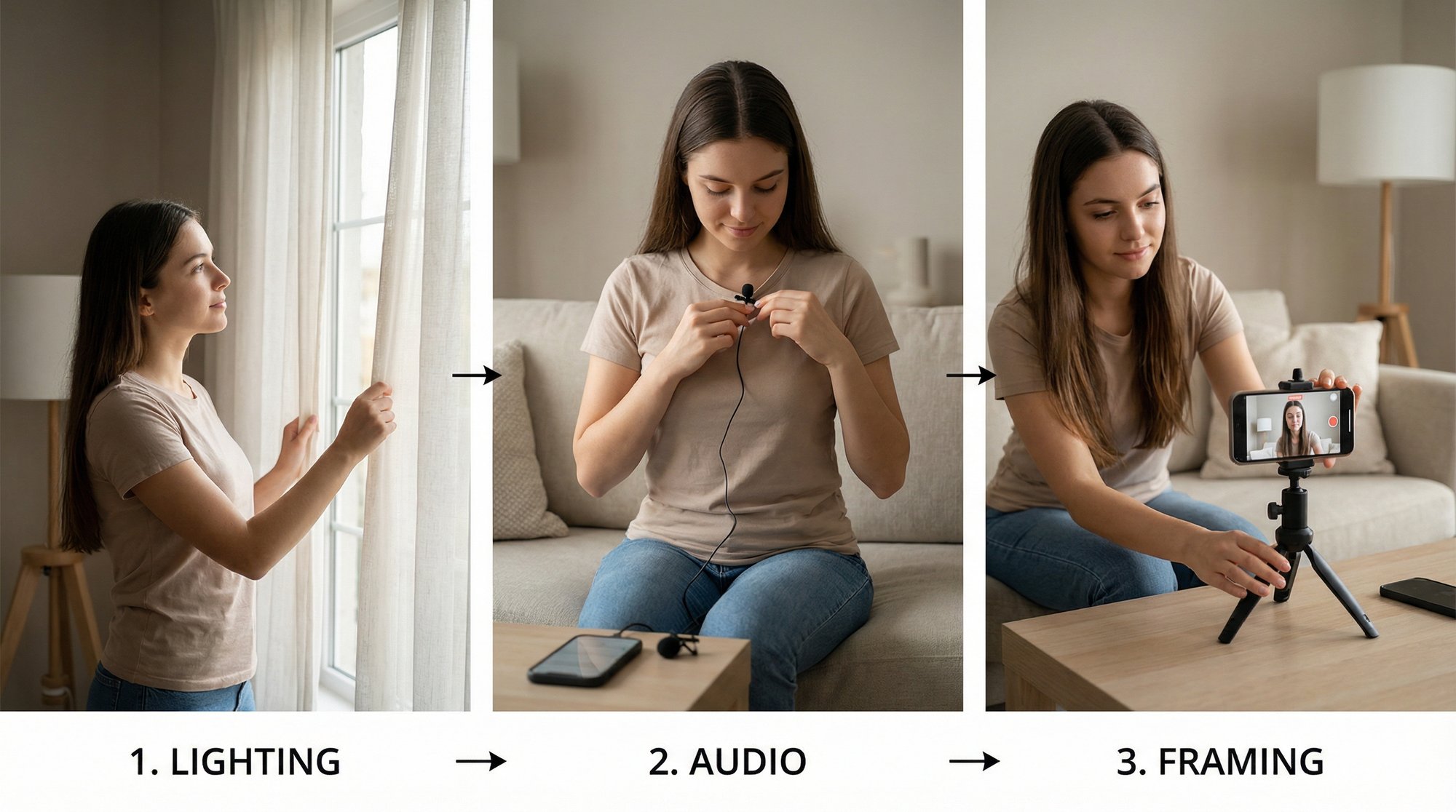
You don't need a film studio. A few inexpensive tools will make your raw footage look and sound ten times better without adding any real complexity.
A Simple Teleprompter App: Don't think of this as a script reader. Use an app like Teleprompter Premium to display just 3-4 bullet points. It keeps you on track, but more importantly, it keeps your eyes locked on the camera lens, creating a much more direct connection with your audience.
Find Your Light (It's Free): Seriously, don't overthink this. The best light is almost always right outside your window. Just turn your desk to face a window. That soft, natural, indirect sunlight is far more flattering than the harsh fluorescent lights in most offices. You'll instantly look more professional.
The $20 Audio Upgrade: Bad audio will make people click away faster than anything else. A simple lavalier microphone that clips onto your shirt and plugs into your phone is the best money you can spend. It cuts out distracting background noise and makes your voice sound crisp and clear.
These little tweaks take maybe five minutes to set up but make a massive difference in the final product.
The Magic of Smart Delegation
Once you've recorded your raw thoughts, your job is done. The absolute key to an effortless workflow is handing off the post-production. Your time is for strategy and leadership, not for getting lost in editing software.
This is where a service designed for this exact problem, like Unfloppable, becomes your secret weapon. You just upload your raw clips, and the rest is handled for you.
Here’s what that looks like in practice:
Smart Editing: Your 3-minute raw clip gets trimmed down to a tight, punchy short video. All the ums, ahs, and rambling bits are cut out, leaving only the most compelling narrative.
Visual Punch: Dynamic captions are added so people can watch with the sound off (which most do). Then, relevant B-roll footage, data visuals, and even custom graphics are woven in to illustrate your points and keep viewers glued to the screen.
Brand Consistency: Every video is polished with your brand colors, logo, and fonts. It ensures that every single piece of content looks professional and reinforces your company's identity.
This hand-off is what makes the whole system sustainable. It frees you up to focus only on sharing what you know, turning a time-suck of a process into a simple upload. By removing that friction, you can finally stay consistent. This systematic approach is fundamental, and our broader guide on how to build a personal brand offers more strategies for creating a lasting impact.
The result? A steady stream of high-quality content that builds your authority, without ever draining your schedule.
Building Your Content Distribution and Repurposing Engine
You can record the best video clips in the world, but if no one sees them, they might as well not exist. The real magic happens when you get your content in front of the right people, consistently. For a busy executive, this isn't about random posting; it's about building a smart, multi-channel system that amplifies your message without eating up your entire calendar.
The entire engine is built on short-form video, and for good reason: it’s incredibly versatile. Think of a single, well-made video not as one piece of content, but as the raw material for a dozen different assets. Each one is designed for the specific platform where your audience is already hanging out. This is how you create a powerful, omnipresent brand that solidifies your expertise.
The goal here is sustainability. An aggressive, all-out content blitz might work for a week, but it leads to burnout. A steady, predictable rhythm on a few key platforms will always outperform sporadic bursts of activity.
The Art of Repurposing a Single Video
I tell my clients all the time: create once, distribute forever. A single two-minute video from your batch recording session can easily be sliced and diced into an entire week's worth of content. This isn't about spamming people with the same thing over and over. It's about reframing the same core idea for different platforms and different consumption habits.
Let's walk through how one video can become the fuel for your whole week:
The Original LinkedIn Video: This is your anchor asset. The short, punchy video goes straight to LinkedIn, complete with captions for the 85% of people who watch with the sound off. It’s visual, direct, and delivers the core message effectively.
The LinkedIn Text Post: A couple of days later, pull the most valuable insight from that video and craft a text-only post. Start with a sharp hook, explain the point, and wrap it up with a question to get a conversation going in the comments.
The Twitter (X) Thread: Break down the video's narrative into a 3- to 5-part thread on X (formerly Twitter). Each tweet can hit a different part of the argument, creating a mini-story that encourages people to keep reading.
The Quote Graphic: Find the most powerful sentence in your script and have your team turn it into a clean, professional graphic for Instagram or LinkedIn. These are highly shareable and reinforce your message in a visually striking way.
The Newsletter Deep Dive: Embed the video or the quote graphic in your weekly newsletter, but add a paragraph of exclusive commentary. Explain why this idea is so critical right now and what you want your subscribers to do with the information.
This approach ensures your audience encounters your big ideas in the format they prefer, which massively increases both reach and retention.
The whole system is designed to be as frictionless as possible. Once you get it rolling, it feels effortless.

This simple cycle—Record, Delegate, Distribute—is what turns personal branding from a chore into a high-leverage, sustainable system.
Your Sustainable Posting Cadence
Consistency is how you build trust. When your audience sees you show up regularly with valuable insights, they start to see you as a reliable authority. But "consistent" doesn't mean "constant." You don't need to be posting three times a day. For most executives, a simple and repeatable schedule is the secret to long-term impact.
A strong personal brand isn’t built in a week of intense activity. It’s built in months of steady, valuable contributions. Focus on a rhythm you can maintain indefinitely.
Here’s a sample weekly calendar built on this repurposing model. It only requires you to come up with two core video ideas per week, yet it keeps you visible across your most important channels.
Day | Platform | Content Format |
|---|---|---|
Monday | Video #1: The original short-form video post. | |
Tuesday | Twitter (X) | Thread: A breakdown of the key ideas from Video #1. |
Wednesday | Text Post: A deeper dive into one insight from Video #1. | |
Thursday | Video #2: The second original short-form video post. | |
Friday | Newsletter | Insight: Feature Video #2 with additional context for subscribers. |
This schedule gives you multiple at-bats during the week without demanding you're constantly on a content treadmill. It respects your time while maximizing your influence. The real power of personal branding for executives comes from this kind of strategic distribution. It ensures your voice is heard, building the authority and trust that ultimately drive business forward.
How to Measure What Matters and Sidestep the Common Pitfalls

Look, creating great content is only half the battle. If you're going to invest your valuable time, you have to know it's paying off in real business terms. It’s easy to get mesmerized by vanity metrics like views and likes, but they’re often fool's gold.
Think about it. A video that gets 100,000 views but doesn’t start a single business conversation is a failure. But a video with just 1,000 highly targeted views that brings in one perfect client? That's a massive win.
Your goal isn't to go viral. The real aim of personal branding for executives is to build influence with the right people—the ones who can hire you, partner with you, or become your next major customer. Measuring that kind of influence requires a smarter approach.
The Metrics That Actually Signal Influence
To get a real sense of your brand's traction, you need to shift your focus from passive numbers to active engagement signals. These are the metrics that prove your content isn't just being seen, but is actually sparking action and building trust.
These leading indicators are your best real-time pulse check:
Profile Visits: Are your videos intriguing enough to make someone click through and learn more about you? A steady rise in profile visits is a fantastic sign that your content is hitting the mark.
Inbound Connection Requests: This is where the magic happens. When ideal prospects start reaching out to you, you know your brand is working. Pay close attention to the quality here—are they the people you actually want to talk to?
High-Quality Comments: Forget the one-word "great post!" replies. I’m talking about meaningful comments that ask follow-up questions or share a related story. This is how you know your ideas are resonating and starting valuable dialogues.
This focus on quality over quantity is how you build real trust. And in today’s market, trust is the ultimate currency of leadership. In fact, research shows 82% of consumers trust companies more when their senior executives are active on social media, and 70% feel more connected to brands where leaders are visible. You can dig into more insights on how a leader's brand drives market dominance on Govforum.io. It's proof that your visibility directly fuels your business credibility.
Tracking the Long-Term Wins
While those leading indicators give you immediate feedback, the ultimate ROI of your personal brand often shows up in what we call lagging indicators. These are the downstream business results that take longer to surface but represent the true payoff of all your hard work.
Keep an eye on these signals:
Mentions in Sales Calls: When your sales team reports back that a prospect said, "Oh yeah, I've been following your CEO on LinkedIn," you've just shortened the sales cycle.
"How Did You Hear About Us?" Data: Add this simple field to your website's contact forms. Seeing your name pop up is concrete proof that your personal brand is a genuine source of inbound leads.
Conference and Podcast Invitations: As your authority grows, you'll find yourself being invited to share your expertise on bigger stages. This is a powerful amplifier for your message and your brand.
Navigating Executive Branding Roadblocks
Every executive I've worked with hits a few bumps on this journey. It’s completely normal. The key is to see them coming and have a plan. Fear of judgment, an inconsistent posting schedule, and the pressure to be perfect can derail even the most well-intentioned leaders.
To help you stay on track, I've put together a quick guide for spotting and solving the most common issues that executives face when building their personal brand.
Navigating Executive Branding Roadblocks
Common Pitfall | Symptom | Actionable Solution |
|---|---|---|
Fear of Judgment | You find yourself hesitating to post, obsessing over what peers or competitors might think. | Reframe your audience. Stop talking to the critics. Instead, speak directly to the one person you want to help. Your focus should be on adding value, not seeking approval. |
Posting Inconsistently | You post in intense bursts but then go silent for weeks, killing all your momentum. | Build a sustainable system. Use the batching and delegation workflow we discussed. A consistent cadence of 2 posts a week is far more powerful than 10 posts one week and zero the next. |
Perfection Paralysis | You spend hours re-recording a simple video, trying to get every word and inflection just right. | Embrace the "80% rule." A good video published today is infinitely better than a "perfect" video that never sees the light of day. Remember, authenticity beats polish every single time. |
This table isn't just a list of problems; it's a playbook for resilience. The most successful executive brands are rarely built on flawless performance.
The most successful executive brands aren't built on flawless performance, but on relentless consistency and a genuine desire to add value. Stop trying to be perfect and start trying to be helpful.
By measuring what truly matters and proactively tackling these common mistakes, you can turn your personal brand from a hopeful experiment into a predictable and powerful engine for business growth.
A Few Lingering Questions You Probably Have
Starting this journey always brings up a few questions. That's completely normal. You're balancing the demands of leadership with this new push for visibility, and it's smart to be cautious. Let's cut through the noise and tackle the most common concerns I hear from executives just like you.
My goal isn't to add another overwhelming project to your to-do list. It's to show you how a smart, systemized approach to personal branding can become a massive asset—without causing burnout.
Let's clear those final hurdles.
How Much Time Do I Really Need to Put In Every Week?
This is always the first question, and the answer usually surprises people. With a smart system, you can build and maintain a powerful executive brand in just 1-2 hours per week. Seriously. This whole model is built on leverage, not just grinding it out.
The secret is separating the work only you can do (sharing your unique perspective) from all the time-sucking tasks like editing and production.
Here’s what that actually looks like:
Recording Your Thoughts (1 hour, twice a month): Block out one focused hour, just twice a month, to record a batch of raw videos. No fancy production—just you, speaking candidly about your core content pillars.
Review & Engage (15-20 minutes, weekly): Your only other weekly commitment is to quickly review the polished, ready-to-post videos and spend a few minutes responding to thoughtful comments.
This approach is built for the long haul. It’s designed to fit into a real leader's schedule, turning "personal branding" from a dreaded project into a manageable, high-impact habit.
Is My Industry Too Niche or Technical for This?
I hear this all the time from leaders in highly specialized fields. They worry their industry is too "boring" or complex for short-form video. The truth is, the exact opposite is true. A technical or niche industry is a goldmine for building a personal brand because you have very little competition for that top expert spot.
Your ideal audience isn't mindlessly scrolling for entertainment. They’re actively looking for someone who can bring clarity to the complex issues they wrestle with every day.
No industry is too boring. Your "niche" topic is someone else's biggest business problem, and your unique perspective is the solution they’re desperately searching for.
Think of short-form video as your tool to:
Break down complex ideas into bite-sized, understandable insights.
Bust common industry myths that are holding people back.
Share an insider’s point of view on where the industry is heading.
Your specialized knowledge isn't a handicap; it's your single biggest advantage.
How Do I Balance My Brand with My Company's Brand?
A well-crafted executive brand should amplify the company brand, not compete with it. When done right, the two work together to create a powerful flywheel. Your personal brand builds human connection and trust, while the company gives you the platform and credibility to be heard.
The simplest way to ensure alignment? See yourself as your company’s chief storyteller.
Your content becomes the vehicle for telling compelling stories about:
The company’s origin, its mission, and the massive problems you're solving.
The incredible people on your team and the culture you're building together.
Your customers’ wins and the real-world impact of your work.
When you invest in your own brand, you create a rising tide that lifts the entire organization. You’re not just building trust in yourself; you’re building trust in the company you lead, turning your personal visibility into a tangible business asset.
Ready to build your executive brand without the headache of editing? At Unfloppable, we turn your raw ideas into polished, ready-to-post videos, so you can focus on leading. Get started and claim your first three videos for free.
Let’s be honest: "personal branding" can sound like a vanity project. Something for influencers, not serious executives. But that’s a dangerously outdated way of thinking.
Today, your personal brand is a strategic imperative. It's the deliberate process of shaping how the world sees your expertise and leadership, turning your reputation from a passive background element into an active engine for growth.
Why Executive Personal Branding Is Your New Competitive Edge

In a market saturated with noise, your customers, investors, and future star employees are digging deeper. They look past the corporate logo and want to know who is steering the ship. They're searching for your vision, your values, and your take on the industry before they decide to invest their money or their careers.
What they find—or don't find—is your personal brand. It's the story that walks into the room before you do.
This isn’t about faking perfection or creating some sanitized corporate persona. Quite the opposite. Real executive branding is about articulating what you genuinely stand for and backing it up, day in and day out. It’s sharing your unique point of view on where the market is headed, what you’ve learned from the tough calls, and the vision that gets you out of bed in the morning.
When you share that story authentically, you build trust on a massive scale.
The Tangible Business Impact of an Executive Brand
Investing in your brand isn't a soft skill; it delivers hard, measurable returns that flow directly to the bottom line. It's one of the highest-leverage activities a leader can undertake, creating a powerful ripple effect across the entire business.
Don't just take my word for it. The data paints a very clear picture of how a strong executive brand translates into real business results.
Business Metric | Performance Uplift |
|---|---|
Market Valuation | 58% higher for companies with strong leadership brands |
Sales Cycle Velocity | 36% faster deal closures |
Talent Retention | 45% improvement in retaining top performers |
Customer Satisfaction | 24% higher customer satisfaction rates |
These aren't just marginal gains. They represent a significant, sustainable competitive advantage driven by leadership presence.
"Your brand is what other people say about you when you’re not in the room." - Jeff Bezos
This quote nails it. Your brand is the reputation you cultivate through your actions, your insights, and how you communicate. A powerful brand ensures the conversation happening without you is exactly the one you want people to have.
It’s More Than Just a Polished Profile
A great LinkedIn profile is table stakes. It’s the beginning, not the end. A true executive brand is an active, living strategy that directly fuels business growth and expands your influence. You're building a platform to share what you see that others don't, which humanizes your company and forges genuine connections.
Here’s where you’ll see the payoff:
A Magnet for Top Talent: The best people don’t want to work for a faceless company; they want to work for and learn from inspiring leaders. Your visible brand turns your organization into a destination for A-players.
Faster Sales Cycles: Imagine your sales team talking to prospects who already know, like, and trust you because of your content. That’s what a strong brand does. It warms up the market, builds credibility, and shortens the path to "yes."
Unmistakable Market Authority: When you consistently share valuable insights, you become the go-to expert. This authority doesn’t just build trust; it opens doors to media opportunities, speaking gigs, and a seat at the table for industry-shaping conversations.
Ultimately, this is about owning your narrative. In a world full of distractions, a strong personal brand is a clear signal of leadership and trust. Mastering it isn't just about advancing your own career—it's about building a durable asset for your entire organization. To dig deeper, our guide on how to build executive presence is the perfect next step.
Finding Your Voice: How to Pinpoint Your Unique Angle and Content Pillars

We've all heard the advice: "Just be authentic." It sounds great, but it’s not a strategy. True authenticity isn't about just winging it; it’s the natural result of a sharp, repeatable framework that defines who you are and what you stand for.
Effective personal branding for executives means swapping vague buzzwords for a rock-solid foundation. This isn’t just about what you know; it's about connecting your expertise to the real needs of your audience through a unique perspective only you can offer.
Without this clarity, you’ll end up creating content that’s all over the place, failing to connect with anyone. The real goal is to articulate your value so clearly that every video feels like a genuine extension of who you are and the problems you live to solve.
The entire process hinges on a Brand Positioning Statement. This isn't some fluffy marketing document; it's your internal north star, making sure every video, post, and comment you publish is anchored to one powerful idea.
Nail Your Brand Positioning Statement
Think of your Brand Positioning Statement as the DNA of your executive brand. It's a simple, powerful formula that forces you to be decisive about who you serve, what you solve, and how your approach is different.
To get started, just answer three questions:
Who is my target audience? And I mean really specific. "Business leaders" is a sea of noise. "Second-time SaaS founders scaling from $5M to $20M ARR" is a person you can actually talk to.
What problem do I solve for them? Get to the heart of their biggest pain points. Don't say, "I help with growth." Instead, try, "I help them cut through the operational chaos that always stalls growth."
What is my unique point of view? This is your secret sauce. It's the unique lens you use to view their problem, and it's what makes your advice stand out from the crowd.
Let’s walk through a real-world example. A tech executive I worked with initially described her brand as, "I help companies implement technology." It's accurate, but it's flat. It doesn't tell you anything memorable.
After digging into the framework, she landed on something much more powerful.
Positioning Statement Example: "I help enterprise CTOs navigate the ethical and operational complexities of AI implementation by championing a human-centric framework that prioritizes transparency and employee trust over speed."
See the difference? This statement has teeth. It’s specific, it’s audience-focused, and it’s built around a strong, defensible point of view. You instantly know what she stands for and who she’s here to help.
Translate Your Positioning into Content Pillars
With your positioning locked in, the next move is to build out your Content Pillars. These are the 3-5 core themes you’ll talk about again and again. They are the main channels of your personal brand, the topics you want to completely own.
Content pillars are your best defense against content paralysis. Instead of staring at a blank screen wondering what to post, you have a defined set of topics that constantly reinforce your expertise. This is how you make sure every single video builds on the last, cementing your authority in your chosen space.
Let’s go back to our tech executive and see how her content pillars flow directly from her positioning statement:
Pillar 1: Ethical AI Implementation. This is her core expertise. She can create videos on AI bias audits, making algorithms transparent, and how to talk about AI strategy with the board.
Pillar 2: Scaling Distributed Teams. This hits on a huge operational headache for her CTO audience. Content here could cover remote leadership tactics, building asynchronous workflows, and keeping company culture alive across time zones.
Pillar 3: Customer-Led Innovation. This pillar reinforces her "human-centric" viewpoint. She could film content about using customer feedback to shape product roadmaps or how to create beta testing programs that actually work.
Notice how the pillars are distinct, but they all ladder up to her core brand promise. They’re all designed to serve her target audience while showcasing her unique perspective. This structured approach is the secret to building an influential executive brand that sticks. If you're looking to dive deeper into this, our guide on finding your business niche offers some great insights for sharpening your focus. This framework ensures your message is not just heard, but remembered.
Nail Your Video Workflow (Without Wasting a Whole Day)
Let's be honest, the thought of creating video content is exhausting. For a busy executive, it brings up images of complicated software, wasted days, and endless retakes. This is probably the single biggest reason leaders don't build a powerful personal brand online—but it's based on a completely outdated way of thinking.
The secret isn’t to suddenly become a video producer. It's to build a simple, repeatable system that cuts out 90% of the effort while keeping all the impact. Your expertise is the valuable part; the video is just the vehicle.
Our mission here is to turn video creation from a dreaded chore into a sustainable habit. We’re not aiming for Hollywood perfection. We’re aiming for a workflow so simple it feels effortless to stick with.
Batch Record Your Brain
The smartest way to get a month’s worth of content is to knock it all out in one go. This isn't about memorizing scripts. It's about talking—off the cuff—about the content pillars you already know inside and out.
Block off just one hour. Find a quiet spot, prop up your phone, and just start riffing on one specific idea from one of your pillars for 2-3 minutes. Stop. Take a breath. And do it again with another idea. In less than 60 minutes, you can easily bank 15-20 raw video clips.
"The goal isn't a perfect video. The goal is to get one valuable idea out of your head clearly. Everything else can be fixed in the edit."
This batching approach takes the pressure off. Instead of constantly feeling like you have to be "on," you have one focused burst of activity that fuels your content calendar for weeks. It’s the only way this works with a demanding executive schedule.
The Toolkit for Effortless Recording
You don't need a film studio. A few inexpensive tools will make your raw footage look and sound ten times better without adding any real complexity.
A Simple Teleprompter App: Don't think of this as a script reader. Use an app like Teleprompter Premium to display just 3-4 bullet points. It keeps you on track, but more importantly, it keeps your eyes locked on the camera lens, creating a much more direct connection with your audience.
Find Your Light (It's Free): Seriously, don't overthink this. The best light is almost always right outside your window. Just turn your desk to face a window. That soft, natural, indirect sunlight is far more flattering than the harsh fluorescent lights in most offices. You'll instantly look more professional.
The $20 Audio Upgrade: Bad audio will make people click away faster than anything else. A simple lavalier microphone that clips onto your shirt and plugs into your phone is the best money you can spend. It cuts out distracting background noise and makes your voice sound crisp and clear.
These little tweaks take maybe five minutes to set up but make a massive difference in the final product.
The Magic of Smart Delegation
Once you've recorded your raw thoughts, your job is done. The absolute key to an effortless workflow is handing off the post-production. Your time is for strategy and leadership, not for getting lost in editing software.
This is where a service designed for this exact problem, like Unfloppable, becomes your secret weapon. You just upload your raw clips, and the rest is handled for you.
Here’s what that looks like in practice:
Smart Editing: Your 3-minute raw clip gets trimmed down to a tight, punchy short video. All the ums, ahs, and rambling bits are cut out, leaving only the most compelling narrative.
Visual Punch: Dynamic captions are added so people can watch with the sound off (which most do). Then, relevant B-roll footage, data visuals, and even custom graphics are woven in to illustrate your points and keep viewers glued to the screen.
Brand Consistency: Every video is polished with your brand colors, logo, and fonts. It ensures that every single piece of content looks professional and reinforces your company's identity.
This hand-off is what makes the whole system sustainable. It frees you up to focus only on sharing what you know, turning a time-suck of a process into a simple upload. By removing that friction, you can finally stay consistent. This systematic approach is fundamental, and our broader guide on how to build a personal brand offers more strategies for creating a lasting impact.
The result? A steady stream of high-quality content that builds your authority, without ever draining your schedule.
Building Your Content Distribution and Repurposing Engine
You can record the best video clips in the world, but if no one sees them, they might as well not exist. The real magic happens when you get your content in front of the right people, consistently. For a busy executive, this isn't about random posting; it's about building a smart, multi-channel system that amplifies your message without eating up your entire calendar.
The entire engine is built on short-form video, and for good reason: it’s incredibly versatile. Think of a single, well-made video not as one piece of content, but as the raw material for a dozen different assets. Each one is designed for the specific platform where your audience is already hanging out. This is how you create a powerful, omnipresent brand that solidifies your expertise.
The goal here is sustainability. An aggressive, all-out content blitz might work for a week, but it leads to burnout. A steady, predictable rhythm on a few key platforms will always outperform sporadic bursts of activity.
The Art of Repurposing a Single Video
I tell my clients all the time: create once, distribute forever. A single two-minute video from your batch recording session can easily be sliced and diced into an entire week's worth of content. This isn't about spamming people with the same thing over and over. It's about reframing the same core idea for different platforms and different consumption habits.
Let's walk through how one video can become the fuel for your whole week:
The Original LinkedIn Video: This is your anchor asset. The short, punchy video goes straight to LinkedIn, complete with captions for the 85% of people who watch with the sound off. It’s visual, direct, and delivers the core message effectively.
The LinkedIn Text Post: A couple of days later, pull the most valuable insight from that video and craft a text-only post. Start with a sharp hook, explain the point, and wrap it up with a question to get a conversation going in the comments.
The Twitter (X) Thread: Break down the video's narrative into a 3- to 5-part thread on X (formerly Twitter). Each tweet can hit a different part of the argument, creating a mini-story that encourages people to keep reading.
The Quote Graphic: Find the most powerful sentence in your script and have your team turn it into a clean, professional graphic for Instagram or LinkedIn. These are highly shareable and reinforce your message in a visually striking way.
The Newsletter Deep Dive: Embed the video or the quote graphic in your weekly newsletter, but add a paragraph of exclusive commentary. Explain why this idea is so critical right now and what you want your subscribers to do with the information.
This approach ensures your audience encounters your big ideas in the format they prefer, which massively increases both reach and retention.
The whole system is designed to be as frictionless as possible. Once you get it rolling, it feels effortless.

This simple cycle—Record, Delegate, Distribute—is what turns personal branding from a chore into a high-leverage, sustainable system.
Your Sustainable Posting Cadence
Consistency is how you build trust. When your audience sees you show up regularly with valuable insights, they start to see you as a reliable authority. But "consistent" doesn't mean "constant." You don't need to be posting three times a day. For most executives, a simple and repeatable schedule is the secret to long-term impact.
A strong personal brand isn’t built in a week of intense activity. It’s built in months of steady, valuable contributions. Focus on a rhythm you can maintain indefinitely.
Here’s a sample weekly calendar built on this repurposing model. It only requires you to come up with two core video ideas per week, yet it keeps you visible across your most important channels.
Day | Platform | Content Format |
|---|---|---|
Monday | Video #1: The original short-form video post. | |
Tuesday | Twitter (X) | Thread: A breakdown of the key ideas from Video #1. |
Wednesday | Text Post: A deeper dive into one insight from Video #1. | |
Thursday | Video #2: The second original short-form video post. | |
Friday | Newsletter | Insight: Feature Video #2 with additional context for subscribers. |
This schedule gives you multiple at-bats during the week without demanding you're constantly on a content treadmill. It respects your time while maximizing your influence. The real power of personal branding for executives comes from this kind of strategic distribution. It ensures your voice is heard, building the authority and trust that ultimately drive business forward.
How to Measure What Matters and Sidestep the Common Pitfalls

Look, creating great content is only half the battle. If you're going to invest your valuable time, you have to know it's paying off in real business terms. It’s easy to get mesmerized by vanity metrics like views and likes, but they’re often fool's gold.
Think about it. A video that gets 100,000 views but doesn’t start a single business conversation is a failure. But a video with just 1,000 highly targeted views that brings in one perfect client? That's a massive win.
Your goal isn't to go viral. The real aim of personal branding for executives is to build influence with the right people—the ones who can hire you, partner with you, or become your next major customer. Measuring that kind of influence requires a smarter approach.
The Metrics That Actually Signal Influence
To get a real sense of your brand's traction, you need to shift your focus from passive numbers to active engagement signals. These are the metrics that prove your content isn't just being seen, but is actually sparking action and building trust.
These leading indicators are your best real-time pulse check:
Profile Visits: Are your videos intriguing enough to make someone click through and learn more about you? A steady rise in profile visits is a fantastic sign that your content is hitting the mark.
Inbound Connection Requests: This is where the magic happens. When ideal prospects start reaching out to you, you know your brand is working. Pay close attention to the quality here—are they the people you actually want to talk to?
High-Quality Comments: Forget the one-word "great post!" replies. I’m talking about meaningful comments that ask follow-up questions or share a related story. This is how you know your ideas are resonating and starting valuable dialogues.
This focus on quality over quantity is how you build real trust. And in today’s market, trust is the ultimate currency of leadership. In fact, research shows 82% of consumers trust companies more when their senior executives are active on social media, and 70% feel more connected to brands where leaders are visible. You can dig into more insights on how a leader's brand drives market dominance on Govforum.io. It's proof that your visibility directly fuels your business credibility.
Tracking the Long-Term Wins
While those leading indicators give you immediate feedback, the ultimate ROI of your personal brand often shows up in what we call lagging indicators. These are the downstream business results that take longer to surface but represent the true payoff of all your hard work.
Keep an eye on these signals:
Mentions in Sales Calls: When your sales team reports back that a prospect said, "Oh yeah, I've been following your CEO on LinkedIn," you've just shortened the sales cycle.
"How Did You Hear About Us?" Data: Add this simple field to your website's contact forms. Seeing your name pop up is concrete proof that your personal brand is a genuine source of inbound leads.
Conference and Podcast Invitations: As your authority grows, you'll find yourself being invited to share your expertise on bigger stages. This is a powerful amplifier for your message and your brand.
Navigating Executive Branding Roadblocks
Every executive I've worked with hits a few bumps on this journey. It’s completely normal. The key is to see them coming and have a plan. Fear of judgment, an inconsistent posting schedule, and the pressure to be perfect can derail even the most well-intentioned leaders.
To help you stay on track, I've put together a quick guide for spotting and solving the most common issues that executives face when building their personal brand.
Navigating Executive Branding Roadblocks
Common Pitfall | Symptom | Actionable Solution |
|---|---|---|
Fear of Judgment | You find yourself hesitating to post, obsessing over what peers or competitors might think. | Reframe your audience. Stop talking to the critics. Instead, speak directly to the one person you want to help. Your focus should be on adding value, not seeking approval. |
Posting Inconsistently | You post in intense bursts but then go silent for weeks, killing all your momentum. | Build a sustainable system. Use the batching and delegation workflow we discussed. A consistent cadence of 2 posts a week is far more powerful than 10 posts one week and zero the next. |
Perfection Paralysis | You spend hours re-recording a simple video, trying to get every word and inflection just right. | Embrace the "80% rule." A good video published today is infinitely better than a "perfect" video that never sees the light of day. Remember, authenticity beats polish every single time. |
This table isn't just a list of problems; it's a playbook for resilience. The most successful executive brands are rarely built on flawless performance.
The most successful executive brands aren't built on flawless performance, but on relentless consistency and a genuine desire to add value. Stop trying to be perfect and start trying to be helpful.
By measuring what truly matters and proactively tackling these common mistakes, you can turn your personal brand from a hopeful experiment into a predictable and powerful engine for business growth.
A Few Lingering Questions You Probably Have
Starting this journey always brings up a few questions. That's completely normal. You're balancing the demands of leadership with this new push for visibility, and it's smart to be cautious. Let's cut through the noise and tackle the most common concerns I hear from executives just like you.
My goal isn't to add another overwhelming project to your to-do list. It's to show you how a smart, systemized approach to personal branding can become a massive asset—without causing burnout.
Let's clear those final hurdles.
How Much Time Do I Really Need to Put In Every Week?
This is always the first question, and the answer usually surprises people. With a smart system, you can build and maintain a powerful executive brand in just 1-2 hours per week. Seriously. This whole model is built on leverage, not just grinding it out.
The secret is separating the work only you can do (sharing your unique perspective) from all the time-sucking tasks like editing and production.
Here’s what that actually looks like:
Recording Your Thoughts (1 hour, twice a month): Block out one focused hour, just twice a month, to record a batch of raw videos. No fancy production—just you, speaking candidly about your core content pillars.
Review & Engage (15-20 minutes, weekly): Your only other weekly commitment is to quickly review the polished, ready-to-post videos and spend a few minutes responding to thoughtful comments.
This approach is built for the long haul. It’s designed to fit into a real leader's schedule, turning "personal branding" from a dreaded project into a manageable, high-impact habit.
Is My Industry Too Niche or Technical for This?
I hear this all the time from leaders in highly specialized fields. They worry their industry is too "boring" or complex for short-form video. The truth is, the exact opposite is true. A technical or niche industry is a goldmine for building a personal brand because you have very little competition for that top expert spot.
Your ideal audience isn't mindlessly scrolling for entertainment. They’re actively looking for someone who can bring clarity to the complex issues they wrestle with every day.
No industry is too boring. Your "niche" topic is someone else's biggest business problem, and your unique perspective is the solution they’re desperately searching for.
Think of short-form video as your tool to:
Break down complex ideas into bite-sized, understandable insights.
Bust common industry myths that are holding people back.
Share an insider’s point of view on where the industry is heading.
Your specialized knowledge isn't a handicap; it's your single biggest advantage.
How Do I Balance My Brand with My Company's Brand?
A well-crafted executive brand should amplify the company brand, not compete with it. When done right, the two work together to create a powerful flywheel. Your personal brand builds human connection and trust, while the company gives you the platform and credibility to be heard.
The simplest way to ensure alignment? See yourself as your company’s chief storyteller.
Your content becomes the vehicle for telling compelling stories about:
The company’s origin, its mission, and the massive problems you're solving.
The incredible people on your team and the culture you're building together.
Your customers’ wins and the real-world impact of your work.
When you invest in your own brand, you create a rising tide that lifts the entire organization. You’re not just building trust in yourself; you’re building trust in the company you lead, turning your personal visibility into a tangible business asset.
Ready to build your executive brand without the headache of editing? At Unfloppable, we turn your raw ideas into polished, ready-to-post videos, so you can focus on leading. Get started and claim your first three videos for free.