How to Build Personal Brand with Short-Form Video

Discover how to build personal brand using short-form video. This guide provides actionable strategies for messaging, content creation, and distribution.

Feb 10, 2026

When it comes to building a personal brand, it’s about three things: defining your authentic message, creating valuable content that proves you know your stuff, and getting that content in front of the right people, consistently. For founders and leaders today, there is no faster way to connect, build trust, and stake your claim as an authority than with short-form video.

Why Your Personal Brand Is Your Greatest Asset

Let’s be honest. In a market flooded with noise, the most valuable thing you own isn't your product or your service—it's your reputation. Your personal brand is really just the story people tell about you when you're not around. The moment you start shaping that story intentionally, you turn your reputation into a powerful economic engine for your business.

This isn't about becoming a TikTok influencer or chasing viral fame. It’s a strategic play to position yourself as the undeniable expert in your corner of the world. Think of it as your direct line to customer trust, high-quality leads, and genuine market authority. When people trust you, they're much more likely to trust your company and buy what you’re selling. It’s that simple.

The Knowing-Doing Gap

Here’s the thing: everyone knows personal branding is important, but almost no one is actually doing it right. While 70% of professionals say a personal brand is vital for their career, a staggering 85% admit they don't have a defined strategy. This is a massive opportunity. We also know that businesses with consistent branding see revenue jump by over 20%. If you're curious, you can dig into the full personal branding statistics to see just how big that gap is.

This guide is your playbook to close that gap. We're going to focus on the most efficient and effective tool you have right now: simple, authentic talking-head videos. No fancy studios, no complicated production—just your expertise and a smartphone.

The entire process boils down to three core steps.

A flowchart outlining the personal branding process: message (idea), create (video), and distribute (paper plane).

This simple flow—Message, Create, Distribute—is the foundation for turning your knowledge into a magnet for opportunity.

Your Short-Form Video Branding Playbook at a Glance

To give you a clearer picture of what this system looks like in practice, here’s a quick summary of the core pillars we’re about to build.

Pillar

Core Focus

Key Outcome

Positioning & Message

Defining your unique expertise and the specific audience you serve.

A crystal-clear brand identity that attracts your ideal customer.

Content Pillars & Formats

Creating a repeatable content plan based on your core areas of knowledge.

An endless well of video ideas, ending the "what do I post?" problem for good.

Recording & Batching

Efficiently recording weeks of content in a single focused session.

A consistent supply of raw video footage without the daily grind.

Editing & Repurposing

Turning raw footage into polished, multi-platform assets (with Unfloppable).

Professional, on-brand videos ready for every platform, done effortlessly.

Distribution & Growth

Systematically sharing content and measuring its impact on business goals.

Measurable brand growth, increased reach, and tangible business results.

This table isn't just a list of steps; it's a complete system designed to work together, turning your ideas into influence.

What This Guide Will Cover

We're about to walk through a clear, actionable framework designed to take you from a fuzzy idea to a consistent content machine. Forget the overwhelm. This is your step-by-step system.

Here's a quick look at where we're headed:

  • Pinpoint Your Message: We’ll nail down exactly what you want to be known for and who you need to reach.

  • Develop Content Pillars: You'll build a simple content strategy that means you never have to wonder what to talk about.

  • Record with Ease: Discover a batching workflow to shoot a month of content in just a couple of hours.

  • Streamline Your Editing: We'll show you how to get polished, ready-to-post videos without ever touching a complex editing app.

  • Distribute Like a Pro: Learn how to get your content seen by the right people and measure what actually moves the needle for your business.

This is your complete playbook for building a personal brand that drives real results, one short video at a time.

Pinpointing Your Authentic Message and Position

Smiling businessman at a desk with a laptop and smartphone, speech bubble says 'YOUR GREATEST ASSET'.

Before you even think about hitting record, we need to lay the groundwork. Let's be clear: a powerful personal brand isn't about inventing some slick online persona. It's about figuring out who you genuinely are and amplifying that to attract the right people and opportunities.

This is the strategic heavy lifting. It’s what makes your content feel cohesive and intentional, not like you're just throwing spaghetti at the wall. The goal here is to shift from being a generalist—just another voice in the crowd—to a recognized specialist. You can't be known for everything, so getting crystal clear is your biggest advantage.

Uncover Your Unique Value Proposition

So, what’s your angle? Your unique value proposition (UVP) is the sweet spot where your expertise, your passion, and an audience's desperate need all collide. It’s the answer to the question, "Why should I listen to you out of the thousands of other creators?"

To nail this down, think about three things:

  • Your Expertise: What have you actually done? I’m talking about the skills you've spent years honing, the projects you’ve led, the wins you've secured, and even the failures you've learned from. What problems can you solve better than almost anyone?

  • Your Perspective: This is your secret sauce. What unique experiences or stories do you bring to the table? Maybe you're a bootstrapped founder who knows how to make every penny count, or a marketer who broke into the industry from a completely different field. This is where your personality lives.

  • Your Passion: What gets you fired up? You can't fake enthusiasm for long. Your content has to be fueled by something you genuinely care about. What topic could you talk about for hours on end without getting bored?

Your UVP emerges where these three areas overlap. For instance, instead of being "a marketing guy," your UVP could be "practical, no-BS marketing tactics for early-stage SaaS founders who don't have a seven-figure budget." See the difference? It's specific, targeted, and screams value.

A strong personal brand doesn’t try to be everything to everyone. It aims to be everything to someone. Your unique value proposition is the filter that attracts your people and repels everyone else.

This laser focus is non-negotiable for anyone serious about figuring out how to build a personal brand that cuts through the noise.

Identify Your Ideal Audience with Precision

Once you know what you're bringing to the conversation, you need to know exactly who you're talking to. "Entrepreneurs" is not an audience. "Marketers" is way too broad. You need to get uncomfortably specific and picture a single person you're trying to help.

Get into their head. Ask yourself:

  • What’s their actual job title? What kind of company do they work for?

  • What are the day-to-day frustrations that keep them up at night?

  • What's the career goal they're secretly chasing?

  • Where do they hang out online? What podcasts or newsletters are they into?

  • What kind of slang or inside jokes would make them feel like you get them?

This isn't a fluffy marketing exercise; it's about building empathy. When you deeply understand someone's problems and goals, you can create content that feels like you're reading their mind. Every video should feel like a one-on-one conversation with this person.

Develop Your Core Message and Voice

Okay, let's pull this all together into a simple messaging framework. This is your brand's North Star, ensuring every piece of content you create feels consistent. Your voice is the personality you inject—are you witty and direct? Or more of a thoughtful, nurturing guide? It has to be an authentic extension of who you are.

Here’s a simple way to map it out:

Element

Description

Example for a B2B SaaS Founder

Core Message

The single big idea you want to own in people's minds.

"Building a startup isn't about genius ideas; it's about relentless execution."

Brand Voice

The personality and flavor of your communication.

Direct, candid, maybe a little contrarian.

Key Talking Points

A few recurring themes that reinforce your core message.

Founder mental health, scrappy sales tactics, painful hiring lessons.

Words to Avoid

Jargon or phrases that just aren't you.

"Synergy," "paradigm shift," and other corporate buzzwords.

This simple framework becomes your compass. It keeps your videos focused and helps you build a memorable identity over time. By nailing this foundation first, you stop making random content and start strategically building a brand that connects, resonates, and actually moves the needle.

Nail Your Core Content Pillars and Formats

Now that you’ve got your message locked in, it's time to build the engine that will actually pump out your content. Relying on random sparks of inspiration is a surefire path to burnout. What you need is a system—a structure that guarantees you'll never run out of ideas and ensures every video hammers home your authority.

This is where content pillars come in.

Think of your pillars as the three to five core topics you want to completely own. These are the major themes you’ll return to again and again, each time with a slightly different take. Your pillars should live right at the intersection of what you know best and what your audience desperately needs to solve. It’s that sweet spot that makes your content feel both authentic and incredibly valuable.

Choosing Your Core Content Pillars

The real magic here is in the focus. Instead of trying to be everything to everyone, you’re carving out your specific lanes. This clarity is what makes you memorable, especially when someone is trying to figure out how to build personal brand authority in a crowded space.

So, how do you find your pillars? Start by riffing on topics that meet these three tests:

  • You could talk about it for hours. These are the subjects you're genuinely obsessed with. If you could give a 30-minute talk on it with zero prep, it’s a contender.

  • It solves a real problem for your audience. Your pillars have to hit on the pain points, questions, and goals of the people you want to attract. What keeps them up at night?

  • It naturally points back to what you do. Your content should subtly guide people toward your work. A great pillar creates organic opportunities to show, not just tell, the value you or your business provides.

Let’s say you’re the founder of a project management SaaS. Your pillars might look like this:

  • Bootstrapped Founder Lessons: Raw stories about failures, wins, and the gritty reality of building a company without a dime of VC money.

  • Productivity for Scrappy Teams: Practical, no-fluff advice on how small teams can get more done with less.

  • The Future of Remote Work: Sharp commentary on industry trends and your unique perspective on what it really takes to manage a distributed team.

See how they’re distinct but connected? Together, they build a cohesive story around your brand.

Your content pillars aren’t just topics; they're promises. They signal exactly what people can expect from you, building the kind of trust and anticipation that turns casual viewers into loyal fans.

This whole framework turns content creation from a daily headache into a simple, repeatable process. You’re no longer staring at a blank screen wondering what to say. You just pick a pillar, pick an angle, and go.

Bringing Your Pillars to Life with Video Formats

Once your pillars are set, you need a few go-to formats to deliver your message. Just listing off tips day after day gets old, fast. The trick is to mix up your delivery to keep things fresh and show off different sides of your expertise and personality.

And forget about being a polished TV host. Real authenticity on short-form video comes from those candid, seemingly unscripted moments.

Here are a few powerhouse formats that are perfect for building a personal brand.

The Storytelling Format

Humans are wired for stories, not spreadsheets. One of the best ways to forge a real connection is by sharing personal anecdotes about your struggles, breakthroughs, and the lessons you learned the hard way.

  • For example: A marketing consultant could share a 60-second video detailing their single biggest client screw-up and the painful lesson that changed their entire approach. That’s infinitely more powerful than just saying, "It's important to listen to your clients."

The Reaction and Commentary Format

This is how you position yourself as the go-to expert in your niche. React to industry news, a hot-take article, or even a controversial video from another creator. It’s a chance to show off your critical thinking and unique perspective in real-time.

  • For example: Use the "green screen" effect to pop up a headline about a new AI tool. Then, give your immediate, unfiltered take on whether it's a game-changer or just overhyped junk.

The Q&A and Myth-Busting Format

Jump directly into the conversations your audience is already having. Use the "comment reply" feature on TikTok or Instagram to answer a specific question, or make a whole video debunking a common myth in your field. This shows you’re listening and makes your followers feel heard.

  • For example: A financial advisor sees a comment asking, "Is it too late to start investing in my 40s?" They can create a direct, empathetic video response that completely demolishes the myth that you have to start in your 20s.

When you start combining your 3-5 content pillars with a rotation of these killer formats, you’ve basically built a content machine. It gives you a nearly endless supply of video ideas. You’re not just sharing information anymore—you’re building a dynamic, multi-dimensional personal brand that people actually want to follow.

Nail Your Recording Workflow (Without the Drama)

The real secret to building a powerful personal brand isn’t about hustling 24/7 or finding more hours in the day. It's about building a smarter, simpler system that works for you. Consistency is what separates the brands that grow from those that fade, and this is your playbook for pumping out a ton of high-quality video content without the usual stress.

Seriously, forget the idea that you need a professional film crew or a studio that costs a fortune.

You can get stunning results with gear you probably already have, or can get your hands on easily. The goal here is a simple, repeatable process that lets you focus on what you do best—sharing your expertise—instead of getting bogged down in production logistics.

Note cards on a desk illustrating core content pillars: Idea, Story, Tip.

Your Essential Smartphone Video Toolkit

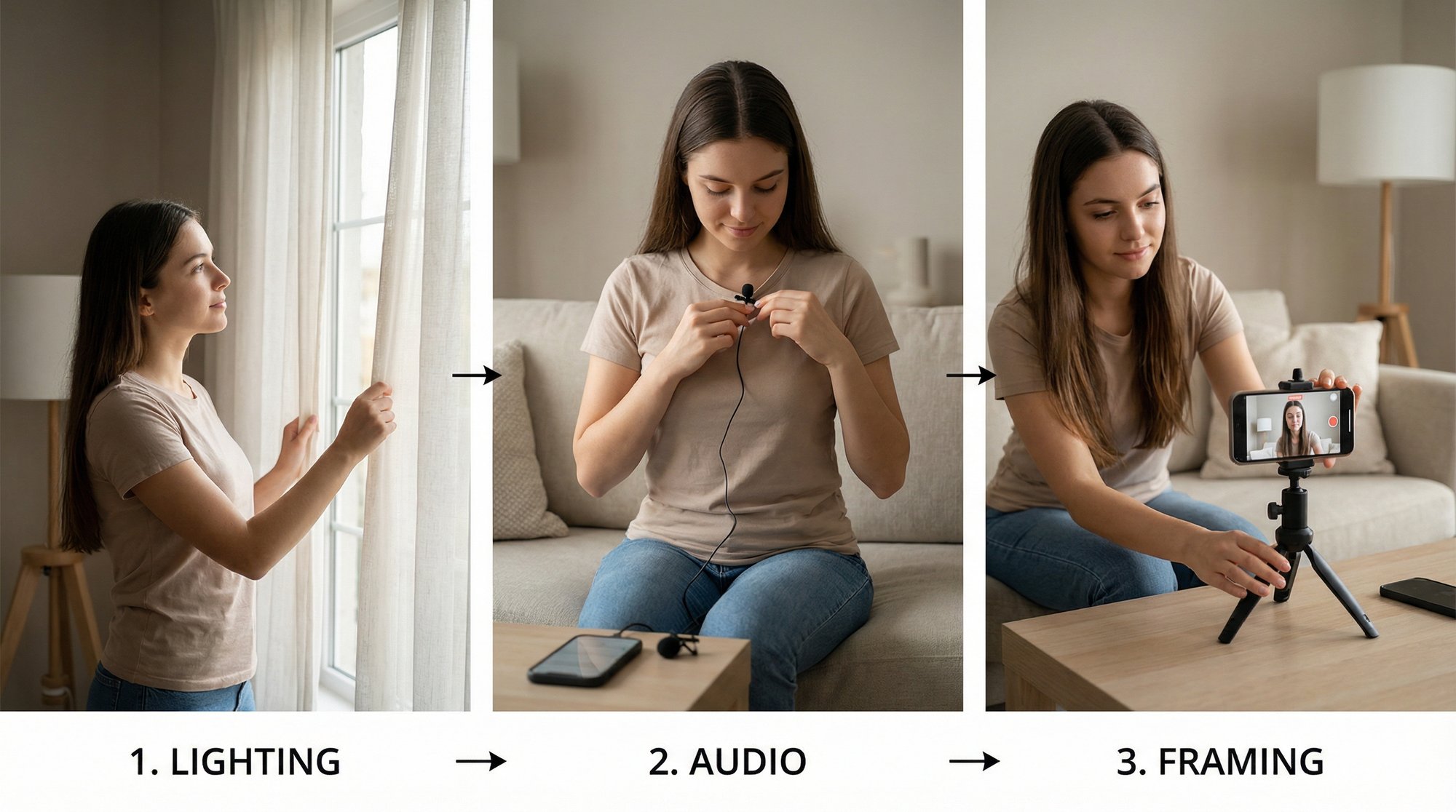
Creating professional-looking talking-head videos is surprisingly within reach. Before you even think about dropping cash on an expensive camera, I want you to focus on the two things that make a massive difference in how people perceive your content: sound and light.

Think about it—viewers might forgive a slightly grainy video, but they will bounce immediately if they can't hear you clearly. And good lighting? It can make your smartphone camera look ten times better than it has any right to.

Here's a breakdown of a simple, effective setup.

Equipment

Recommendation

Why It Matters

Microphone

A simple lavalier (lapel) mic that plugs right into your phone.

This is non-negotiable. It gets the mic close to your mouth, capturing crisp, clear audio and cutting out all the distracting echo and background noise your phone's built-in mic picks up.

Lighting

A ring light or a single key light placed in front of you.

Good lighting makes you pop. It separates you from the background, gets rid of unflattering shadows on your face, and gives your video a clean, polished look.

Tripod

A basic, stable tripod designed for your smartphone.

A steady shot is a professional shot. A tripod frees up your hands so you can gesture and be more expressive without giving your audience motion sickness.

That’s it. This simple setup is all you need to create videos that look and sound fantastic, putting you leagues ahead of most creators right out of the gate.

The Magic of Batching Your Content

If you take only one thing away from this guide, let it be this: content batching. This is the single biggest unlock for your entire workflow. Instead of the daily grind of brainstorming, recording, editing, and posting, you dedicate one focused block of time to record all your raw footage for the month.

I like to think of it as meal prepping for my personal brand. You do all the "cooking" (the recording) in one go. For the rest of the month, you just grab a finished "meal" from the fridge and serve it up.

This approach is an absolute game-changer, especially if you're trying to figure out how to build personal brand authority while also, you know, running a business. It cleanly separates the creative, on-camera energy from the more technical tasks of editing and scheduling.

Your Two-Hour Recording Session Blueprint

So, how do you turn a single two-hour window into 20-30 raw video clips? It’s simpler than you think. This is enough content to keep you posting consistently for an entire month.

Here’s the breakdown:

  • Prep Work (Before You Hit Record): Take about 30 minutes before your session to turn your ideas into simple bullet points. Don’t write out a full script—that often sounds robotic. Just jot down the main talking points for each video. This keeps you on track but lets your delivery feel natural and conversational.

  • The Recording Block (The Main Event): Set up your gear, hit record, and just start flowing. Deliver one idea, take a beat, and then move on to the next. Pro tip: change your shirt halfway through the session. This little trick gives you visual variety, making it look like you filmed on different days.

  • File Organization (The Final Step): This part is crucial, so don't skip it. As soon as you're done, transfer all your video files into a cloud folder on Google Drive or Dropbox. Name the folder something obvious like "July 2024 Raw Videos." This keeps everything tidy and makes the handoff to an editor (or your future self) a breeze.

This system eliminates the daily "what do I post today?" panic and ensures you always have a backlog of great content ready to go. For more hands-on advice, check out our guide on how to create engaging Instagram Reels. Once you master this workflow, you can put all your energy where it belongs: delivering your message with clarity and impact.

Your Secret Weapon: The Editing & Repurposing Workflow

Alright, you’ve done the hard part. You've batched your content, and now you have a folder full of raw video clips just waiting to be turned into gold. But this is the exact moment where the momentum stalls for so many entrepreneurs. It’s the editing.

This is the bottleneck. The friction point. The reason most personal brands die a quiet death in a Google Drive folder.

You're at a crossroads here. Do you add "part-time video editor" to your already overflowing job description, spending hours wrestling with timelines, captions, and b-roll? Or do you build a system that makes the friction disappear so you can get back to what you're actually good at?

The DIY Trap: Why Editing It Yourself Costs More Than You Think

I get the temptation to just edit the videos yourself. It feels scrappy, smart, and saves a few bucks. But what’s the hidden cost?

Every hour you spend hunting for the right stock clip or getting caption timing just right is an hour you’re not on a sales call, improving your product, or talking to your customers. It’s a classic case of founder-led busywork that feels productive but ultimately grinds your progress to a halt.

Consistency is everything in content, and nothing kills consistency faster than a process you dread. A smooth editing and repurposing workflow isn't some nice-to-have luxury; it's the engine that guarantees your ideas actually see the light of day.

This is precisely why services like Unfloppable exist. Think of it as a "smart editor" that takes your raw footage and turns it into polished, post-ready videos—all without you ever opening an editing app.

A smartphone on a tripod records a person, next to a microphone, lamp, and plant on a wooden desk with text 'BATCH & RECORD'.

The entire workflow is built to be almost invisible. You just upload your raw thoughts, and a few days later, a sharp, engaging video comes back, ready to go live.

This isn't just a convenience; it's becoming a necessity. The personal branding services market is set to explode to USD 1,156 million by 2034, growing at a 9.0% CAGR. Founders simply need scalable content solutions to keep up. Having a system to turn raw footage into finished videos is how you effectively reach the 72% of U.S. adults on social media without burning out.

Finding an Editing Partner, Not Just a Service

Don't think of this as just outsourcing a task. See it as bringing on an intelligent partner. A service like Unfloppable doesn't just snip your "ums" and "ahs"; it actively enhances your message. It automatically finds relevant b-roll, adds dynamic text overlays to punch up your points, and can even search your own media library for clips that perfectly illustrate what you're saying.

This is how you get a video that feels dynamic and holds attention—which is the only thing that matters on platforms like Instagram and TikTok.

Let me paint a picture for you:

  • You record a 60-second clip ranting about a terrible customer service experience you had.

  • The service automatically finds b-roll of a frustrated person on a phone.

  • It adds text overlays that pop up to highlight your main takeaway.

  • It even pulls in a screenshot from your own product to show how you solve that exact problem.

What you get back is a compelling, story-driven video that feels authentic and human.

This is absolutely critical. A human-centric approach builds infinitely more trust than the sterile, disconnected videos churned out by fully synthetic AI tools. Authenticity is your single greatest asset. Don't trade it for automation that pumps out soulless content.

This is the best way to avoid what many are starting to call "AI slop." Your goal is to connect with people, not just fill a content calendar.

Getting Your Most Valuable Asset Back

At the end of the day, this system is about one thing: reclaiming your time. The hours you save aren't just empty slots in your calendar; they are opportunities.

By removing the editing bottleneck, you create a sustainable, repeatable system for content creation. One that actually supports your business goals instead of draining your will to live. This is how you show up, build authority, and finally turn your personal brand into the asset it's supposed to be.

Getting Your Content Seen: A Smart Distribution and Growth Strategy

Look, creating great videos is only half the job. If you pour your heart into a piece of content and no one sees it, what's the point? The other half—the part that actually moves the needle—is getting your videos in front of the right eyeballs. A smart distribution strategy is what turns this from a creative hobby into a reliable growth machine for your brand.

It's not about frantically posting everywhere, all the time. That's a one-way ticket to burnout. It's about showing up consistently on the right platforms with content that feels native to each one. This is how you make sure your hard work actually pays off.

Design a Posting Schedule You Can Actually Stick To

Consistency is the currency of social media. It builds trust and trains the algorithm to favor you, but it shouldn't come at the cost of your sanity. A simple, repeatable schedule is your secret weapon. Instead of throwing spaghetti at the wall, map out a weekly plan based on where your ideal audience is already hanging out.

Here’s a sample schedule I've seen work wonders for founders and experts:

  • LinkedIn (3 times per week): This is your professional hub. Think sharp insights, career stories, and commentary on industry news. Videos here hit differently when you pair them with a thoughtful text post that adds context or poses a question to get the comments flowing.

  • Instagram Reels (4 times per week): Here’s where your professional side can loosen its tie a bit. Mix your expertise with more personality. Behind-the-scenes glimpses, quick-fire tips, and personal stories are gold on Reels.

  • TikTok (3-5 times per week): Don't overthink it. Jump on trends, share quick-hitting advice, and talk directly to the camera like you're on a FaceTime call. The platform rewards frequency and raw authenticity, so perfection is not the goal.

Treat this as a starting point, not a rigid rulebook. The whole idea is to find a rhythm you can maintain for months on end, not just for one heroic week.

Look Past Vanity Metrics to Measure What Really Matters

Sure, views and likes feel great. They give you a nice little dopamine hit. But they don't pay the bills. If you really want to know if your personal brand is building authority that impacts your business, you have to track the metrics that signal someone is genuinely interested.

Vanity metrics make you feel famous. Business metrics make you money. Focus on the actions that show someone is moving from a passive viewer to a potential customer.

Stop obsessing over the view count and start paying attention to these three signals:

  1. Profile Visits: This is huge. It means your video was so compelling that someone stopped scrolling and tapped your name to learn more about you. That's the first real step on their journey with your brand.

  2. Website Clicks (from your bio link): This is a direct line from your content to your business. It's one of the most powerful conversions you can track because it shows your videos are successfully driving traffic to your home base.

  3. Inbound DMs and Inquiries: When someone takes the time to slide into your DMs with a question or a comment about your content, you've officially made a real connection. These are the conversations that spark partnerships and sales.

Your Monthly Growth Check-In

To make sure your strategy is actually working, you need a simple feedback loop. Set aside just 30 minutes once a month to review your performance. No need for complex spreadsheets—just answer three straightforward questions.

Question to Ask

What It's Telling You

Your Next Move

Which content pillar got people talking the most?

This shows you exactly what topics are hitting a nerve with your audience right now.

Double down on that pillar next month. Come at it with fresh angles and different formats.

Which video format absolutely crushed it?

This reveals how your audience prefers to hear from you (e.g., stories, Q&As, trend reactions).

Make more of what's working. Prioritize creating videos in that winning format.

What content drove the most profile visits or DMs?

This pinpoints the videos that are best at turning casual viewers into warm leads.

Figure out why it worked so well and create more content designed to do the same thing.

This dead-simple review turns your data into clear, actionable next steps. It helps you constantly refine your approach, ensuring your personal brand not only grows its reach but brings in real, tangible results for your business.

Ready to turn your ideas into polished, high-performing videos without all the hassle? A service like Unfloppable can handle the heavy lifting for you.

Common Personal Branding Questions Answered

So, you're ready to jump into personal branding with video, but a few nagging questions are holding you back. This is completely normal. Honestly, it would be weird if you didn't have some hesitation. Let's tackle these common roadblocks head-on so you can start building with confidence.

One of the biggest myths I see is that you need a huge following right out of the gate. Forget about going viral. Your first goal isn't to hit a million views; it's to connect with the first 100 right people who will become your true fans. If you focus on creating genuinely useful content for that specific person, the audience will build itself.

Then there's that voice in your head asking, "What do I possibly have to say that's new?" Stop right there. Your brand isn't about inventing some groundbreaking theory. It’s about filtering existing ideas through your unique lens—your experiences, your personality, your wins, and especially your screw-ups. That’s what people connect with.

The most powerful personal brands aren't built on being the smartest person in the room. They're built on being the most generous with what they know, in a way that only they can.

And what about the time? The thought of creating content every single day is enough to make anyone want to quit before they start. That’s precisely why the batching system we talked about earlier is non-negotiable. It's the only sustainable way to figure out how to build personal brand authority while also, you know, running your actual business.

How Do I Handle Negative Comments?

It’s going to happen. The moment you start making any noise, someone will have something to say. The key is to have a simple game plan.

  • Trolls? Ignore and delete. Don't feed them.

  • Legitimate criticism? Engage thoughtfully. Thank them for the feedback.

  • A valid point? Use it. Let the feedback make your next video even better.

Honestly, getting a negative comment is often a sign that your content is finally breaking out of your initial echo chamber. It's a weird, backwards milestone.

What If I'm Not a Natural on Camera?

Join the club. Seriously, almost no one is. The secret isn't some hidden talent; it's just reps.

Your first 20 videos are practice. That's it. Don't even worry about them being good. Just get them done. Talk to the camera like you're explaining something to a friend over a beer. People connect with realness, not a flawless, robotic delivery. Authenticity wins every single time.

Ready to turn your raw ideas into polished, engaging videos without ever touching an editing app? Unfloppable acts as your smart editing partner, helping you build your personal brand one powerful video at a time. Try it for free at Unfloppable.com.

When it comes to building a personal brand, it’s about three things: defining your authentic message, creating valuable content that proves you know your stuff, and getting that content in front of the right people, consistently. For founders and leaders today, there is no faster way to connect, build trust, and stake your claim as an authority than with short-form video.

Why Your Personal Brand Is Your Greatest Asset

Let’s be honest. In a market flooded with noise, the most valuable thing you own isn't your product or your service—it's your reputation. Your personal brand is really just the story people tell about you when you're not around. The moment you start shaping that story intentionally, you turn your reputation into a powerful economic engine for your business.

This isn't about becoming a TikTok influencer or chasing viral fame. It’s a strategic play to position yourself as the undeniable expert in your corner of the world. Think of it as your direct line to customer trust, high-quality leads, and genuine market authority. When people trust you, they're much more likely to trust your company and buy what you’re selling. It’s that simple.

The Knowing-Doing Gap

Here’s the thing: everyone knows personal branding is important, but almost no one is actually doing it right. While 70% of professionals say a personal brand is vital for their career, a staggering 85% admit they don't have a defined strategy. This is a massive opportunity. We also know that businesses with consistent branding see revenue jump by over 20%. If you're curious, you can dig into the full personal branding statistics to see just how big that gap is.

This guide is your playbook to close that gap. We're going to focus on the most efficient and effective tool you have right now: simple, authentic talking-head videos. No fancy studios, no complicated production—just your expertise and a smartphone.

The entire process boils down to three core steps.

A flowchart outlining the personal branding process: message (idea), create (video), and distribute (paper plane).

This simple flow—Message, Create, Distribute—is the foundation for turning your knowledge into a magnet for opportunity.

Your Short-Form Video Branding Playbook at a Glance

To give you a clearer picture of what this system looks like in practice, here’s a quick summary of the core pillars we’re about to build.

Pillar

Core Focus

Key Outcome

Positioning & Message

Defining your unique expertise and the specific audience you serve.

A crystal-clear brand identity that attracts your ideal customer.

Content Pillars & Formats

Creating a repeatable content plan based on your core areas of knowledge.

An endless well of video ideas, ending the "what do I post?" problem for good.

Recording & Batching

Efficiently recording weeks of content in a single focused session.

A consistent supply of raw video footage without the daily grind.

Editing & Repurposing

Turning raw footage into polished, multi-platform assets (with Unfloppable).

Professional, on-brand videos ready for every platform, done effortlessly.

Distribution & Growth

Systematically sharing content and measuring its impact on business goals.

Measurable brand growth, increased reach, and tangible business results.

This table isn't just a list of steps; it's a complete system designed to work together, turning your ideas into influence.

What This Guide Will Cover

We're about to walk through a clear, actionable framework designed to take you from a fuzzy idea to a consistent content machine. Forget the overwhelm. This is your step-by-step system.

Here's a quick look at where we're headed:

  • Pinpoint Your Message: We’ll nail down exactly what you want to be known for and who you need to reach.

  • Develop Content Pillars: You'll build a simple content strategy that means you never have to wonder what to talk about.

  • Record with Ease: Discover a batching workflow to shoot a month of content in just a couple of hours.

  • Streamline Your Editing: We'll show you how to get polished, ready-to-post videos without ever touching a complex editing app.

  • Distribute Like a Pro: Learn how to get your content seen by the right people and measure what actually moves the needle for your business.

This is your complete playbook for building a personal brand that drives real results, one short video at a time.

Pinpointing Your Authentic Message and Position

Smiling businessman at a desk with a laptop and smartphone, speech bubble says 'YOUR GREATEST ASSET'.

Before you even think about hitting record, we need to lay the groundwork. Let's be clear: a powerful personal brand isn't about inventing some slick online persona. It's about figuring out who you genuinely are and amplifying that to attract the right people and opportunities.

This is the strategic heavy lifting. It’s what makes your content feel cohesive and intentional, not like you're just throwing spaghetti at the wall. The goal here is to shift from being a generalist—just another voice in the crowd—to a recognized specialist. You can't be known for everything, so getting crystal clear is your biggest advantage.

Uncover Your Unique Value Proposition

So, what’s your angle? Your unique value proposition (UVP) is the sweet spot where your expertise, your passion, and an audience's desperate need all collide. It’s the answer to the question, "Why should I listen to you out of the thousands of other creators?"

To nail this down, think about three things:

  • Your Expertise: What have you actually done? I’m talking about the skills you've spent years honing, the projects you’ve led, the wins you've secured, and even the failures you've learned from. What problems can you solve better than almost anyone?

  • Your Perspective: This is your secret sauce. What unique experiences or stories do you bring to the table? Maybe you're a bootstrapped founder who knows how to make every penny count, or a marketer who broke into the industry from a completely different field. This is where your personality lives.

  • Your Passion: What gets you fired up? You can't fake enthusiasm for long. Your content has to be fueled by something you genuinely care about. What topic could you talk about for hours on end without getting bored?

Your UVP emerges where these three areas overlap. For instance, instead of being "a marketing guy," your UVP could be "practical, no-BS marketing tactics for early-stage SaaS founders who don't have a seven-figure budget." See the difference? It's specific, targeted, and screams value.

A strong personal brand doesn’t try to be everything to everyone. It aims to be everything to someone. Your unique value proposition is the filter that attracts your people and repels everyone else.

This laser focus is non-negotiable for anyone serious about figuring out how to build a personal brand that cuts through the noise.

Identify Your Ideal Audience with Precision

Once you know what you're bringing to the conversation, you need to know exactly who you're talking to. "Entrepreneurs" is not an audience. "Marketers" is way too broad. You need to get uncomfortably specific and picture a single person you're trying to help.

Get into their head. Ask yourself:

  • What’s their actual job title? What kind of company do they work for?

  • What are the day-to-day frustrations that keep them up at night?

  • What's the career goal they're secretly chasing?

  • Where do they hang out online? What podcasts or newsletters are they into?

  • What kind of slang or inside jokes would make them feel like you get them?

This isn't a fluffy marketing exercise; it's about building empathy. When you deeply understand someone's problems and goals, you can create content that feels like you're reading their mind. Every video should feel like a one-on-one conversation with this person.

Develop Your Core Message and Voice

Okay, let's pull this all together into a simple messaging framework. This is your brand's North Star, ensuring every piece of content you create feels consistent. Your voice is the personality you inject—are you witty and direct? Or more of a thoughtful, nurturing guide? It has to be an authentic extension of who you are.

Here’s a simple way to map it out:

Element

Description

Example for a B2B SaaS Founder

Core Message

The single big idea you want to own in people's minds.

"Building a startup isn't about genius ideas; it's about relentless execution."

Brand Voice

The personality and flavor of your communication.

Direct, candid, maybe a little contrarian.

Key Talking Points

A few recurring themes that reinforce your core message.

Founder mental health, scrappy sales tactics, painful hiring lessons.

Words to Avoid

Jargon or phrases that just aren't you.

"Synergy," "paradigm shift," and other corporate buzzwords.

This simple framework becomes your compass. It keeps your videos focused and helps you build a memorable identity over time. By nailing this foundation first, you stop making random content and start strategically building a brand that connects, resonates, and actually moves the needle.

Nail Your Core Content Pillars and Formats

Now that you’ve got your message locked in, it's time to build the engine that will actually pump out your content. Relying on random sparks of inspiration is a surefire path to burnout. What you need is a system—a structure that guarantees you'll never run out of ideas and ensures every video hammers home your authority.

This is where content pillars come in.

Think of your pillars as the three to five core topics you want to completely own. These are the major themes you’ll return to again and again, each time with a slightly different take. Your pillars should live right at the intersection of what you know best and what your audience desperately needs to solve. It’s that sweet spot that makes your content feel both authentic and incredibly valuable.

Choosing Your Core Content Pillars

The real magic here is in the focus. Instead of trying to be everything to everyone, you’re carving out your specific lanes. This clarity is what makes you memorable, especially when someone is trying to figure out how to build personal brand authority in a crowded space.

So, how do you find your pillars? Start by riffing on topics that meet these three tests:

  • You could talk about it for hours. These are the subjects you're genuinely obsessed with. If you could give a 30-minute talk on it with zero prep, it’s a contender.

  • It solves a real problem for your audience. Your pillars have to hit on the pain points, questions, and goals of the people you want to attract. What keeps them up at night?

  • It naturally points back to what you do. Your content should subtly guide people toward your work. A great pillar creates organic opportunities to show, not just tell, the value you or your business provides.

Let’s say you’re the founder of a project management SaaS. Your pillars might look like this:

  • Bootstrapped Founder Lessons: Raw stories about failures, wins, and the gritty reality of building a company without a dime of VC money.

  • Productivity for Scrappy Teams: Practical, no-fluff advice on how small teams can get more done with less.

  • The Future of Remote Work: Sharp commentary on industry trends and your unique perspective on what it really takes to manage a distributed team.

See how they’re distinct but connected? Together, they build a cohesive story around your brand.

Your content pillars aren’t just topics; they're promises. They signal exactly what people can expect from you, building the kind of trust and anticipation that turns casual viewers into loyal fans.

This whole framework turns content creation from a daily headache into a simple, repeatable process. You’re no longer staring at a blank screen wondering what to say. You just pick a pillar, pick an angle, and go.

Bringing Your Pillars to Life with Video Formats

Once your pillars are set, you need a few go-to formats to deliver your message. Just listing off tips day after day gets old, fast. The trick is to mix up your delivery to keep things fresh and show off different sides of your expertise and personality.

And forget about being a polished TV host. Real authenticity on short-form video comes from those candid, seemingly unscripted moments.

Here are a few powerhouse formats that are perfect for building a personal brand.

The Storytelling Format

Humans are wired for stories, not spreadsheets. One of the best ways to forge a real connection is by sharing personal anecdotes about your struggles, breakthroughs, and the lessons you learned the hard way.

  • For example: A marketing consultant could share a 60-second video detailing their single biggest client screw-up and the painful lesson that changed their entire approach. That’s infinitely more powerful than just saying, "It's important to listen to your clients."

The Reaction and Commentary Format

This is how you position yourself as the go-to expert in your niche. React to industry news, a hot-take article, or even a controversial video from another creator. It’s a chance to show off your critical thinking and unique perspective in real-time.

  • For example: Use the "green screen" effect to pop up a headline about a new AI tool. Then, give your immediate, unfiltered take on whether it's a game-changer or just overhyped junk.

The Q&A and Myth-Busting Format

Jump directly into the conversations your audience is already having. Use the "comment reply" feature on TikTok or Instagram to answer a specific question, or make a whole video debunking a common myth in your field. This shows you’re listening and makes your followers feel heard.

  • For example: A financial advisor sees a comment asking, "Is it too late to start investing in my 40s?" They can create a direct, empathetic video response that completely demolishes the myth that you have to start in your 20s.

When you start combining your 3-5 content pillars with a rotation of these killer formats, you’ve basically built a content machine. It gives you a nearly endless supply of video ideas. You’re not just sharing information anymore—you’re building a dynamic, multi-dimensional personal brand that people actually want to follow.

Nail Your Recording Workflow (Without the Drama)

The real secret to building a powerful personal brand isn’t about hustling 24/7 or finding more hours in the day. It's about building a smarter, simpler system that works for you. Consistency is what separates the brands that grow from those that fade, and this is your playbook for pumping out a ton of high-quality video content without the usual stress.

Seriously, forget the idea that you need a professional film crew or a studio that costs a fortune.

You can get stunning results with gear you probably already have, or can get your hands on easily. The goal here is a simple, repeatable process that lets you focus on what you do best—sharing your expertise—instead of getting bogged down in production logistics.

Note cards on a desk illustrating core content pillars: Idea, Story, Tip.

Your Essential Smartphone Video Toolkit

Creating professional-looking talking-head videos is surprisingly within reach. Before you even think about dropping cash on an expensive camera, I want you to focus on the two things that make a massive difference in how people perceive your content: sound and light.

Think about it—viewers might forgive a slightly grainy video, but they will bounce immediately if they can't hear you clearly. And good lighting? It can make your smartphone camera look ten times better than it has any right to.

Here's a breakdown of a simple, effective setup.

Equipment

Recommendation

Why It Matters

Microphone

A simple lavalier (lapel) mic that plugs right into your phone.

This is non-negotiable. It gets the mic close to your mouth, capturing crisp, clear audio and cutting out all the distracting echo and background noise your phone's built-in mic picks up.

Lighting

A ring light or a single key light placed in front of you.

Good lighting makes you pop. It separates you from the background, gets rid of unflattering shadows on your face, and gives your video a clean, polished look.

Tripod

A basic, stable tripod designed for your smartphone.

A steady shot is a professional shot. A tripod frees up your hands so you can gesture and be more expressive without giving your audience motion sickness.

That’s it. This simple setup is all you need to create videos that look and sound fantastic, putting you leagues ahead of most creators right out of the gate.

The Magic of Batching Your Content

If you take only one thing away from this guide, let it be this: content batching. This is the single biggest unlock for your entire workflow. Instead of the daily grind of brainstorming, recording, editing, and posting, you dedicate one focused block of time to record all your raw footage for the month.

I like to think of it as meal prepping for my personal brand. You do all the "cooking" (the recording) in one go. For the rest of the month, you just grab a finished "meal" from the fridge and serve it up.

This approach is an absolute game-changer, especially if you're trying to figure out how to build personal brand authority while also, you know, running a business. It cleanly separates the creative, on-camera energy from the more technical tasks of editing and scheduling.

Your Two-Hour Recording Session Blueprint

So, how do you turn a single two-hour window into 20-30 raw video clips? It’s simpler than you think. This is enough content to keep you posting consistently for an entire month.

Here’s the breakdown:

  • Prep Work (Before You Hit Record): Take about 30 minutes before your session to turn your ideas into simple bullet points. Don’t write out a full script—that often sounds robotic. Just jot down the main talking points for each video. This keeps you on track but lets your delivery feel natural and conversational.

  • The Recording Block (The Main Event): Set up your gear, hit record, and just start flowing. Deliver one idea, take a beat, and then move on to the next. Pro tip: change your shirt halfway through the session. This little trick gives you visual variety, making it look like you filmed on different days.

  • File Organization (The Final Step): This part is crucial, so don't skip it. As soon as you're done, transfer all your video files into a cloud folder on Google Drive or Dropbox. Name the folder something obvious like "July 2024 Raw Videos." This keeps everything tidy and makes the handoff to an editor (or your future self) a breeze.

This system eliminates the daily "what do I post today?" panic and ensures you always have a backlog of great content ready to go. For more hands-on advice, check out our guide on how to create engaging Instagram Reels. Once you master this workflow, you can put all your energy where it belongs: delivering your message with clarity and impact.

Your Secret Weapon: The Editing & Repurposing Workflow

Alright, you’ve done the hard part. You've batched your content, and now you have a folder full of raw video clips just waiting to be turned into gold. But this is the exact moment where the momentum stalls for so many entrepreneurs. It’s the editing.

This is the bottleneck. The friction point. The reason most personal brands die a quiet death in a Google Drive folder.

You're at a crossroads here. Do you add "part-time video editor" to your already overflowing job description, spending hours wrestling with timelines, captions, and b-roll? Or do you build a system that makes the friction disappear so you can get back to what you're actually good at?

The DIY Trap: Why Editing It Yourself Costs More Than You Think

I get the temptation to just edit the videos yourself. It feels scrappy, smart, and saves a few bucks. But what’s the hidden cost?

Every hour you spend hunting for the right stock clip or getting caption timing just right is an hour you’re not on a sales call, improving your product, or talking to your customers. It’s a classic case of founder-led busywork that feels productive but ultimately grinds your progress to a halt.

Consistency is everything in content, and nothing kills consistency faster than a process you dread. A smooth editing and repurposing workflow isn't some nice-to-have luxury; it's the engine that guarantees your ideas actually see the light of day.

This is precisely why services like Unfloppable exist. Think of it as a "smart editor" that takes your raw footage and turns it into polished, post-ready videos—all without you ever opening an editing app.

A smartphone on a tripod records a person, next to a microphone, lamp, and plant on a wooden desk with text 'BATCH & RECORD'.

The entire workflow is built to be almost invisible. You just upload your raw thoughts, and a few days later, a sharp, engaging video comes back, ready to go live.

This isn't just a convenience; it's becoming a necessity. The personal branding services market is set to explode to USD 1,156 million by 2034, growing at a 9.0% CAGR. Founders simply need scalable content solutions to keep up. Having a system to turn raw footage into finished videos is how you effectively reach the 72% of U.S. adults on social media without burning out.

Finding an Editing Partner, Not Just a Service

Don't think of this as just outsourcing a task. See it as bringing on an intelligent partner. A service like Unfloppable doesn't just snip your "ums" and "ahs"; it actively enhances your message. It automatically finds relevant b-roll, adds dynamic text overlays to punch up your points, and can even search your own media library for clips that perfectly illustrate what you're saying.

This is how you get a video that feels dynamic and holds attention—which is the only thing that matters on platforms like Instagram and TikTok.

Let me paint a picture for you:

  • You record a 60-second clip ranting about a terrible customer service experience you had.

  • The service automatically finds b-roll of a frustrated person on a phone.

  • It adds text overlays that pop up to highlight your main takeaway.

  • It even pulls in a screenshot from your own product to show how you solve that exact problem.

What you get back is a compelling, story-driven video that feels authentic and human.

This is absolutely critical. A human-centric approach builds infinitely more trust than the sterile, disconnected videos churned out by fully synthetic AI tools. Authenticity is your single greatest asset. Don't trade it for automation that pumps out soulless content.

This is the best way to avoid what many are starting to call "AI slop." Your goal is to connect with people, not just fill a content calendar.

Getting Your Most Valuable Asset Back

At the end of the day, this system is about one thing: reclaiming your time. The hours you save aren't just empty slots in your calendar; they are opportunities.

By removing the editing bottleneck, you create a sustainable, repeatable system for content creation. One that actually supports your business goals instead of draining your will to live. This is how you show up, build authority, and finally turn your personal brand into the asset it's supposed to be.

Getting Your Content Seen: A Smart Distribution and Growth Strategy

Look, creating great videos is only half the job. If you pour your heart into a piece of content and no one sees it, what's the point? The other half—the part that actually moves the needle—is getting your videos in front of the right eyeballs. A smart distribution strategy is what turns this from a creative hobby into a reliable growth machine for your brand.

It's not about frantically posting everywhere, all the time. That's a one-way ticket to burnout. It's about showing up consistently on the right platforms with content that feels native to each one. This is how you make sure your hard work actually pays off.

Design a Posting Schedule You Can Actually Stick To

Consistency is the currency of social media. It builds trust and trains the algorithm to favor you, but it shouldn't come at the cost of your sanity. A simple, repeatable schedule is your secret weapon. Instead of throwing spaghetti at the wall, map out a weekly plan based on where your ideal audience is already hanging out.

Here’s a sample schedule I've seen work wonders for founders and experts:

  • LinkedIn (3 times per week): This is your professional hub. Think sharp insights, career stories, and commentary on industry news. Videos here hit differently when you pair them with a thoughtful text post that adds context or poses a question to get the comments flowing.

  • Instagram Reels (4 times per week): Here’s where your professional side can loosen its tie a bit. Mix your expertise with more personality. Behind-the-scenes glimpses, quick-fire tips, and personal stories are gold on Reels.

  • TikTok (3-5 times per week): Don't overthink it. Jump on trends, share quick-hitting advice, and talk directly to the camera like you're on a FaceTime call. The platform rewards frequency and raw authenticity, so perfection is not the goal.

Treat this as a starting point, not a rigid rulebook. The whole idea is to find a rhythm you can maintain for months on end, not just for one heroic week.

Look Past Vanity Metrics to Measure What Really Matters

Sure, views and likes feel great. They give you a nice little dopamine hit. But they don't pay the bills. If you really want to know if your personal brand is building authority that impacts your business, you have to track the metrics that signal someone is genuinely interested.

Vanity metrics make you feel famous. Business metrics make you money. Focus on the actions that show someone is moving from a passive viewer to a potential customer.

Stop obsessing over the view count and start paying attention to these three signals:

  1. Profile Visits: This is huge. It means your video was so compelling that someone stopped scrolling and tapped your name to learn more about you. That's the first real step on their journey with your brand.

  2. Website Clicks (from your bio link): This is a direct line from your content to your business. It's one of the most powerful conversions you can track because it shows your videos are successfully driving traffic to your home base.

  3. Inbound DMs and Inquiries: When someone takes the time to slide into your DMs with a question or a comment about your content, you've officially made a real connection. These are the conversations that spark partnerships and sales.

Your Monthly Growth Check-In

To make sure your strategy is actually working, you need a simple feedback loop. Set aside just 30 minutes once a month to review your performance. No need for complex spreadsheets—just answer three straightforward questions.

Question to Ask

What It's Telling You

Your Next Move

Which content pillar got people talking the most?

This shows you exactly what topics are hitting a nerve with your audience right now.

Double down on that pillar next month. Come at it with fresh angles and different formats.

Which video format absolutely crushed it?

This reveals how your audience prefers to hear from you (e.g., stories, Q&As, trend reactions).

Make more of what's working. Prioritize creating videos in that winning format.

What content drove the most profile visits or DMs?

This pinpoints the videos that are best at turning casual viewers into warm leads.

Figure out why it worked so well and create more content designed to do the same thing.

This dead-simple review turns your data into clear, actionable next steps. It helps you constantly refine your approach, ensuring your personal brand not only grows its reach but brings in real, tangible results for your business.

Ready to turn your ideas into polished, high-performing videos without all the hassle? A service like Unfloppable can handle the heavy lifting for you.

Common Personal Branding Questions Answered

So, you're ready to jump into personal branding with video, but a few nagging questions are holding you back. This is completely normal. Honestly, it would be weird if you didn't have some hesitation. Let's tackle these common roadblocks head-on so you can start building with confidence.

One of the biggest myths I see is that you need a huge following right out of the gate. Forget about going viral. Your first goal isn't to hit a million views; it's to connect with the first 100 right people who will become your true fans. If you focus on creating genuinely useful content for that specific person, the audience will build itself.

Then there's that voice in your head asking, "What do I possibly have to say that's new?" Stop right there. Your brand isn't about inventing some groundbreaking theory. It’s about filtering existing ideas through your unique lens—your experiences, your personality, your wins, and especially your screw-ups. That’s what people connect with.

The most powerful personal brands aren't built on being the smartest person in the room. They're built on being the most generous with what they know, in a way that only they can.

And what about the time? The thought of creating content every single day is enough to make anyone want to quit before they start. That’s precisely why the batching system we talked about earlier is non-negotiable. It's the only sustainable way to figure out how to build personal brand authority while also, you know, running your actual business.

How Do I Handle Negative Comments?

It’s going to happen. The moment you start making any noise, someone will have something to say. The key is to have a simple game plan.

  • Trolls? Ignore and delete. Don't feed them.

  • Legitimate criticism? Engage thoughtfully. Thank them for the feedback.

  • A valid point? Use it. Let the feedback make your next video even better.

Honestly, getting a negative comment is often a sign that your content is finally breaking out of your initial echo chamber. It's a weird, backwards milestone.

What If I'm Not a Natural on Camera?

Join the club. Seriously, almost no one is. The secret isn't some hidden talent; it's just reps.

Your first 20 videos are practice. That's it. Don't even worry about them being good. Just get them done. Talk to the camera like you're explaining something to a friend over a beer. People connect with realness, not a flawless, robotic delivery. Authenticity wins every single time.

Ready to turn your raw ideas into polished, engaging videos without ever touching an editing app? Unfloppable acts as your smart editing partner, helping you build your personal brand one powerful video at a time. Try it for free at Unfloppable.com.