How to Become a Thought Leader Using Short-Form Video

Learn how to become a thought leader using short-form video with a clear niche, content pillars, batching workflow, publishing cadence, and growth metrics.

Apr 13, 2026

You’re probably doing the hard part already.

You’re on customer calls. You’re in product reviews. You’re making judgment calls your team can’t make without you. Then you open LinkedIn or Instagram and see someone with thinner experience getting more attention because they package their thinking better than you do.

That gap frustrates founders because it feels unfair. You know more than the people dominating the feed, but your ideas live in Slack threads, investor updates, and one-off sales calls. They never compound in public.

That’s the opportunity behind learning how to become a thought leader. It’s not vanity. It’s distribution for your expertise.

Short-form video is the fastest route for most founders. You can explain a sharp idea in under a minute, react to industry noise while it’s still fresh, and show how you think without spending half a day writing. Video also forces clarity. If you can’t say it clearly on camera, the idea probably isn’t ready yet.

This also matters more than most founders admit. Thought leadership is built slowly, post by post, comment by comment, not in one breakout moment. And it doesn’t require celebrity status. 77% of professionals agree that being a thought leader does not require a large social media following, while people with 5,000 to 10,000 connections often outperform those with 10,000+ followers in engagement rates, according to ThoughtLDR’s thought leadership research. The audience is there too. 54% of decision-makers spend at least one hour weekly on thought leadership content, while 24% of senior leaders consume it daily and 31% weekly in that same source.

You don’t need to become an influencer. You need to become easy to remember.

Introduction to Video-Based Thought Leadership

It’s Tuesday night. You just finished a customer call where you explained your market better than any competitor could. By Friday, that insight is gone from public view because it stayed trapped in Zoom, Slack, and your own head.

That is why founder thought leadership breaks down. The problem usually isn’t expertise. It’s production.

Short-form video solves that faster than blog posts, polished keynote clips, or occasional LinkedIn essays. You can capture a sharp idea while it’s still fresh, publish it in under a minute, and build a visible record of how you think. Done right, video turns passing insight into assets that compound.

It also fits the constraints founders deal with. You are not going to write a strong article three times a week between hiring, sales, and product reviews. You can, however, batch a set of short videos in one session, send them through a clean editing workflow, and keep publishing without turning content into a second job. That is the gap most thought leadership advice ignores. Strategy means very little if the format is too slow to sustain.

Why founders should lead with video

Video carries judgment better than text. People can hear whether your point is precise, forced, rehearsed, or earned. They can see whether you understand the trade-offs behind your advice or you’re just repeating category clichés.

That makes short-form video the strongest starting format for founders who want to create a personal brand around expertise instead of personality alone.

It also gives you more shots on goal. One recording block can produce a week or two of content if you run it through a disciplined workflow. Record several tight takes around one theme, cut them into platform-native clips, add captions, and schedule distribution. Unfloppable’s batching and editing process is useful here because it removes the bottleneck that kills consistency. Your job is to show up with clear ideas. The system handles the conversion from raw footage to publishable assets.

You build thought leadership by making strong ideas easy to publish, easy to repeat, and easy to remember.

What usually goes wrong

A typical founder mistake is assuming good ideas will spread on their own.

They won’t.

If your best thinking only appears in live calls, private memos, and occasional text posts, the market has nothing consistent to attach to your name. Meanwhile, another founder with weaker insight but a tighter publishing habit becomes the familiar voice in the category.

The fix starts with restraint. Pick a narrow topic people can remember you for, not a broad field that makes you sound interchangeable. If you need help tightening that focus, start with a clear niching strategy for subject-matter experts. Then build around a workflow you can repeat every week: batch ideas, record in clusters, edit quickly, and publish on a schedule you can maintain.

Authority comes from repetition with substance. Short-form video gives you the fastest route there if you treat production as part of strategy, not an afterthought.

Finding Your Niche and Voice

Broad expertise is impressive in a board meeting. It’s useless in public content.

If you want people to remember you, they need to associate your name with a specific problem, audience, or angle. “Startup growth” is too broad. “Pricing strategy for vertical SaaS” is usable. “Operational discipline for bootstrapped DTC brands” is usable. “What AI changes in B2B onboarding” is usable.

A person in a green hoodie sitting at a desk and reviewing a mind map on a tablet.

Narrow beats impressive

Founders resist narrowing because they think it limits opportunity. Usually it does the opposite.

A narrow niche makes your content easier to trust. It gives your audience a reason to follow you. It also gives you a filter for what not to post, which is just as important.

Start with these three questions:

  1. What problem do people already ask you about?

  2. What do you believe that others in your category get wrong?**

  3. Which topic connects tightly to your business without turning every post into a pitch?

If you can’t answer all three, don’t record yet. Think harder.

Build a point of view, not a bio

Your title doesn’t make your content valuable. Your interpretation does.

A founder’s strongest voice usually sits inside one of these lanes:

  • Operator voice. You explain what works because you’ve run it.

  • Contrarian voice. You push against lazy industry consensus.

  • Translator voice. You make technical or strategic shifts understandable.

  • Pattern-spotter voice. You connect repeated signals others miss.

You don’t need to pick one forever. But you do need a default voice. Otherwise every video sounds like it came from a different person.

Here’s the mistake I see often. A founder says, “I help companies grow with marketing, sales, product, hiring, and AI.” That’s not a niche. That’s a résumé in sentence form.

A better version sounds like this:

Weak positioning

Strong positioning

I talk about startup growth

I explain why early-stage SaaS teams stall after initial traction

I post about branding

I break down how founders can make expert content feel human on camera

I share leadership lessons

I show first-time CEOs how to communicate decisions with more precision

Use a simple niche test

Before you commit, test your niche against four criteria.

  • Specific enough to own. Could someone summarize your territory in one sentence?

  • Deep enough to sustain. Can you talk about it from multiple angles for months?

  • Useful to buyers. Does it connect to a pain your market already has?

  • Distinct from your peers. Would your content sound different from five other founders in your space?

If your niche fails one of those, tighten it.

For founders still sorting this out, this guide on how to create a personal brand is useful because it pushes you to define what people should remember you for, not just what you do.

Find your usable voice on camera

You do not need a polished presenter voice. You need a recognizable one.

The easiest way to get there is to stop trying to sound “content-ready.” Speak the way you speak in a good customer call. Sharp. Direct. Slightly opinionated. No lecture tone.

A practical exercise:

  • Record three short takes on the same topic.

  • In take one, explain it like you’re talking to a buyer.

  • In take two, explain it like you’re correcting bad advice.

  • In take three, explain it like you’re coaching your own team.

Then review which one feels most natural and most differentiated.

Practical rule: If your script sounds like a LinkedIn post read aloud, rewrite it. Spoken content needs shorter sentences, cleaner verbs, and a stronger opinion.

If you want a tighter framework for narrowing your market before you define your content angle, this explainer on niching definition is worth reading.

A usable niche statement

Don’t overcomplicate this. Write one sentence using this structure:

I help [specific audience] understand [specific problem] by sharing [specific type of insight].

Examples:

  • I help seed-stage SaaS founders understand why demos fail by sharing sales and messaging breakdowns.

  • I help e-commerce operators understand where retention comes from by sharing practical lifecycle analysis.

  • I help B2B service firms understand how expert-led video content builds trust without sounding staged.

That sentence becomes your filter. If a video doesn’t fit it, cut it.

Creating Content Pillars and Formats

Founders burn out when every new post starts from zero.

Content pillars solve that. They give you repeatable lanes to think inside, which means faster ideation, cleaner planning, and a feed that feels coherent instead of random.

A conceptual sculpture featuring three colorful spheres on branches next to the text Content Strategy.

Pick three to five pillars only

More than five and you’re diluting your authority. Fewer than three and your content gets repetitive.

For most founders, these pillar types work well:

Industry analysis

Use this pillar when news breaks, a competitor makes a move, or a platform shift changes behavior.

These videos tell people you’re paying attention in real time. They also let you show judgment, which is more memorable than generic education.

Example prompts:

  • What everyone is missing about this market change

  • Why this launch matters less than people think

  • The second-order effect nobody’s talking about

Tactical breakdowns

This is your bread and butter. Teach something practical from your own experience.

Keep these tight. One lesson per video. One mistake, one framework, or one decision criterion.

A founder talking about onboarding, for example, could break down:

  • the first thing to fix when activation stalls

  • why too many handoff steps kill momentum

  • what teams should standardize before hiring

Operator stories

Stories build credibility without sounding self-promotional if they focus on decisions, not chest-thumping.

Use moments like:

  • a bad hire you corrected

  • a pricing assumption that turned out wrong

  • a customer objection that changed your positioning

  • a process your team cut because it wasted time

People remember lessons wrapped in lived context.

Point-of-view clips

This pillar is where your brand sharpens.

These are your strongest opinion pieces. They should be concise, arguable, and grounded in experience. Not rage bait. Not vague “hot takes.” A useful stance.

If nobody could disagree with your opinion, it’s probably too soft to build authority.

Match the format to the job

A lot of founders pick one format and run it into the ground. Don’t do that. Different formats serve different functions.

Here’s a practical map:

Format

Best use

What it signals

Talking-head how-to

Teaching a concept clearly

Competence

Reaction video

Responding to timely industry shifts

Relevance

Story clip

Sharing a lesson from experience

Credibility

Myth-busting video

Challenging common advice

Conviction

FAQ answer

Addressing repeat audience questions

Trust

Your audience doesn’t need the same emotional input every time. Some videos should teach. Some should challenge. Some should make people feel you’ve lived through the problem they’re facing.

A good way to study spoken delivery and pacing is to review strong talking head video examples and pay attention to how quickly each clip gets to the point.

Build a weekly mix, not a random queue

Don’t ask, “What should I post today?”

Ask, “What combination of pillars gives my audience the clearest picture of how I think?”

A strong weekly mix might look like this:

  • One tactical breakdown to teach something concrete

  • One point-of-view clip to sharpen your positioning

  • One story or reaction to add relevance and personality

That’s enough variety without turning your content calendar into chaos.

A useful example of content planning in motion is below. Watch how the format shifts while the subject stays coherent.

A simple pillar worksheet

Write out your plan like this:

  • Pillar one. The core business problem I want to be known for.

  • Pillar two. The mistakes I see repeatedly in the market.

  • Pillar three. The behind-the-scenes operating lessons only I can tell.

  • Optional pillar four. Timely reactions to industry events.

  • Optional pillar five. Audience questions worth answering publicly.

Then under each pillar, list ten video ideas. If you can’t get to ten without straining, the pillar is probably too vague.

Optimizing Production Workflow

Good founders don’t lose thought leadership momentum because they lack ideas. They lose it because production gets bloated.

Recording feels manageable. Editing drags. Review loops expand. File names get messy. A simple content plan turns into a side job.

You need a lean workflow. Not a creative adventure.

A flowchart showing an optimized four-step video workflow process for planning, recording, editing, and exporting content.

Treat thought leadership like an operating system

The people who build real authority don’t rely on mood. They rely on process.

A rigorous progression matters here. Danchez’s framework on becoming a thought leader breaks that path into four stages: build a professional baseline, become an expert, become a contributor, then become an authority through consistent output. The same source says 80% to 90% of aspirants fail early, only 10% to 20% succeed long-term, and top thought leaders maintain 2 to 4 high-quality outputs monthly. It also notes that inconsistent production drops engagement by 70%.

That’s the operational truth. If your workflow is fragile, your authority will be too.

Plan in batches, not one clip at a time

Single-video production is inefficient. You spend too much time resetting your camera, your brain, and your energy.

Batch recording works better because your setup cost gets spread across multiple outputs.

Use this sequence:

  1. Group ideas by pillar
    Record related topics together. If you’re in “pricing mode,” record several pricing takes back-to-back.

  2. Write bullet scripts, not full scripts
    Full scripts make founders sound stiff. Bullet points keep delivery direct.

  3. Prepare examples before you hit record
    Don’t pause mid-take trying to remember the customer story or product moment you want to reference.

  4. Define the hook in advance
    The first line matters more than the fifth. Don’t improvise that part.

A clean pre-record checklist looks like this:

  • Topic name. Short internal title for the clip.

  • Audience. Who this is for.

  • Hook. The first sentence.

  • Core point. One idea only.

  • Support. Example, story, or contrast.

  • Close. Final takeaway or next question.

Record like an operator

The recording session should feel repetitive on purpose.

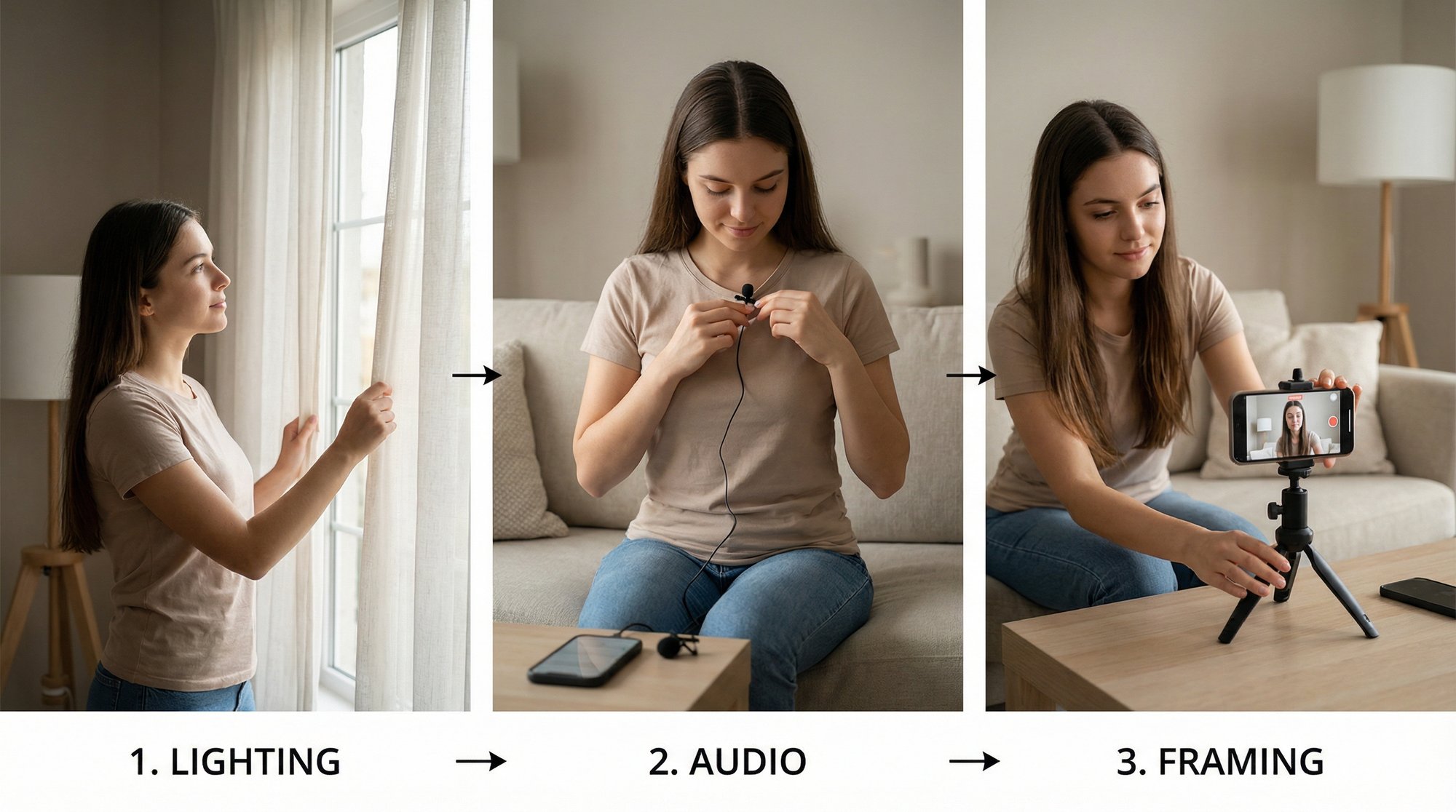
Keep the camera position fixed. Keep lighting fixed. Keep your framing fixed. Production consistency makes editing faster and your brand more recognizable.

Use one dedicated recording block each week or every two weeks. During that block:

  • Start with easy wins. Record the clearest topics first so your energy ramps up fast.

  • Do multiple takes only when needed. Chasing a perfect take wastes time.

  • Pause between ideas. Give yourself clean edit points.

  • Speak shorter than you think. Most founders over-explain on camera.

A great short-form video is usually the shortest version of an opinion that still feels complete.

Brief edits so they come back usable

Founders often create their own bottleneck by giving vague edit feedback.

“Make it pop” is useless. “Tighten the pauses, add captions, pull one supporting visual when I mention onboarding friction, and cut the final sentence” is usable.

Your edit brief should cover five things:

Editing input

What to specify

Trim style

Fast-paced, moderate, or conversational

Captions

Clean subtitles, emphasis words, or minimal text

Visual support

Screenshots, B-roll, charts, or none

Brand treatment

Font, color, framing style

Export intent

Reels, LinkedIn, TikTok, or multi-platform

If you’re reviewing your broader stack and trying to keep the workflow efficient, this roundup of best tools for content creators can help you simplify the surrounding pieces like planning, scheduling, and link management.

Cut review time aggressively

Founders waste hours nitpicking edits that don’t affect performance.

Review for these things only:

  • Clarity. Is the point obvious in the first few seconds?

  • Pacing. Does any line drag?

  • Accuracy. Are claims stated correctly?

  • Brand fit. Does the clip sound like you?

Ignore tiny imperfections that nobody else will notice.

A useful review method is two-pass feedback:

  • first pass for structural changes only

  • second pass for final polish only

Don’t mix the two. That’s how review loops multiply.

Build a repeatable content machine

Once your system is stable, your workflow should look like this:

  • One planning block

  • One recording block

  • One upload and edit brief handoff

  • One review block

  • One publishing queue

That’s it.

If you need inspiration beyond your own internal examples, look at your customer calls, sales objections, investor questions, hiring conversations, and product debates. Those are usually your best thought leadership topics because they come from real friction, not abstract brainstorming.

Publishing and Amplifying Videos

You record a strong batch on Monday, approve the edits on Wednesday, then let the files sit in a folder until next week. Or you panic-post five clips in three days with weak hooks and inconsistent framing. Founders usually fail in one of those two ways: they publish too rarely to stay familiar, or they publish so loosely that the feed starts to feel disposable.

Publishing is the point where your short-form video strategy either compounds or stalls. If video is your main thought leadership channel, distribution cannot be an afterthought tacked onto editing. It needs its own system, tied to the same batching workflow you use to record and hand off clips through Unfloppable.

A hand holding a smartphone showing various social media application icons, symbolizing digital marketing and online reach.

Use a controlled publishing cadence

A practical framework from B2 Communications on thought leadership strategy recommends publishing original content regularly at 1 to 2 pieces per week, with video as a strong format for engagement. For most founders, that is the right baseline.

It gives you enough frequency to stay present without turning every week into a production fire drill.

Use your batch that way on purpose:

  • record multiple clips in one session

  • choose the best 1 to 2 for that week

  • queue the rest as reserves, follow-ups, or platform variations

  • leave room for one reactive post if something timely happens

This is the trade-off. Fewer posts with stronger judgment beat daily posting with sloppy standards.

Adapt the packaging, not the idea

Do not invent a separate content strategy for every platform. That wastes time and usually weakens the original point.

One strong video can do several jobs:

  • a native short-form post on LinkedIn

  • a faster-cut Reel with tighter captions

  • a Story built around one takeaway

  • a text post that pulls out the clip’s sharpest argument

The idea stays intact. The wrapper changes based on viewer behavior.

Short-form video gives founders an edge here. One recorded answer from a batch can become your primary asset for the week, instead of forcing you to create from scratch for every channel.

Publish with a job in mind

Every clip needs a clear role in the lineup. If you cannot name the job, do not publish it.

Use four buckets:

  • Education for clarifying a problem buyers keep misunderstanding

  • Point of view for taking a clear stance in your category

  • Story for showing judgment through experience

  • Reaction for joining an active conversation while it still matters

A week of only educational clips makes you useful but forgettable. A week of only hot takes makes you memorable but hard to trust. Build a mix.

A simple rule helps here. Do not ask whether the clip is good in isolation. Ask whether it strengthens this week’s publishing mix.

Amplify like an operator

Posting is only the first move. The second move is getting the right people to see it without looking needy.

Use selective amplification:

  • tag people only when they are directly relevant to the argument

  • answer comments with a real extension of the idea

  • post into niche groups only when the clip clearly matches the discussion

  • turn strong comments and objections into follow-up videos from your next batch

This is another place where workflow matters. If you are already batching with Unfloppable, keep a running list of comments, objections, and questions during the week, then record responses in the next session. That turns audience feedback into your next set of short-form assets with almost no extra planning time.

Treat strong clips like reusable assets

Some videos earn more distribution. Give them more fuel.

When a clip drives saves, meaningful comments, direct messages, or profile visits, keep working the idea. Cut a tighter version with a stronger first line. Pull one quote into a text post. Expand the point in a webinar answer or podcast pitch. Reuse the same argument across formats until the market stops responding.

Your feed also functions as proof of speaking ability. B2 Communications on thought leadership strategy notes that only about 15% of B2B professionals secure 3+ speaking gigs per year initially, rising to 1 to 2 per quarter for leaders. Consistent publishing helps because event hosts, podcast producers, and partners can see how clearly you think on camera before they ever book you.

Building Credibility and Tracking Growth

You post short-form video for six weeks. Views look decent. Comments are positive. Then a serious prospect gets on a call and still asks, "Why should we trust you?"

That gap is the true test.

Credibility in video-based thought leadership comes from three things. The right person on camera, clear proof behind the point, and a publishing system that shows consistent judgment over time. If your short-form clips are smart but generic, polished but detached from real decisions, or delegated to someone without authority, you will get attention without trust.

Credibility comes from specific judgment

Short-form video works best when you stop trying to sound broadly useful and start sounding precise.

Your audience does not need another summary of industry basics. They need to see how you think under real constraints. Show the trade-off. Name the bad option. Explain why you chose one path over another. That is what makes a founder or operator credible on camera.

Use proof that fits a fast video format:

  • operator lessons from decisions you made

  • before-and-after examples from your process

  • product or workflow breakdowns

  • research you can cite accurately

  • sharp explanations of what you would not do, and why

If you do not have clean numbers, do not force fake precision. State the lesson plainly and anchor it to the situation.

Analysts at New York Times Licensing thought leadership statistics found that 72% of readers are more likely to act and research further when thought leadership matches their specific needs. The same source notes that CEOs and high-level managers create thought leadership content in over 50% of companies, while subject matter experts contribute in 49.4%, and that 48% of thought leadership content generates leads or sales, while 67% of readers discuss strong pieces with peers and colleagues. The takeaway is simple. Relevance and authority beat volume.

Put senior perspective on camera

A common credibility mistake is treating thought leadership as a junior marketing task.

Marketing should package the message. Leadership should own the point of view.

If you are the founder, you should be on camera regularly. If your strongest expert is a product lead, operator, strategist, or client-facing specialist, feature them too. Short-form video gives you a fast way to put real expertise in front of the market, but only if the person speaking has earned the right to make the claim.

This is also where workflow matters. If your team uses Unfloppable to batch recording and editing, do not waste that system on low-authority talking heads. Use those sessions to capture founder takes, expert reactions, decision breakdowns, and recurring objections from sales calls. That gives you credibility and production efficiency at the same time.

Build borrowed credibility outside your own feed

Owned channels prove consistency. Third-party environments prove your ideas hold up elsewhere.

Get your best people into places where someone else controls the room:

  • webinars

  • podcast interviews

  • expert roundtables

  • customer event panels

  • joint videos with credible peers

Then cut those appearances into short-form clips. A strong answer from a webinar often outperforms a scripted talking-head post because the context adds trust. The audience can see you responding in real time.

Credibility asset

Why it matters

Best reuse move

Webinar appearance

Shows live thinking and depth

Cut short clips from decisive answers

Podcast guest spot

Builds trust through conversation

Pull concise opinion clips

Expert collaboration

Adds adjacent audience trust

Publish split-screen clips or reaction follow-ups

Panel discussion

Signals industry recognition

Turn one sharp answer into a standalone post

Track signs of authority that affect pipeline

Do not judge thought leadership on views alone.

Track audience response, but tie it to business movement. A useful scorecard has two layers.

Audience signals

  • watch retention

  • saves

  • shares

  • substantive comments

  • profile visits after a post

Business signals

  • inbound messages that mention a topic or clip

  • demo requests after a publishing streak

  • podcast, webinar, or speaking invites

  • partnership conversations

  • sales calls where the prospect already agrees with your framing

Use simple attribution. Add tagged links where it makes sense. Log "how did you hear about us" answers in your CRM. Ask inbound leads which video, topic, or repeated point made them reach out.

If you want a cleaner operating model, build your tracking around the same production cadence you use for publishing. A scalable content creation workflow for short-form video teams works best when batching, editing, publishing, and measurement all run on one repeatable schedule.

What good measurement looks like

A founder with a working thought leadership system can answer a few blunt questions fast:

  • Which topics bring in buyers instead of peers?

  • Which clips start direct conversations?

  • Which speaker creates the strongest trust signal?

  • Which borrowed-credibility appearances are worth repeating?

  • Which ideas should stay short-form, and which deserve a webinar, sales deck, or larger asset?

That is the standard. Your videos should make the right people trust you faster, enter the pipeline warmer, and arrive with fewer basic objections. If that is not happening, the fix is usually not more posting. It is sharper positioning, stronger speakers, and tighter reuse of the proof you already have.

Advanced Tips and Scaling Strategies

Scaling thought leadership isn't about posting more. It is about designing tighter constraints around what you say, how you record it, and how fast your team can turn it into short-form video without diluting your point of view.

Founders get into trouble when they treat volume as the goal. More clips from a weak system create more forgettable content, more review cycles, and more calendar drag. Scale precision first. Then increase output.

Build for micro-authority, not broad awareness

Short-form video works best when it is aimed at a narrow market with clear stakes. Pick the buyers, peers, and partners who already matter to revenue. Speak to their specific problems, objections, and decisions.

Broad internet reach looks good in screenshots. It rarely builds the kind of trust that drives inbound, referrals, or serious invitations.

A better target is repeat recognition inside a small category. You want the right people to hear your framing often enough that your name comes up in sales calls, hiring discussions, partner conversations, and industry events.

Add capacity in this order

Do not build a content department too early. Build a small operating unit that can record, edit, publish, and learn on a fixed cadence.

Start with three roles:

  • Founder for judgment, delivery, and final calls on what is worth saying

  • Operator or marketer for topic capture, scheduling, approvals, and performance review

  • Editor for turning one recording block into multiple publish-ready clips

One editing resource is enough to run a serious program if the workflow is built around batches instead of one-off posts. That is where founders save time. Record once, cut multiple angles, publish over several weeks, and review performance in groups instead of clip by clip. If your team needs a clearer operating model, use this guide to a scalable short-form video content workflow.

Audit the system every quarter

Flat results usually come from drift, not bad luck on the platform.

Your niche gets blurry. Your opinions get safer. Hooks lose force. Examples start repeating. Publishing slips because recording is no longer tied to a real production schedule.

Run a quarterly audit that answers five questions:

  • Which topics bring in qualified conversations?

  • Which clips get watched to the payoff?

  • Which recurring points still feel sharp?

  • Which formats waste editing time without earning attention?

  • Which themes deserve expansion into sales enablement, webinars, or partnerships?

Cut stale angles fast. Keep the repeat winners. Replace weak formats before they become habit.

Turn strong clips into business assets

A short-form video should not die on the feed if it keeps proving itself.

Promote repeat winners into larger assets:

  • a webinar outline

  • a podcast pitch

  • a founder memo

  • a customer training session

  • a sales narrative your team can reuse in calls

A personal brand starts helping the business directly here. The clip tests the idea. The larger asset carries it into pipeline, partnerships, and category positioning.

Protect the founder voice as the team grows

Scaling usually breaks at the edit.

A team gets bigger, the process gets cleaner, and the content gets weaker because every rough edge gets sanded off. Strong opinions turn into agreeable summaries. Scripts become easier to approve and harder to remember.

Keep the founder's actual language. Keep the hard-earned judgment. Clean up pacing, framing, and structure, but do not flatten the conviction that made the content worth watching in the first place.

The market ignores polished content with no edge. It remembers founders who explain hard things clearly, on video, in a way that sounds lived-in and specific.

That is the standard. Build a system that protects it while making production easier. Unfloppable fits that job well because it lets founders batch ideas, hand off editing, and keep publishing short-form video without turning content into a second full-time role.

You’re probably doing the hard part already.

You’re on customer calls. You’re in product reviews. You’re making judgment calls your team can’t make without you. Then you open LinkedIn or Instagram and see someone with thinner experience getting more attention because they package their thinking better than you do.

That gap frustrates founders because it feels unfair. You know more than the people dominating the feed, but your ideas live in Slack threads, investor updates, and one-off sales calls. They never compound in public.

That’s the opportunity behind learning how to become a thought leader. It’s not vanity. It’s distribution for your expertise.

Short-form video is the fastest route for most founders. You can explain a sharp idea in under a minute, react to industry noise while it’s still fresh, and show how you think without spending half a day writing. Video also forces clarity. If you can’t say it clearly on camera, the idea probably isn’t ready yet.

This also matters more than most founders admit. Thought leadership is built slowly, post by post, comment by comment, not in one breakout moment. And it doesn’t require celebrity status. 77% of professionals agree that being a thought leader does not require a large social media following, while people with 5,000 to 10,000 connections often outperform those with 10,000+ followers in engagement rates, according to ThoughtLDR’s thought leadership research. The audience is there too. 54% of decision-makers spend at least one hour weekly on thought leadership content, while 24% of senior leaders consume it daily and 31% weekly in that same source.

You don’t need to become an influencer. You need to become easy to remember.

Introduction to Video-Based Thought Leadership

It’s Tuesday night. You just finished a customer call where you explained your market better than any competitor could. By Friday, that insight is gone from public view because it stayed trapped in Zoom, Slack, and your own head.

That is why founder thought leadership breaks down. The problem usually isn’t expertise. It’s production.

Short-form video solves that faster than blog posts, polished keynote clips, or occasional LinkedIn essays. You can capture a sharp idea while it’s still fresh, publish it in under a minute, and build a visible record of how you think. Done right, video turns passing insight into assets that compound.

It also fits the constraints founders deal with. You are not going to write a strong article three times a week between hiring, sales, and product reviews. You can, however, batch a set of short videos in one session, send them through a clean editing workflow, and keep publishing without turning content into a second job. That is the gap most thought leadership advice ignores. Strategy means very little if the format is too slow to sustain.

Why founders should lead with video

Video carries judgment better than text. People can hear whether your point is precise, forced, rehearsed, or earned. They can see whether you understand the trade-offs behind your advice or you’re just repeating category clichés.

That makes short-form video the strongest starting format for founders who want to create a personal brand around expertise instead of personality alone.

It also gives you more shots on goal. One recording block can produce a week or two of content if you run it through a disciplined workflow. Record several tight takes around one theme, cut them into platform-native clips, add captions, and schedule distribution. Unfloppable’s batching and editing process is useful here because it removes the bottleneck that kills consistency. Your job is to show up with clear ideas. The system handles the conversion from raw footage to publishable assets.

You build thought leadership by making strong ideas easy to publish, easy to repeat, and easy to remember.

What usually goes wrong

A typical founder mistake is assuming good ideas will spread on their own.

They won’t.

If your best thinking only appears in live calls, private memos, and occasional text posts, the market has nothing consistent to attach to your name. Meanwhile, another founder with weaker insight but a tighter publishing habit becomes the familiar voice in the category.

The fix starts with restraint. Pick a narrow topic people can remember you for, not a broad field that makes you sound interchangeable. If you need help tightening that focus, start with a clear niching strategy for subject-matter experts. Then build around a workflow you can repeat every week: batch ideas, record in clusters, edit quickly, and publish on a schedule you can maintain.

Authority comes from repetition with substance. Short-form video gives you the fastest route there if you treat production as part of strategy, not an afterthought.

Finding Your Niche and Voice

Broad expertise is impressive in a board meeting. It’s useless in public content.

If you want people to remember you, they need to associate your name with a specific problem, audience, or angle. “Startup growth” is too broad. “Pricing strategy for vertical SaaS” is usable. “Operational discipline for bootstrapped DTC brands” is usable. “What AI changes in B2B onboarding” is usable.

A person in a green hoodie sitting at a desk and reviewing a mind map on a tablet.

Narrow beats impressive

Founders resist narrowing because they think it limits opportunity. Usually it does the opposite.

A narrow niche makes your content easier to trust. It gives your audience a reason to follow you. It also gives you a filter for what not to post, which is just as important.

Start with these three questions:

  1. What problem do people already ask you about?

  2. What do you believe that others in your category get wrong?**

  3. Which topic connects tightly to your business without turning every post into a pitch?

If you can’t answer all three, don’t record yet. Think harder.

Build a point of view, not a bio

Your title doesn’t make your content valuable. Your interpretation does.

A founder’s strongest voice usually sits inside one of these lanes:

  • Operator voice. You explain what works because you’ve run it.

  • Contrarian voice. You push against lazy industry consensus.

  • Translator voice. You make technical or strategic shifts understandable.

  • Pattern-spotter voice. You connect repeated signals others miss.

You don’t need to pick one forever. But you do need a default voice. Otherwise every video sounds like it came from a different person.

Here’s the mistake I see often. A founder says, “I help companies grow with marketing, sales, product, hiring, and AI.” That’s not a niche. That’s a résumé in sentence form.

A better version sounds like this:

Weak positioning

Strong positioning

I talk about startup growth

I explain why early-stage SaaS teams stall after initial traction

I post about branding

I break down how founders can make expert content feel human on camera

I share leadership lessons

I show first-time CEOs how to communicate decisions with more precision

Use a simple niche test

Before you commit, test your niche against four criteria.

  • Specific enough to own. Could someone summarize your territory in one sentence?

  • Deep enough to sustain. Can you talk about it from multiple angles for months?

  • Useful to buyers. Does it connect to a pain your market already has?

  • Distinct from your peers. Would your content sound different from five other founders in your space?

If your niche fails one of those, tighten it.

For founders still sorting this out, this guide on how to create a personal brand is useful because it pushes you to define what people should remember you for, not just what you do.

Find your usable voice on camera

You do not need a polished presenter voice. You need a recognizable one.

The easiest way to get there is to stop trying to sound “content-ready.” Speak the way you speak in a good customer call. Sharp. Direct. Slightly opinionated. No lecture tone.

A practical exercise:

  • Record three short takes on the same topic.

  • In take one, explain it like you’re talking to a buyer.

  • In take two, explain it like you’re correcting bad advice.

  • In take three, explain it like you’re coaching your own team.

Then review which one feels most natural and most differentiated.

Practical rule: If your script sounds like a LinkedIn post read aloud, rewrite it. Spoken content needs shorter sentences, cleaner verbs, and a stronger opinion.

If you want a tighter framework for narrowing your market before you define your content angle, this explainer on niching definition is worth reading.

A usable niche statement

Don’t overcomplicate this. Write one sentence using this structure:

I help [specific audience] understand [specific problem] by sharing [specific type of insight].

Examples:

  • I help seed-stage SaaS founders understand why demos fail by sharing sales and messaging breakdowns.

  • I help e-commerce operators understand where retention comes from by sharing practical lifecycle analysis.

  • I help B2B service firms understand how expert-led video content builds trust without sounding staged.

That sentence becomes your filter. If a video doesn’t fit it, cut it.

Creating Content Pillars and Formats

Founders burn out when every new post starts from zero.

Content pillars solve that. They give you repeatable lanes to think inside, which means faster ideation, cleaner planning, and a feed that feels coherent instead of random.

A conceptual sculpture featuring three colorful spheres on branches next to the text Content Strategy.

Pick three to five pillars only

More than five and you’re diluting your authority. Fewer than three and your content gets repetitive.

For most founders, these pillar types work well:

Industry analysis

Use this pillar when news breaks, a competitor makes a move, or a platform shift changes behavior.

These videos tell people you’re paying attention in real time. They also let you show judgment, which is more memorable than generic education.

Example prompts:

  • What everyone is missing about this market change

  • Why this launch matters less than people think

  • The second-order effect nobody’s talking about

Tactical breakdowns

This is your bread and butter. Teach something practical from your own experience.

Keep these tight. One lesson per video. One mistake, one framework, or one decision criterion.

A founder talking about onboarding, for example, could break down:

  • the first thing to fix when activation stalls

  • why too many handoff steps kill momentum

  • what teams should standardize before hiring

Operator stories

Stories build credibility without sounding self-promotional if they focus on decisions, not chest-thumping.

Use moments like:

  • a bad hire you corrected

  • a pricing assumption that turned out wrong

  • a customer objection that changed your positioning

  • a process your team cut because it wasted time

People remember lessons wrapped in lived context.

Point-of-view clips

This pillar is where your brand sharpens.

These are your strongest opinion pieces. They should be concise, arguable, and grounded in experience. Not rage bait. Not vague “hot takes.” A useful stance.

If nobody could disagree with your opinion, it’s probably too soft to build authority.

Match the format to the job

A lot of founders pick one format and run it into the ground. Don’t do that. Different formats serve different functions.

Here’s a practical map:

Format

Best use

What it signals

Talking-head how-to

Teaching a concept clearly

Competence

Reaction video

Responding to timely industry shifts

Relevance

Story clip

Sharing a lesson from experience

Credibility

Myth-busting video

Challenging common advice

Conviction

FAQ answer

Addressing repeat audience questions

Trust

Your audience doesn’t need the same emotional input every time. Some videos should teach. Some should challenge. Some should make people feel you’ve lived through the problem they’re facing.

A good way to study spoken delivery and pacing is to review strong talking head video examples and pay attention to how quickly each clip gets to the point.

Build a weekly mix, not a random queue

Don’t ask, “What should I post today?”

Ask, “What combination of pillars gives my audience the clearest picture of how I think?”

A strong weekly mix might look like this:

  • One tactical breakdown to teach something concrete

  • One point-of-view clip to sharpen your positioning

  • One story or reaction to add relevance and personality

That’s enough variety without turning your content calendar into chaos.

A useful example of content planning in motion is below. Watch how the format shifts while the subject stays coherent.

A simple pillar worksheet

Write out your plan like this:

  • Pillar one. The core business problem I want to be known for.

  • Pillar two. The mistakes I see repeatedly in the market.

  • Pillar three. The behind-the-scenes operating lessons only I can tell.

  • Optional pillar four. Timely reactions to industry events.

  • Optional pillar five. Audience questions worth answering publicly.

Then under each pillar, list ten video ideas. If you can’t get to ten without straining, the pillar is probably too vague.

Optimizing Production Workflow

Good founders don’t lose thought leadership momentum because they lack ideas. They lose it because production gets bloated.

Recording feels manageable. Editing drags. Review loops expand. File names get messy. A simple content plan turns into a side job.

You need a lean workflow. Not a creative adventure.

A flowchart showing an optimized four-step video workflow process for planning, recording, editing, and exporting content.

Treat thought leadership like an operating system

The people who build real authority don’t rely on mood. They rely on process.

A rigorous progression matters here. Danchez’s framework on becoming a thought leader breaks that path into four stages: build a professional baseline, become an expert, become a contributor, then become an authority through consistent output. The same source says 80% to 90% of aspirants fail early, only 10% to 20% succeed long-term, and top thought leaders maintain 2 to 4 high-quality outputs monthly. It also notes that inconsistent production drops engagement by 70%.

That’s the operational truth. If your workflow is fragile, your authority will be too.

Plan in batches, not one clip at a time

Single-video production is inefficient. You spend too much time resetting your camera, your brain, and your energy.

Batch recording works better because your setup cost gets spread across multiple outputs.

Use this sequence:

  1. Group ideas by pillar
    Record related topics together. If you’re in “pricing mode,” record several pricing takes back-to-back.

  2. Write bullet scripts, not full scripts
    Full scripts make founders sound stiff. Bullet points keep delivery direct.

  3. Prepare examples before you hit record
    Don’t pause mid-take trying to remember the customer story or product moment you want to reference.

  4. Define the hook in advance
    The first line matters more than the fifth. Don’t improvise that part.

A clean pre-record checklist looks like this:

  • Topic name. Short internal title for the clip.

  • Audience. Who this is for.

  • Hook. The first sentence.

  • Core point. One idea only.

  • Support. Example, story, or contrast.

  • Close. Final takeaway or next question.

Record like an operator

The recording session should feel repetitive on purpose.

Keep the camera position fixed. Keep lighting fixed. Keep your framing fixed. Production consistency makes editing faster and your brand more recognizable.

Use one dedicated recording block each week or every two weeks. During that block:

  • Start with easy wins. Record the clearest topics first so your energy ramps up fast.

  • Do multiple takes only when needed. Chasing a perfect take wastes time.

  • Pause between ideas. Give yourself clean edit points.

  • Speak shorter than you think. Most founders over-explain on camera.

A great short-form video is usually the shortest version of an opinion that still feels complete.

Brief edits so they come back usable

Founders often create their own bottleneck by giving vague edit feedback.

“Make it pop” is useless. “Tighten the pauses, add captions, pull one supporting visual when I mention onboarding friction, and cut the final sentence” is usable.

Your edit brief should cover five things:

Editing input

What to specify

Trim style

Fast-paced, moderate, or conversational

Captions

Clean subtitles, emphasis words, or minimal text

Visual support

Screenshots, B-roll, charts, or none

Brand treatment

Font, color, framing style

Export intent

Reels, LinkedIn, TikTok, or multi-platform

If you’re reviewing your broader stack and trying to keep the workflow efficient, this roundup of best tools for content creators can help you simplify the surrounding pieces like planning, scheduling, and link management.

Cut review time aggressively

Founders waste hours nitpicking edits that don’t affect performance.

Review for these things only:

  • Clarity. Is the point obvious in the first few seconds?

  • Pacing. Does any line drag?

  • Accuracy. Are claims stated correctly?

  • Brand fit. Does the clip sound like you?

Ignore tiny imperfections that nobody else will notice.

A useful review method is two-pass feedback:

  • first pass for structural changes only

  • second pass for final polish only

Don’t mix the two. That’s how review loops multiply.

Build a repeatable content machine

Once your system is stable, your workflow should look like this:

  • One planning block

  • One recording block

  • One upload and edit brief handoff

  • One review block

  • One publishing queue

That’s it.

If you need inspiration beyond your own internal examples, look at your customer calls, sales objections, investor questions, hiring conversations, and product debates. Those are usually your best thought leadership topics because they come from real friction, not abstract brainstorming.

Publishing and Amplifying Videos

You record a strong batch on Monday, approve the edits on Wednesday, then let the files sit in a folder until next week. Or you panic-post five clips in three days with weak hooks and inconsistent framing. Founders usually fail in one of those two ways: they publish too rarely to stay familiar, or they publish so loosely that the feed starts to feel disposable.

Publishing is the point where your short-form video strategy either compounds or stalls. If video is your main thought leadership channel, distribution cannot be an afterthought tacked onto editing. It needs its own system, tied to the same batching workflow you use to record and hand off clips through Unfloppable.

A hand holding a smartphone showing various social media application icons, symbolizing digital marketing and online reach.

Use a controlled publishing cadence

A practical framework from B2 Communications on thought leadership strategy recommends publishing original content regularly at 1 to 2 pieces per week, with video as a strong format for engagement. For most founders, that is the right baseline.

It gives you enough frequency to stay present without turning every week into a production fire drill.

Use your batch that way on purpose:

  • record multiple clips in one session

  • choose the best 1 to 2 for that week

  • queue the rest as reserves, follow-ups, or platform variations

  • leave room for one reactive post if something timely happens

This is the trade-off. Fewer posts with stronger judgment beat daily posting with sloppy standards.

Adapt the packaging, not the idea

Do not invent a separate content strategy for every platform. That wastes time and usually weakens the original point.

One strong video can do several jobs:

  • a native short-form post on LinkedIn

  • a faster-cut Reel with tighter captions

  • a Story built around one takeaway

  • a text post that pulls out the clip’s sharpest argument

The idea stays intact. The wrapper changes based on viewer behavior.

Short-form video gives founders an edge here. One recorded answer from a batch can become your primary asset for the week, instead of forcing you to create from scratch for every channel.

Publish with a job in mind

Every clip needs a clear role in the lineup. If you cannot name the job, do not publish it.

Use four buckets:

  • Education for clarifying a problem buyers keep misunderstanding

  • Point of view for taking a clear stance in your category

  • Story for showing judgment through experience

  • Reaction for joining an active conversation while it still matters

A week of only educational clips makes you useful but forgettable. A week of only hot takes makes you memorable but hard to trust. Build a mix.

A simple rule helps here. Do not ask whether the clip is good in isolation. Ask whether it strengthens this week’s publishing mix.

Amplify like an operator

Posting is only the first move. The second move is getting the right people to see it without looking needy.

Use selective amplification:

  • tag people only when they are directly relevant to the argument

  • answer comments with a real extension of the idea

  • post into niche groups only when the clip clearly matches the discussion

  • turn strong comments and objections into follow-up videos from your next batch

This is another place where workflow matters. If you are already batching with Unfloppable, keep a running list of comments, objections, and questions during the week, then record responses in the next session. That turns audience feedback into your next set of short-form assets with almost no extra planning time.

Treat strong clips like reusable assets

Some videos earn more distribution. Give them more fuel.

When a clip drives saves, meaningful comments, direct messages, or profile visits, keep working the idea. Cut a tighter version with a stronger first line. Pull one quote into a text post. Expand the point in a webinar answer or podcast pitch. Reuse the same argument across formats until the market stops responding.

Your feed also functions as proof of speaking ability. B2 Communications on thought leadership strategy notes that only about 15% of B2B professionals secure 3+ speaking gigs per year initially, rising to 1 to 2 per quarter for leaders. Consistent publishing helps because event hosts, podcast producers, and partners can see how clearly you think on camera before they ever book you.

Building Credibility and Tracking Growth

You post short-form video for six weeks. Views look decent. Comments are positive. Then a serious prospect gets on a call and still asks, "Why should we trust you?"

That gap is the true test.

Credibility in video-based thought leadership comes from three things. The right person on camera, clear proof behind the point, and a publishing system that shows consistent judgment over time. If your short-form clips are smart but generic, polished but detached from real decisions, or delegated to someone without authority, you will get attention without trust.

Credibility comes from specific judgment

Short-form video works best when you stop trying to sound broadly useful and start sounding precise.

Your audience does not need another summary of industry basics. They need to see how you think under real constraints. Show the trade-off. Name the bad option. Explain why you chose one path over another. That is what makes a founder or operator credible on camera.

Use proof that fits a fast video format:

  • operator lessons from decisions you made

  • before-and-after examples from your process

  • product or workflow breakdowns

  • research you can cite accurately

  • sharp explanations of what you would not do, and why

If you do not have clean numbers, do not force fake precision. State the lesson plainly and anchor it to the situation.

Analysts at New York Times Licensing thought leadership statistics found that 72% of readers are more likely to act and research further when thought leadership matches their specific needs. The same source notes that CEOs and high-level managers create thought leadership content in over 50% of companies, while subject matter experts contribute in 49.4%, and that 48% of thought leadership content generates leads or sales, while 67% of readers discuss strong pieces with peers and colleagues. The takeaway is simple. Relevance and authority beat volume.

Put senior perspective on camera

A common credibility mistake is treating thought leadership as a junior marketing task.

Marketing should package the message. Leadership should own the point of view.

If you are the founder, you should be on camera regularly. If your strongest expert is a product lead, operator, strategist, or client-facing specialist, feature them too. Short-form video gives you a fast way to put real expertise in front of the market, but only if the person speaking has earned the right to make the claim.

This is also where workflow matters. If your team uses Unfloppable to batch recording and editing, do not waste that system on low-authority talking heads. Use those sessions to capture founder takes, expert reactions, decision breakdowns, and recurring objections from sales calls. That gives you credibility and production efficiency at the same time.

Build borrowed credibility outside your own feed

Owned channels prove consistency. Third-party environments prove your ideas hold up elsewhere.

Get your best people into places where someone else controls the room:

  • webinars

  • podcast interviews

  • expert roundtables

  • customer event panels

  • joint videos with credible peers

Then cut those appearances into short-form clips. A strong answer from a webinar often outperforms a scripted talking-head post because the context adds trust. The audience can see you responding in real time.

Credibility asset

Why it matters

Best reuse move

Webinar appearance

Shows live thinking and depth

Cut short clips from decisive answers

Podcast guest spot

Builds trust through conversation

Pull concise opinion clips

Expert collaboration

Adds adjacent audience trust

Publish split-screen clips or reaction follow-ups

Panel discussion

Signals industry recognition

Turn one sharp answer into a standalone post

Track signs of authority that affect pipeline

Do not judge thought leadership on views alone.

Track audience response, but tie it to business movement. A useful scorecard has two layers.

Audience signals

  • watch retention

  • saves

  • shares

  • substantive comments

  • profile visits after a post

Business signals

  • inbound messages that mention a topic or clip

  • demo requests after a publishing streak

  • podcast, webinar, or speaking invites

  • partnership conversations

  • sales calls where the prospect already agrees with your framing

Use simple attribution. Add tagged links where it makes sense. Log "how did you hear about us" answers in your CRM. Ask inbound leads which video, topic, or repeated point made them reach out.

If you want a cleaner operating model, build your tracking around the same production cadence you use for publishing. A scalable content creation workflow for short-form video teams works best when batching, editing, publishing, and measurement all run on one repeatable schedule.

What good measurement looks like

A founder with a working thought leadership system can answer a few blunt questions fast:

  • Which topics bring in buyers instead of peers?

  • Which clips start direct conversations?

  • Which speaker creates the strongest trust signal?

  • Which borrowed-credibility appearances are worth repeating?

  • Which ideas should stay short-form, and which deserve a webinar, sales deck, or larger asset?

That is the standard. Your videos should make the right people trust you faster, enter the pipeline warmer, and arrive with fewer basic objections. If that is not happening, the fix is usually not more posting. It is sharper positioning, stronger speakers, and tighter reuse of the proof you already have.

Advanced Tips and Scaling Strategies

Scaling thought leadership isn't about posting more. It is about designing tighter constraints around what you say, how you record it, and how fast your team can turn it into short-form video without diluting your point of view.

Founders get into trouble when they treat volume as the goal. More clips from a weak system create more forgettable content, more review cycles, and more calendar drag. Scale precision first. Then increase output.

Build for micro-authority, not broad awareness

Short-form video works best when it is aimed at a narrow market with clear stakes. Pick the buyers, peers, and partners who already matter to revenue. Speak to their specific problems, objections, and decisions.

Broad internet reach looks good in screenshots. It rarely builds the kind of trust that drives inbound, referrals, or serious invitations.

A better target is repeat recognition inside a small category. You want the right people to hear your framing often enough that your name comes up in sales calls, hiring discussions, partner conversations, and industry events.

Add capacity in this order

Do not build a content department too early. Build a small operating unit that can record, edit, publish, and learn on a fixed cadence.

Start with three roles:

  • Founder for judgment, delivery, and final calls on what is worth saying

  • Operator or marketer for topic capture, scheduling, approvals, and performance review

  • Editor for turning one recording block into multiple publish-ready clips

One editing resource is enough to run a serious program if the workflow is built around batches instead of one-off posts. That is where founders save time. Record once, cut multiple angles, publish over several weeks, and review performance in groups instead of clip by clip. If your team needs a clearer operating model, use this guide to a scalable short-form video content workflow.

Audit the system every quarter

Flat results usually come from drift, not bad luck on the platform.

Your niche gets blurry. Your opinions get safer. Hooks lose force. Examples start repeating. Publishing slips because recording is no longer tied to a real production schedule.

Run a quarterly audit that answers five questions:

  • Which topics bring in qualified conversations?

  • Which clips get watched to the payoff?

  • Which recurring points still feel sharp?

  • Which formats waste editing time without earning attention?

  • Which themes deserve expansion into sales enablement, webinars, or partnerships?

Cut stale angles fast. Keep the repeat winners. Replace weak formats before they become habit.

Turn strong clips into business assets

A short-form video should not die on the feed if it keeps proving itself.

Promote repeat winners into larger assets:

  • a webinar outline

  • a podcast pitch

  • a founder memo

  • a customer training session

  • a sales narrative your team can reuse in calls

A personal brand starts helping the business directly here. The clip tests the idea. The larger asset carries it into pipeline, partnerships, and category positioning.

Protect the founder voice as the team grows

Scaling usually breaks at the edit.

A team gets bigger, the process gets cleaner, and the content gets weaker because every rough edge gets sanded off. Strong opinions turn into agreeable summaries. Scripts become easier to approve and harder to remember.

Keep the founder's actual language. Keep the hard-earned judgment. Clean up pacing, framing, and structure, but do not flatten the conviction that made the content worth watching in the first place.

The market ignores polished content with no edge. It remembers founders who explain hard things clearly, on video, in a way that sounds lived-in and specific.

That is the standard. Build a system that protects it while making production easier. Unfloppable fits that job well because it lets founders batch ideas, hand off editing, and keep publishing short-form video without turning content into a second full-time role.