What Is Thought Leadership Marketing? Master Industry Influence
Discover what is thought leadership marketing, how it builds trust, authority & drives growth. Become an industry expert.
Apr 2, 2026
Let's cut through the jargon. Thought leadership marketing isn't about shouting the loudest; it's about becoming the most trusted voice in your field. It’s the practice of consistently sharing your unique expertise to build authority, guide your industry, and become the go-to expert people seek out when it matters most.
What Is Thought Leadership Marketing Really

Think about it this way: traditional marketing often feels like screaming for attention in a crowded market. Thought leadership is different. It's like building a lighthouse on a rocky shore.
Your expertise is the light—a steady, reliable beacon that doesn't chase ships but guides them safely to harbor. Over time, those you guide come to trust your light implicitly. This approach is built on three non-negotiable pillars:
Expertise: You need a genuine, deep understanding of your domain. This isn't something you can fake.
Authenticity: Your perspective has to be your own. It should reflect your real-world experience, your voice, and your unique point of view.
Consistency: Showing up once won't build trust. You have to be a consistent presence to gain momentum and stay on your audience's radar.
The Key Difference From Content Marketing
People often lump thought leadership and content marketing together, but that's a mistake. While thought leadership is a form of content marketing, it’s a much more specialized discipline. It's the difference between creating a helpful map of a known city and drawing the map for an entirely new territory.
Content marketing answers questions. Thought leadership makes you question the answers.
The goal isn't just to be helpful; it's to challenge your audience's thinking, introduce new frameworks, and position yourself as the only one who can navigate the complexities ahead.
When you look at compelling thought leadership content examples, you'll see this in action. They don't just rehash old ideas; they offer a fresh, proprietary take that can't be googled in five seconds.
And this distinction is what drives real business. A landmark Edelman-LinkedIn study revealed that a staggering 55% of decision-makers rely on thought leadership content to vet companies they're considering working with. They aren't looking for another "how-to" guide; they're looking for a true expert.
To make it even clearer, let's break down the core differences.
Thought Leadership vs Content Marketing At a Glance
The following table lays out the fundamental distinctions in goals, tone, and outcomes between these two crucial marketing functions.
Aspect | Thought Leadership Marketing | Traditional Content Marketing |
|---|---|---|
Primary Goal | Build authority and influence industry thinking | Attract, educate, and generate leads |
Tone of Voice | Provocative, insightful, and visionary | Helpful, informative, and accessible |
Content Focus | Original ideas, research, and new perspectives | Best practices, tutorials, and known information |
Outcome | Becomes the go-to source for industry direction | Becomes a reliable source for practical answers |
Ultimately, it boils down to this: content marketing gets your foot in the door. Thought leadership is what makes them choose you, trust you, and keep coming back. It turns your brand from just another vendor into the definitive authority.
Why Building Authority Isn't Just a "Nice to Have" Anymore

It’s one thing to know what thought leadership is. It’s another thing entirely to understand why it’s become absolutely critical for growth. Let's be honest, the world is drowning in ads and generic blog posts. In this environment, true authority is the only competitive advantage that can’t be easily copied.
It’s the difference between a brand that's constantly screaming for attention and one that commands it without even trying.
Think about it this way: thought leadership completely flips the script on how you get customers. Instead of you hunting down prospects, they start seeking you out. Your content becomes their go-to resource, answering their burning questions and solving their problems long before they ever think about buying.
By the time they finally do reach out, they aren't just cold leads. They're educated, qualified buyers who already see you as the expert. That trust is your most valuable asset, and it pays dividends.
Close Deals Faster and Charge What You're Worth
When you consistently share genuine insights, you build something incredibly powerful: brand affinity. People stop seeing you as just another vendor and start seeing you as their trusted guide. This relationship does wonders for your sales process, dramatically shortening the cycle because all the hard work of building credibility is already done.
Even better, real authority lets you step off the pricing hamster wheel. An expert's guidance is worth far more than a simple product or service. When you're the recognized authority in your space, customers don't just accept higher prices—they expect them. They're paying for the certainty and confidence that only you can provide.
Don’t just take my word for it. Recent industry studies have shown that 60% of decision-makers are willing to pay a premium to work with a company that has proven its expertise through thought leadership.
That’s not a marketing expense; it's a direct investment in your profitability.
Win the Big Deals and Create Die-Hard Fans
Here’s the bottom line: thought leadership is about closing deals. It’s not about warm fuzzies; it’s about concrete business results. When a buyer is on the fence, weighing their options, the company that has been educating them all along holds a massive psychological advantage.
The data on this is impossible to ignore. A stunning 53% of buyers said insightful content was a primary reason for their final choice. And for nearly half of them, it was the key factor that led them to discover and choose a smaller challenger brand over an established industry leader.
This makes authority the great equalizer. You might not be able to outspend the giants in your industry, but you can absolutely out-think them. For even more proof, you can explore more compelling statistics on how thought leadership impacts buyer behavior.
Ultimately, this approach doesn't just create customers; it creates advocates. When you genuinely help people get smarter and solve their problems, they don't forget it. They become fiercely loyal—not because of a discount, but because you helped them succeed. That's a level of loyalty that advertising can never buy. It’s earned, one piece of great content at a time.
Why Talking-Head Video Is Your Secret Weapon
Okay, we’ve talked about why you need to be seen as an authority. Now let’s get real about the most direct way to make that happen in 2026. While long-form articles and dense whitepapers still have their place, the real game-changer today is simple, authentic, talking-head video.
Forget about slick corporate productions that cost a fortune. This is the complete opposite. A great talking-head video simply puts a human face to your expertise, stripping away all the jargon and polish. When a founder or expert just looks into the camera and shares a genuine thought, it forges a connection that a wall of text simply can't match.
This is how you build trust, fast. Your audience sees your facial expressions and hears the conviction in your voice. They get a feel for your personality. That’s what transforms a faceless brand into someone they know, like, and trust.
The Low-Effort, High-Impact Workflow
I know what you're thinking: "I don't have time to become a YouTuber." The biggest hurdle for busy founders is the sheer complexity of video production. But what if the most effective method was also the easiest?
The best workflow is brutally simple.
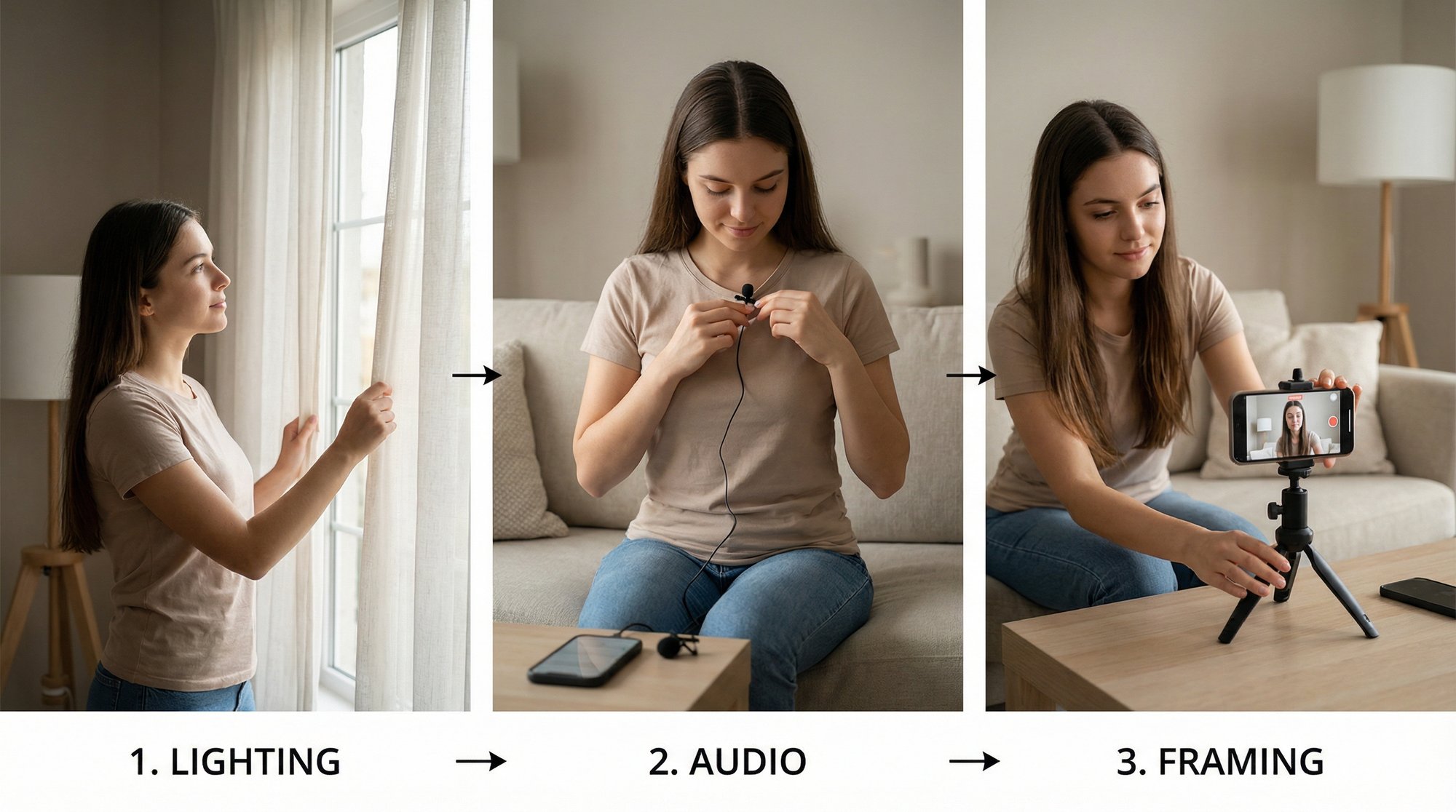
Capture Your Ideas Raw: The next time a great idea or a strong opinion pops into your head, just grab your phone and record it. Don't sweat the lighting, the background, or getting every word perfect. Just get the core thought down while it's fresh.
Hand Off the Hard Part: Instead of wrestling with editing software for hours, you send that raw footage to a service that does the polishing. They can add professional captions, clean up the cuts, and drop in relevant B-roll to make your idea shine.
This simple process removes all the friction that causes most people to quit. The goal here isn't to create a viral, trend-chasing video. It's about delivering one clear, authentic idea at a time. This makes creating content sustainable, not a dreaded chore. You can see what this raw, effective style looks like in these talking-head video examples.
Authenticity Is Everything
In an online world flooded with AI-generated fluff and impossibly perfect Instagram feeds, being real is a radical act. People are exhausted by the polish; they're starved for genuine human connection and credible advice. A simple video of you sharing what you know—imperfections and all—feels more trustworthy than any slickly produced advertisement.
Think about it: by simply talking about your work, you’re turning your ideas into strategic assets. You’re building a personal brand rooted in real expertise, creating influence that naturally attracts opportunities and grows your business.
Of course, once you have the video, you need to put it where the right people will see it. Understanding the nuances of each platform is key. For example, knowing how to properly post video to LinkedIn can make a massive difference in your reach.
This is precisely where a service like Unfloppable comes in. It’s built for this exact workflow. You just provide your raw, spoken insights, and Unfloppable turns them into a consistent stream of high-quality thought leadership videos. We handle the production headaches so you can stay focused on what you do best: sharing your expertise and leading the conversation in your field.
Alright, you've seen how powerful authentic video can be. Now, let's zoom out and build your entire playbook. A winning thought leadership strategy isn't about a single viral video; it’s about creating an entire ecosystem where every article, post, and video reinforces your expertise.
Think of it like building a case. Each piece of content is another piece of evidence that points to you as the go-to authority in your space. This means moving beyond just one format and creating a rich portfolio of content that meets your audience wherever they hang out online. It all works together.
But here’s the most important part: you can't lead by just repeating what everyone else is saying. It all starts with a strong, unique point of view.
Find Your Unique Angle And Core Pillars
Before you ever hit record or type a single word, you need to figure out what you stand for. What's the one thing you believe that goes against the common industry wisdom? Which "best practice" do you think is completely wrong? This unique angle is the foundation of your entire strategy.
Once you’ve got that, you’ll want to build your content around a few core pillars—maybe two to four key themes that spring directly from your expertise and that unique point of view. These pillars act as guardrails, keeping your content focused and ensuring everything you publish builds on what came before.
For instance, your pillars could be:
Challenging a Common Myth: Content that systematically debunks a widely held, but flawed, belief in your industry.
Presenting a New Framework: A proprietary model you’ve developed for solving a common, painful problem.
Predicting a Future Trend: Offering sharp, data-backed analysis on where the market is really headed, not just where it’s been.
These pillars provide structure and keep you from producing random, disconnected content. They are the essential building blocks for establishing a powerful personal brand built on expertise.
Diversify Your Content Formats
With your pillars locked in, it’s time to get creative with formats. Different people consume content in different ways, and using a variety of formats allows you to express your core ideas across multiple channels and platforms.
To give you a clearer picture, here’s a quick-reference table of content formats you can use to bring your thought leadership to life.
Content Format | Best For (Platform) | Strategic Goal |
|---|---|---|
Short-Form "Talking Head" Videos | LinkedIn, TikTok, Instagram | Build rapid familiarity & trust |
Opinionated Articles | LinkedIn, Medium, Company Blog | Go deep on a core pillar & spark debate |
Data-Backed Reports/Posts | Company Blog, Industry Publications | Become a primary source of information |
Niche Webinars/Live Q&As | LinkedIn Live, YouTube Live | Solve a specific pain point & capture leads |
Actionable How-To Guides | Company Blog, SEO | Attract an audience searching for solutions |
This table shows how different formats serve different strategic functions, from building initial trust to establishing you as a definitive source.
The workflow for creating this content, especially when starting with video, is simpler than you might think. You can often use a single recorded video as the source material for many other formats.

It really is that straightforward: you start with a powerful idea, capture it on camera, and then polish and repurpose it for distribution across different channels.
Amplify Your Insights For Maximum Reach
Let’s be honest: creating brilliant content is only half the job. If no one sees it, it might as well not exist. This is where so many people drop the ball. Your distribution plan is just as critical as your content itself.
Don't just post and pray. You need a proactive plan to get your insights in front of the right eyeballs.
The trust factor is undeniable. An incredible 75% of decision-makers find thought leadership more trustworthy than traditional marketing materials. For these buyers, compelling content can even inspire them to research solutions they hadn't previously considered.
This means being strategic. When you share content on social media, don’t just drop a link. Pull out a key quote or pose a provocative question to spark a real conversation. Send your best work to your email list with some exclusive behind-the-scenes context that only subscribers get.
By combining a unique point of view with a smart mix of content formats and a deliberate distribution plan, you create a powerful engine for building authority. This is how you stop being just another voice in the noise and become the voice people seek out and trust.
Measuring the ROI of Your Influence
Alright, so you're putting in the work. You’re sharing your expertise, creating content, and building a name for yourself. But how do you know if any of it is actually paying off?
It's easy to get caught up in the trap of chasing likes and shares, but those numbers don't pay the bills. The real challenge is tying your thought leadership directly to revenue. You need to prove that your influence is a genuine growth engine, not just another marketing expense.
Ultimately, you have to be able to answer the big question: "Did our expertise bring in new business?" When you can confidently say yes, you've cracked the code.
Focus on What Actually Moves the Needle
To see the real impact, you have to look past the fleeting social media applause and zero in on what we call leading indicators. Think of these as the early signals that a potential customer is moving closer to a purchase.
These aren't fuzzy metrics; they are tangible signs that your content is hitting the mark with the right people.
Here's where I always tell founders to start:
Branded Search Volume: Are more people typing your company or your personal name directly into Google? A spike here is a huge sign that your reputation is growing and people are actively seeking you out.
"I Saw Your Content" Demo Requests: This one is pure gold. When someone books a demo and their message says, “I saw your LinkedIn video about X,” you’ve drawn a straight line from a piece of content to a sales-qualified lead.
Unsolicited Prospect Feedback: Don't ignore those DMs and emails from prospects telling you how much a specific post helped them. This qualitative feedback is powerful proof that your influence is building real trust.
The best thought leadership doesn't just show up in an analytics dashboard; it shows up in your inbox. A single, high-quality inbound lead who found you through your content is worth more than a thousand passive likes.
Track the "What" and the "Why"
A solid measurement plan needs to tell the whole story. You need the hard numbers—the "what"—but you also need the human context—the "why." A comprehensive SaaS content marketing strategy should always account for both.
Think of it as building a case. The quantitative data is your evidence, and the qualitative feedback is your star witness.
Quantitative Metrics (The "What")
Content Citations and Mentions: Who else is talking about your ideas? Track how often other experts, trade publications, or blogs are referencing your work. This shows your ideas are shaping the industry conversation.
Website Referral Traffic: Check your analytics. Are people clicking through to your website from your LinkedIn posts or from articles that feature you? This measures how well your content drives action.
Lead Source Attribution: Make sure your CRM is set up to tag leads that come from your thought leadership efforts. This lets you follow their entire journey from first-touch to closed-won.
Qualitative Metrics (The "Why")
Better Sales Conversations: Ask your sales team. Are they noticing that new leads are coming in pre-sold, more educated, and with a higher level of trust? That’s a direct result of your content warming them up.
Partnership and Speaking Inquiries: Are you getting more inbound requests to speak at events, join a podcast, or collaborate with other respected brands? This is a direct measure of your growing authority in the space.
Quality of Engagement: Go beyond the like count and actually read the comments. Are they generic "great post!" comments, or are they thoughtful questions and discussions from people who look exactly like your ideal customer?
By tracking this mix of indicators, you build an undeniable case for the value of your thought leadership. This isn't about chasing viral fame. It's about systematically building a reputation that magnetizes your best customers and drives measurable growth.
Your Roadmap From Idea to Influence With Unfloppable

You get it. You've seen how powerful authentic thought leadership can be. It builds rock-solid trust, dramatically shortens sales cycles, and positions your brand as the one people turn to for answers.
But let’s be honest: knowing you should do it and actually doing it are worlds apart. This is especially true when you're a founder juggling a million priorities or leading a small, scrappy team.
The real roadblock isn’t a lack of great ideas. It’s the lack of a simple, repeatable system to get those ideas out into the world. Most thought leadership plans fizzle out because they're way too complicated, demanding hours of writing, editing, and production that you just don't have.
This is where you stop overthinking and start doing. Here’s a dead-simple, four-step roadmap for turning your raw expertise into a steady stream of high-impact content, all powered by Unfloppable. We designed this process to fit into the cracks of your day, not take it over.
Step 1: Ideate and Capture
Your best insights almost never arrive on a schedule. They strike while you're talking to a customer, walking the dog, or reacting to some breaking industry news. The old way was to scribble a note that would get lost in a notebook. The new way is to capture the idea on the spot.
The next time you have a strong opinion or a fresh take, don’t let it disappear.
Just pull out your phone, open the camera, and talk. That's it. Record your raw, unfiltered thoughts for a couple of minutes. Don’t sweat the "ums" or "ahs" or a perfect delivery. The only goal here is to capture the core of the idea while the passion is still fresh. This becomes your raw material.
Step 2: Create and Record
With the idea still buzzing in your head, it's time to lay the foundation. Find a quiet corner and record a simple talking-head video. Again, this isn't a Hollywood production.
Your entire focus should be on one thing: clarity. Speak directly to your ideal customer. Explain your point of view exactly as you would if you were sitting across from them with a coffee. This authentic, direct-to-camera style is what forges a real human connection and builds the trust you're after.
Think of this video as the "source code" for all the content that will spin out from it.
Step 3: Produce With Unfloppable
This is where the magic happens, and it's precisely where most founders get stuck and give up. Instead of wrestling with confusing editing software for hours, you simply upload your raw video to Unfloppable. This one move eliminates the single biggest obstacle to being consistent.
Unfloppable essentially becomes your on-demand video production team. We take your spoken ideas and transform them into polished, ready-to-post short-form videos.
You don't need any editing skills. You don’t need to find B-roll or create graphics. You just talk, and we handle the rest, turning your expertise into a strategic asset that works for you.
Our system intelligently adds eye-catching visuals, dynamic captions, and your own branding to make your message pop. We make sure the final videos are not just informative but genuinely engaging and perfectly formatted for platforms like LinkedIn, Instagram, and TikTok.
Step 4: Distribute and Influence
With your polished videos back from Unfloppable in hand, the final step is to put them to work. Share them across the social platforms where your ideal customers actually hang out.
But don’t just post and ghost. The real influence comes from engaging with the comments and sparking a meaningful conversation.
This simple, four-step process—Ideate, Create, Produce, and Distribute—is your key to building a powerful personal brand without all the production headaches. By leaning on Unfloppable, you completely remove the friction. You finally have a system for turning your spoken ideas into real influence, one video at a time.
Got Questions? Let's Get Practical.
Even the best strategy runs into real-world questions. I get it. You’re busy running a company. So let’s tackle the most common roadblocks I see founders hit when they start building their authority.
How Can I Possibly Stand Out When My Market Is So Crowded?
Simple: stop trying to shout louder and start speaking more specifically. The impulse is to compete on broad topics like "marketing," but that's a losing game. The real win comes from going narrower and taking a stronger stance.
Instead of being just another voice on "marketing," you become the person to talk to about "product-led growth for early-stage B2B SaaS." See the difference? Your goal isn’t to be better; it’s to be different.
So, stop obsessively tracking what your competitors are saying. Your unique angle isn't out there—it's in you. It's buried in your experiences and your unfiltered opinions.
Attack the ‘Best Practices’: What piece of common industry advice do you secretly think is garbage? Say it. Your contrarian view is where your most potent content is hiding.
Find an Unsolved Problem: What’s a nagging, specific pain point your ideal customer has that everyone else ignores? Go there. Own that conversation completely.
Create a Mashup: What happens when you apply ideas from behavioral psychology to user onboarding? Or principles from urban planning to community building? These intersections are where fresh, original thinking is born.
Your most powerful angle isn't something you invent out of thin air. It’s something you uncover. It’s the meeting point of your real-world expertise, a strong point of view, and a problem your audience is dying to solve.
Seriously, How Much Time Does This Take Every Week?
Let me be clear: consistency will always beat intensity. Don't try to be a hero with an eight-hour content marathon once a month. You’ll just burn out.
It's far more effective to carve out two to three focused hours a week. That’s it.
Here’s what that looks like. Spend an hour capturing your raw thoughts and recording a straightforward, talking-head video. Use another hour to have that video’s transcript turned into a sharp LinkedIn post, a few tweets, or a short blog article.
The whole point is to build a system that feels sustainable, not draining. If your process feels overwhelming, you’re doing it wrong.
Is This a Waste of Time for a Niche B2B Product?
Absolutely not. In fact, it’s probably the single most powerful thing you can do. The more niche your B2B product, the more effective thought leadership is.
Think about it. Your potential buyers are specialists. They’re sophisticated, they’re busy, and they can smell generic marketing fluff from a mile away. They aren’t scrolling for flashy ads. They're looking for a trusted peer who actually gets their world.
For a niche company, becoming a thought leader helps you:
Build Credibility, Fast: You can quickly become the biggest and most trusted name in your small pond.
Attract the Right People: The only people who resonate with your deep, specific content are the exact-fit leads you want to talk to.
Command a Higher Price: Your expertise doesn’t just sell a product; it demonstrates the immense value baked into your specialized solution, making price a secondary concern.
When you consistently share insights that matter to your small audience, you stop being just another vendor. You become the only logical choice.
Ready to turn your ideas into influence without the production headaches? Unfloppable transforms your raw, spoken insights into a steady stream of polished videos that build your brand. Stop worrying about editing and start leading the conversation.
Let's cut through the jargon. Thought leadership marketing isn't about shouting the loudest; it's about becoming the most trusted voice in your field. It’s the practice of consistently sharing your unique expertise to build authority, guide your industry, and become the go-to expert people seek out when it matters most.
What Is Thought Leadership Marketing Really

Think about it this way: traditional marketing often feels like screaming for attention in a crowded market. Thought leadership is different. It's like building a lighthouse on a rocky shore.
Your expertise is the light—a steady, reliable beacon that doesn't chase ships but guides them safely to harbor. Over time, those you guide come to trust your light implicitly. This approach is built on three non-negotiable pillars:
Expertise: You need a genuine, deep understanding of your domain. This isn't something you can fake.
Authenticity: Your perspective has to be your own. It should reflect your real-world experience, your voice, and your unique point of view.
Consistency: Showing up once won't build trust. You have to be a consistent presence to gain momentum and stay on your audience's radar.
The Key Difference From Content Marketing
People often lump thought leadership and content marketing together, but that's a mistake. While thought leadership is a form of content marketing, it’s a much more specialized discipline. It's the difference between creating a helpful map of a known city and drawing the map for an entirely new territory.
Content marketing answers questions. Thought leadership makes you question the answers.
The goal isn't just to be helpful; it's to challenge your audience's thinking, introduce new frameworks, and position yourself as the only one who can navigate the complexities ahead.
When you look at compelling thought leadership content examples, you'll see this in action. They don't just rehash old ideas; they offer a fresh, proprietary take that can't be googled in five seconds.
And this distinction is what drives real business. A landmark Edelman-LinkedIn study revealed that a staggering 55% of decision-makers rely on thought leadership content to vet companies they're considering working with. They aren't looking for another "how-to" guide; they're looking for a true expert.
To make it even clearer, let's break down the core differences.
Thought Leadership vs Content Marketing At a Glance
The following table lays out the fundamental distinctions in goals, tone, and outcomes between these two crucial marketing functions.
Aspect | Thought Leadership Marketing | Traditional Content Marketing |
|---|---|---|
Primary Goal | Build authority and influence industry thinking | Attract, educate, and generate leads |
Tone of Voice | Provocative, insightful, and visionary | Helpful, informative, and accessible |
Content Focus | Original ideas, research, and new perspectives | Best practices, tutorials, and known information |
Outcome | Becomes the go-to source for industry direction | Becomes a reliable source for practical answers |
Ultimately, it boils down to this: content marketing gets your foot in the door. Thought leadership is what makes them choose you, trust you, and keep coming back. It turns your brand from just another vendor into the definitive authority.
Why Building Authority Isn't Just a "Nice to Have" Anymore

It’s one thing to know what thought leadership is. It’s another thing entirely to understand why it’s become absolutely critical for growth. Let's be honest, the world is drowning in ads and generic blog posts. In this environment, true authority is the only competitive advantage that can’t be easily copied.
It’s the difference between a brand that's constantly screaming for attention and one that commands it without even trying.
Think about it this way: thought leadership completely flips the script on how you get customers. Instead of you hunting down prospects, they start seeking you out. Your content becomes their go-to resource, answering their burning questions and solving their problems long before they ever think about buying.
By the time they finally do reach out, they aren't just cold leads. They're educated, qualified buyers who already see you as the expert. That trust is your most valuable asset, and it pays dividends.
Close Deals Faster and Charge What You're Worth
When you consistently share genuine insights, you build something incredibly powerful: brand affinity. People stop seeing you as just another vendor and start seeing you as their trusted guide. This relationship does wonders for your sales process, dramatically shortening the cycle because all the hard work of building credibility is already done.
Even better, real authority lets you step off the pricing hamster wheel. An expert's guidance is worth far more than a simple product or service. When you're the recognized authority in your space, customers don't just accept higher prices—they expect them. They're paying for the certainty and confidence that only you can provide.
Don’t just take my word for it. Recent industry studies have shown that 60% of decision-makers are willing to pay a premium to work with a company that has proven its expertise through thought leadership.
That’s not a marketing expense; it's a direct investment in your profitability.
Win the Big Deals and Create Die-Hard Fans
Here’s the bottom line: thought leadership is about closing deals. It’s not about warm fuzzies; it’s about concrete business results. When a buyer is on the fence, weighing their options, the company that has been educating them all along holds a massive psychological advantage.
The data on this is impossible to ignore. A stunning 53% of buyers said insightful content was a primary reason for their final choice. And for nearly half of them, it was the key factor that led them to discover and choose a smaller challenger brand over an established industry leader.
This makes authority the great equalizer. You might not be able to outspend the giants in your industry, but you can absolutely out-think them. For even more proof, you can explore more compelling statistics on how thought leadership impacts buyer behavior.
Ultimately, this approach doesn't just create customers; it creates advocates. When you genuinely help people get smarter and solve their problems, they don't forget it. They become fiercely loyal—not because of a discount, but because you helped them succeed. That's a level of loyalty that advertising can never buy. It’s earned, one piece of great content at a time.
Why Talking-Head Video Is Your Secret Weapon
Okay, we’ve talked about why you need to be seen as an authority. Now let’s get real about the most direct way to make that happen in 2026. While long-form articles and dense whitepapers still have their place, the real game-changer today is simple, authentic, talking-head video.
Forget about slick corporate productions that cost a fortune. This is the complete opposite. A great talking-head video simply puts a human face to your expertise, stripping away all the jargon and polish. When a founder or expert just looks into the camera and shares a genuine thought, it forges a connection that a wall of text simply can't match.
This is how you build trust, fast. Your audience sees your facial expressions and hears the conviction in your voice. They get a feel for your personality. That’s what transforms a faceless brand into someone they know, like, and trust.
The Low-Effort, High-Impact Workflow
I know what you're thinking: "I don't have time to become a YouTuber." The biggest hurdle for busy founders is the sheer complexity of video production. But what if the most effective method was also the easiest?
The best workflow is brutally simple.
Capture Your Ideas Raw: The next time a great idea or a strong opinion pops into your head, just grab your phone and record it. Don't sweat the lighting, the background, or getting every word perfect. Just get the core thought down while it's fresh.
Hand Off the Hard Part: Instead of wrestling with editing software for hours, you send that raw footage to a service that does the polishing. They can add professional captions, clean up the cuts, and drop in relevant B-roll to make your idea shine.
This simple process removes all the friction that causes most people to quit. The goal here isn't to create a viral, trend-chasing video. It's about delivering one clear, authentic idea at a time. This makes creating content sustainable, not a dreaded chore. You can see what this raw, effective style looks like in these talking-head video examples.
Authenticity Is Everything
In an online world flooded with AI-generated fluff and impossibly perfect Instagram feeds, being real is a radical act. People are exhausted by the polish; they're starved for genuine human connection and credible advice. A simple video of you sharing what you know—imperfections and all—feels more trustworthy than any slickly produced advertisement.
Think about it: by simply talking about your work, you’re turning your ideas into strategic assets. You’re building a personal brand rooted in real expertise, creating influence that naturally attracts opportunities and grows your business.
Of course, once you have the video, you need to put it where the right people will see it. Understanding the nuances of each platform is key. For example, knowing how to properly post video to LinkedIn can make a massive difference in your reach.
This is precisely where a service like Unfloppable comes in. It’s built for this exact workflow. You just provide your raw, spoken insights, and Unfloppable turns them into a consistent stream of high-quality thought leadership videos. We handle the production headaches so you can stay focused on what you do best: sharing your expertise and leading the conversation in your field.
Alright, you've seen how powerful authentic video can be. Now, let's zoom out and build your entire playbook. A winning thought leadership strategy isn't about a single viral video; it’s about creating an entire ecosystem where every article, post, and video reinforces your expertise.
Think of it like building a case. Each piece of content is another piece of evidence that points to you as the go-to authority in your space. This means moving beyond just one format and creating a rich portfolio of content that meets your audience wherever they hang out online. It all works together.
But here’s the most important part: you can't lead by just repeating what everyone else is saying. It all starts with a strong, unique point of view.
Find Your Unique Angle And Core Pillars
Before you ever hit record or type a single word, you need to figure out what you stand for. What's the one thing you believe that goes against the common industry wisdom? Which "best practice" do you think is completely wrong? This unique angle is the foundation of your entire strategy.
Once you’ve got that, you’ll want to build your content around a few core pillars—maybe two to four key themes that spring directly from your expertise and that unique point of view. These pillars act as guardrails, keeping your content focused and ensuring everything you publish builds on what came before.
For instance, your pillars could be:
Challenging a Common Myth: Content that systematically debunks a widely held, but flawed, belief in your industry.
Presenting a New Framework: A proprietary model you’ve developed for solving a common, painful problem.
Predicting a Future Trend: Offering sharp, data-backed analysis on where the market is really headed, not just where it’s been.
These pillars provide structure and keep you from producing random, disconnected content. They are the essential building blocks for establishing a powerful personal brand built on expertise.
Diversify Your Content Formats
With your pillars locked in, it’s time to get creative with formats. Different people consume content in different ways, and using a variety of formats allows you to express your core ideas across multiple channels and platforms.
To give you a clearer picture, here’s a quick-reference table of content formats you can use to bring your thought leadership to life.
Content Format | Best For (Platform) | Strategic Goal |
|---|---|---|
Short-Form "Talking Head" Videos | LinkedIn, TikTok, Instagram | Build rapid familiarity & trust |
Opinionated Articles | LinkedIn, Medium, Company Blog | Go deep on a core pillar & spark debate |
Data-Backed Reports/Posts | Company Blog, Industry Publications | Become a primary source of information |
Niche Webinars/Live Q&As | LinkedIn Live, YouTube Live | Solve a specific pain point & capture leads |
Actionable How-To Guides | Company Blog, SEO | Attract an audience searching for solutions |
This table shows how different formats serve different strategic functions, from building initial trust to establishing you as a definitive source.
The workflow for creating this content, especially when starting with video, is simpler than you might think. You can often use a single recorded video as the source material for many other formats.

It really is that straightforward: you start with a powerful idea, capture it on camera, and then polish and repurpose it for distribution across different channels.
Amplify Your Insights For Maximum Reach
Let’s be honest: creating brilliant content is only half the job. If no one sees it, it might as well not exist. This is where so many people drop the ball. Your distribution plan is just as critical as your content itself.
Don't just post and pray. You need a proactive plan to get your insights in front of the right eyeballs.
The trust factor is undeniable. An incredible 75% of decision-makers find thought leadership more trustworthy than traditional marketing materials. For these buyers, compelling content can even inspire them to research solutions they hadn't previously considered.
This means being strategic. When you share content on social media, don’t just drop a link. Pull out a key quote or pose a provocative question to spark a real conversation. Send your best work to your email list with some exclusive behind-the-scenes context that only subscribers get.
By combining a unique point of view with a smart mix of content formats and a deliberate distribution plan, you create a powerful engine for building authority. This is how you stop being just another voice in the noise and become the voice people seek out and trust.
Measuring the ROI of Your Influence
Alright, so you're putting in the work. You’re sharing your expertise, creating content, and building a name for yourself. But how do you know if any of it is actually paying off?
It's easy to get caught up in the trap of chasing likes and shares, but those numbers don't pay the bills. The real challenge is tying your thought leadership directly to revenue. You need to prove that your influence is a genuine growth engine, not just another marketing expense.
Ultimately, you have to be able to answer the big question: "Did our expertise bring in new business?" When you can confidently say yes, you've cracked the code.
Focus on What Actually Moves the Needle
To see the real impact, you have to look past the fleeting social media applause and zero in on what we call leading indicators. Think of these as the early signals that a potential customer is moving closer to a purchase.
These aren't fuzzy metrics; they are tangible signs that your content is hitting the mark with the right people.
Here's where I always tell founders to start:
Branded Search Volume: Are more people typing your company or your personal name directly into Google? A spike here is a huge sign that your reputation is growing and people are actively seeking you out.
"I Saw Your Content" Demo Requests: This one is pure gold. When someone books a demo and their message says, “I saw your LinkedIn video about X,” you’ve drawn a straight line from a piece of content to a sales-qualified lead.
Unsolicited Prospect Feedback: Don't ignore those DMs and emails from prospects telling you how much a specific post helped them. This qualitative feedback is powerful proof that your influence is building real trust.
The best thought leadership doesn't just show up in an analytics dashboard; it shows up in your inbox. A single, high-quality inbound lead who found you through your content is worth more than a thousand passive likes.
Track the "What" and the "Why"
A solid measurement plan needs to tell the whole story. You need the hard numbers—the "what"—but you also need the human context—the "why." A comprehensive SaaS content marketing strategy should always account for both.
Think of it as building a case. The quantitative data is your evidence, and the qualitative feedback is your star witness.
Quantitative Metrics (The "What")
Content Citations and Mentions: Who else is talking about your ideas? Track how often other experts, trade publications, or blogs are referencing your work. This shows your ideas are shaping the industry conversation.
Website Referral Traffic: Check your analytics. Are people clicking through to your website from your LinkedIn posts or from articles that feature you? This measures how well your content drives action.
Lead Source Attribution: Make sure your CRM is set up to tag leads that come from your thought leadership efforts. This lets you follow their entire journey from first-touch to closed-won.
Qualitative Metrics (The "Why")
Better Sales Conversations: Ask your sales team. Are they noticing that new leads are coming in pre-sold, more educated, and with a higher level of trust? That’s a direct result of your content warming them up.
Partnership and Speaking Inquiries: Are you getting more inbound requests to speak at events, join a podcast, or collaborate with other respected brands? This is a direct measure of your growing authority in the space.
Quality of Engagement: Go beyond the like count and actually read the comments. Are they generic "great post!" comments, or are they thoughtful questions and discussions from people who look exactly like your ideal customer?
By tracking this mix of indicators, you build an undeniable case for the value of your thought leadership. This isn't about chasing viral fame. It's about systematically building a reputation that magnetizes your best customers and drives measurable growth.
Your Roadmap From Idea to Influence With Unfloppable

You get it. You've seen how powerful authentic thought leadership can be. It builds rock-solid trust, dramatically shortens sales cycles, and positions your brand as the one people turn to for answers.
But let’s be honest: knowing you should do it and actually doing it are worlds apart. This is especially true when you're a founder juggling a million priorities or leading a small, scrappy team.
The real roadblock isn’t a lack of great ideas. It’s the lack of a simple, repeatable system to get those ideas out into the world. Most thought leadership plans fizzle out because they're way too complicated, demanding hours of writing, editing, and production that you just don't have.
This is where you stop overthinking and start doing. Here’s a dead-simple, four-step roadmap for turning your raw expertise into a steady stream of high-impact content, all powered by Unfloppable. We designed this process to fit into the cracks of your day, not take it over.
Step 1: Ideate and Capture
Your best insights almost never arrive on a schedule. They strike while you're talking to a customer, walking the dog, or reacting to some breaking industry news. The old way was to scribble a note that would get lost in a notebook. The new way is to capture the idea on the spot.
The next time you have a strong opinion or a fresh take, don’t let it disappear.
Just pull out your phone, open the camera, and talk. That's it. Record your raw, unfiltered thoughts for a couple of minutes. Don’t sweat the "ums" or "ahs" or a perfect delivery. The only goal here is to capture the core of the idea while the passion is still fresh. This becomes your raw material.
Step 2: Create and Record
With the idea still buzzing in your head, it's time to lay the foundation. Find a quiet corner and record a simple talking-head video. Again, this isn't a Hollywood production.
Your entire focus should be on one thing: clarity. Speak directly to your ideal customer. Explain your point of view exactly as you would if you were sitting across from them with a coffee. This authentic, direct-to-camera style is what forges a real human connection and builds the trust you're after.
Think of this video as the "source code" for all the content that will spin out from it.
Step 3: Produce With Unfloppable
This is where the magic happens, and it's precisely where most founders get stuck and give up. Instead of wrestling with confusing editing software for hours, you simply upload your raw video to Unfloppable. This one move eliminates the single biggest obstacle to being consistent.
Unfloppable essentially becomes your on-demand video production team. We take your spoken ideas and transform them into polished, ready-to-post short-form videos.
You don't need any editing skills. You don’t need to find B-roll or create graphics. You just talk, and we handle the rest, turning your expertise into a strategic asset that works for you.
Our system intelligently adds eye-catching visuals, dynamic captions, and your own branding to make your message pop. We make sure the final videos are not just informative but genuinely engaging and perfectly formatted for platforms like LinkedIn, Instagram, and TikTok.
Step 4: Distribute and Influence
With your polished videos back from Unfloppable in hand, the final step is to put them to work. Share them across the social platforms where your ideal customers actually hang out.
But don’t just post and ghost. The real influence comes from engaging with the comments and sparking a meaningful conversation.
This simple, four-step process—Ideate, Create, Produce, and Distribute—is your key to building a powerful personal brand without all the production headaches. By leaning on Unfloppable, you completely remove the friction. You finally have a system for turning your spoken ideas into real influence, one video at a time.
Got Questions? Let's Get Practical.
Even the best strategy runs into real-world questions. I get it. You’re busy running a company. So let’s tackle the most common roadblocks I see founders hit when they start building their authority.
How Can I Possibly Stand Out When My Market Is So Crowded?
Simple: stop trying to shout louder and start speaking more specifically. The impulse is to compete on broad topics like "marketing," but that's a losing game. The real win comes from going narrower and taking a stronger stance.
Instead of being just another voice on "marketing," you become the person to talk to about "product-led growth for early-stage B2B SaaS." See the difference? Your goal isn’t to be better; it’s to be different.
So, stop obsessively tracking what your competitors are saying. Your unique angle isn't out there—it's in you. It's buried in your experiences and your unfiltered opinions.
Attack the ‘Best Practices’: What piece of common industry advice do you secretly think is garbage? Say it. Your contrarian view is where your most potent content is hiding.
Find an Unsolved Problem: What’s a nagging, specific pain point your ideal customer has that everyone else ignores? Go there. Own that conversation completely.
Create a Mashup: What happens when you apply ideas from behavioral psychology to user onboarding? Or principles from urban planning to community building? These intersections are where fresh, original thinking is born.
Your most powerful angle isn't something you invent out of thin air. It’s something you uncover. It’s the meeting point of your real-world expertise, a strong point of view, and a problem your audience is dying to solve.
Seriously, How Much Time Does This Take Every Week?
Let me be clear: consistency will always beat intensity. Don't try to be a hero with an eight-hour content marathon once a month. You’ll just burn out.
It's far more effective to carve out two to three focused hours a week. That’s it.
Here’s what that looks like. Spend an hour capturing your raw thoughts and recording a straightforward, talking-head video. Use another hour to have that video’s transcript turned into a sharp LinkedIn post, a few tweets, or a short blog article.
The whole point is to build a system that feels sustainable, not draining. If your process feels overwhelming, you’re doing it wrong.
Is This a Waste of Time for a Niche B2B Product?
Absolutely not. In fact, it’s probably the single most powerful thing you can do. The more niche your B2B product, the more effective thought leadership is.
Think about it. Your potential buyers are specialists. They’re sophisticated, they’re busy, and they can smell generic marketing fluff from a mile away. They aren’t scrolling for flashy ads. They're looking for a trusted peer who actually gets their world.
For a niche company, becoming a thought leader helps you:
Build Credibility, Fast: You can quickly become the biggest and most trusted name in your small pond.
Attract the Right People: The only people who resonate with your deep, specific content are the exact-fit leads you want to talk to.
Command a Higher Price: Your expertise doesn’t just sell a product; it demonstrates the immense value baked into your specialized solution, making price a secondary concern.
When you consistently share insights that matter to your small audience, you stop being just another vendor. You become the only logical choice.
Ready to turn your ideas into influence without the production headaches? Unfloppable transforms your raw, spoken insights into a steady stream of polished videos that build your brand. Stop worrying about editing and start leading the conversation.