Real Estate Video Editing: A Complete Guide for 2026
Master real estate video editing with our 2026 guide. Learn step-by-step workflows, platform formats, and how to create videos that get 403% more inquiries.
Apr 8, 2026
Real estate video editing stops being a “nice to have” the moment you look at the business results. Listings with professional videos receive 403% more inquiries and can sell up to 31% faster, according to REsimpli’s roundup of real estate video statistics. That is not a small creative upgrade. That is a visibility and conversion lever.
Most agents still treat editing like cleanup work at the end of production. It is not. Editing is where your raw footage becomes a marketing asset that holds attention, creates trust, and pushes someone to take the next step.
The bigger shift for 2026 is this. The highest-value video opportunity is not always the polished property tour. In many cases, it is the well-edited, agent-led video that builds your personal brand on social platforms. If you understand that difference, your content strategy gets simpler and your return on effort gets much better.
Why Mastering Video Editing Is No Longer Optional
73% of homeowners say they are more likely to list with an agent who uses video, according to the National Association of Realtors. That number matters because video is no longer just a listing extra. It shapes how prospects judge your relevance before they ever call you.
Editing decides whether that judgment works for you or against you.
A rough cut with dead air, awkward pauses, uneven audio, or slow openings makes you look less prepared than you are. A clean edit does the opposite. It helps you sound clear, look confident, and hold attention long enough to earn trust. Two agents can record similar footage on the same phone in the same office, and the better-edited version usually feels more credible.
Editing works like staging for your message. Raw footage may contain good material, but viewers should not have to sort through the clutter themselves. Your cuts, captions, framing, pacing, and on-screen text guide them toward the point you want them to remember.
That matters even more now because the highest-ROI video for many agents is not the cinematic home tour. It is the short, agent-led video posted consistently on social media. A polished listing video can help market one property. A well-edited talking-head video can market you every week, build familiarity, and stay useful long after a listing is gone.
Weak editing usually hurts results in predictable ways:
Viewers leave early because the opening takes too long to get to the point.
Your expertise feels less convincing because rambling delivery and messy cuts create friction.
Your brand looks generic because nothing in the edit helps people remember your face, voice, or point of view.
The call to action gets missed because the video ends without a clear next step.
The business effect is simple. Good editing does not just improve appearance. It increases the odds that a seller watches to the end, remembers your name, and sees you as the agent who understands how modern attention works.
This represents the core shift. Real estate video editing is no longer just about making properties look attractive. It is about making the agent look worth choosing.
The Two Worlds of Real Estate Video Content
73% of homeowners say they are more likely to list with an agent who uses video, according to the National Association of Realtors. That stat matters, but the bigger question is which kind of video builds your business.
Real estate video editing advice often misses a critical distinction. You are usually editing for one of two jobs. One video helps sell a property. The other helps sell confidence in you.

Treat those jobs the same, and the edit starts working against you. A listing tour needs visual flow. A talking-head market update needs trust, speed, and a reason to keep watching. Same software. Different outcome.
Property showcase videos
This is the classic category. Walkthroughs, drone footage, smooth pans, detail shots, and polished listing reels all belong here.
The editing goal is to help a buyer understand the home clearly and feel its appeal. Good edits in this category usually focus on:
Spatial clarity so the viewer can follow the layout without feeling lost
Mood and aspiration through music, color, and pacing
Feature emphasis so the right upgrades get attention
A logical sequence from curb appeal to entry to standout rooms
A property showcase edit works like an in-person showing. You control the route, the pace, and the moments that deserve a pause.
This type of video still matters. It can help a listing look stronger, justify marketing quality to sellers, and make a property feel more memorable online.
Agent as brand videos
This guide focuses on agent-as-brand videos, an area that delivers more long-term pipeline yet receives less attention.
These are the videos where your face, voice, and judgment are the product. Market updates. Neighborhood explainers. Client lessons. Short opinion videos. Quick answers to common buyer and seller questions. The format is often simple, but the business value is high because repeated exposure builds familiarity.
The edit has a different job here. Viewers are not asking, "How large is the kitchen?" They are asking, "Do I trust this person to guide a major financial decision?"
That changes everything.
A strong talking-head edit trims hesitation, gets to the point early, adds captions for silent viewing, and uses supporting visuals only when they clarify the message. If you want to master real estate video editing, this is the category worth studying closely because it builds brand equity between listings, not just during them.
Platform format also matters more here. A vertical Reel, horizontal YouTube video, and square feed post each ask for different framing and graphic choices. If your editor ignores those differences, even a smart message can feel awkward on-screen. A quick understanding of how to change aspect ratio for different video platforms helps prevent that mismatch.
Why the second category often produces more durable ROI
A property video usually expires with the listing.
An agent-led video keeps introducing you long after it goes live. One clip may not win a client. Twenty useful clips can make you familiar enough that a seller already feels they know you before the first call.
Here is the cleanest way to separate the two:
Video type | Main job | Editing priority |
|---|---|---|
Property showcase | Sell a home | Visual flow and premium presentation |
Agent as brand | Build trust in the agent | Clarity, personality, and retention |
Many agents spend heavily on cinematic listing content and post inconsistent, under-edited personal content. That is like spending all your budget on model-home furniture while leaving the front sign unreadable. The polished tour may impress people for a moment. The steady stream of sharp, well-edited agent videos is what keeps your name in the market.
A simple rule helps. If the video is selling the home, edit for space and presentation. If the video is selling your judgment, edit for clarity, pace, and human connection.
The Essential Real Estate Video Editing Workflow
Good editors do not start by clicking around in Premiere Pro, CapCut, or Final Cut Pro and hoping the timeline organizes itself. They follow a sequence.
That sequence matters because editing is less like decorating a room and more like building one. If the frame is crooked, the paint color will not save it.

Pre-edit decisions
Most editing problems begin before the first cut.
If your clips are unlabeled, your best take is buried, and your aspect ratio is wrong for the platform, the edit gets slow and messy. The cleanest workflow starts with a simple intake process.
Organize before you edit
Create folders by project and then by asset type. A basic structure might look like this:
A-roll for your main speaking footage
B-roll for property clips, neighborhood visuals, screenshots, or supporting footage
Audio for music, room tone, or voiceover files
Graphics for logos, lower thirds, captions, and brand templates
Name files in plain English. “Kitchen wide take 2” beats “IMG_4839” every time.
Decide the job of the video
Before you trim anything, answer one question: what should the viewer do after watching?
That answer changes the whole edit.
A listing video might need viewers to book a showing. A talking-head Reel might need them to comment, send a message, or remember your name. If the goal is fuzzy, the cut will feel fuzzy too.
Match format to platform
A strong edit can still fail if the frame does not fit the feed. Vertical usually works for Reels and short-form social. Wider formats suit YouTube or embedded website video.
If you need a practical walkthrough on reframing for different platforms, this guide on how to change aspect ratio is a useful reference.
The edit itself
Here, most agents either overcomplicate the process or undercook it.
A good real estate video edit has one job at a time. First make it understandable. Then make it engaging. Then make it polished.
Build a rough cut first
Do not start with effects, transitions, or animated text.
Start by placing clips in the right order. For a property video, that may mean exterior, entry, living spaces, kitchen, primary suite, outdoor area. For a talking-head Reel, that usually means hook, main point, proof, close.
Your rough cut is the skeleton. It can be ugly. It just needs to stand up.
Cut for momentum
Agents often leave too much dead air in videos because it feels natural in conversation. It does not feel natural in playback.
Trim pauses. Remove repeated phrases. Tighten the beginning. If you speak on camera, get to the point faster than you think you need to.
A useful mental model is this: every extra second must earn rent.
Support the message with B-roll
B-roll is not filler. It is proof.
If you say, “Inventory is tight in this neighborhood,” show the streets, signs, map graphics, or recent local visuals. If you say, “The backyard is the star,” cut to the backyard before the viewer has time to wonder why.
For a deeper strategic breakdown, AgentPulse has a thoughtful resource on master real estate video editing that reinforces how shot selection and pacing shape the final result.
Tip: In talking-head videos, B-roll should clarify what you are saying, not distract from it. If viewers start admiring the edit instead of absorbing the message, you went too far.
After you have the basic sequence, it helps to study one complete example of pacing and visual layering. This walkthrough is a solid reference point:

Post-edit polish
This stage is where amateur footage can begin to look intentional.
It is also where many people overdo things. Real estate video editing works best when polish supports trust. Not when it screams for attention.
Color and exposure cleanup
You do not need a dramatic “cinematic” look for every project. You need consistency.
Rooms should look bright but believable. Skin tones should look natural. Whites should look clean, not blue or orange. In talking-head videos, your face must be easy to read because viewers take their cues from your expression.
Audio correction
Viewers will tolerate average visuals longer than they will tolerate bad sound.
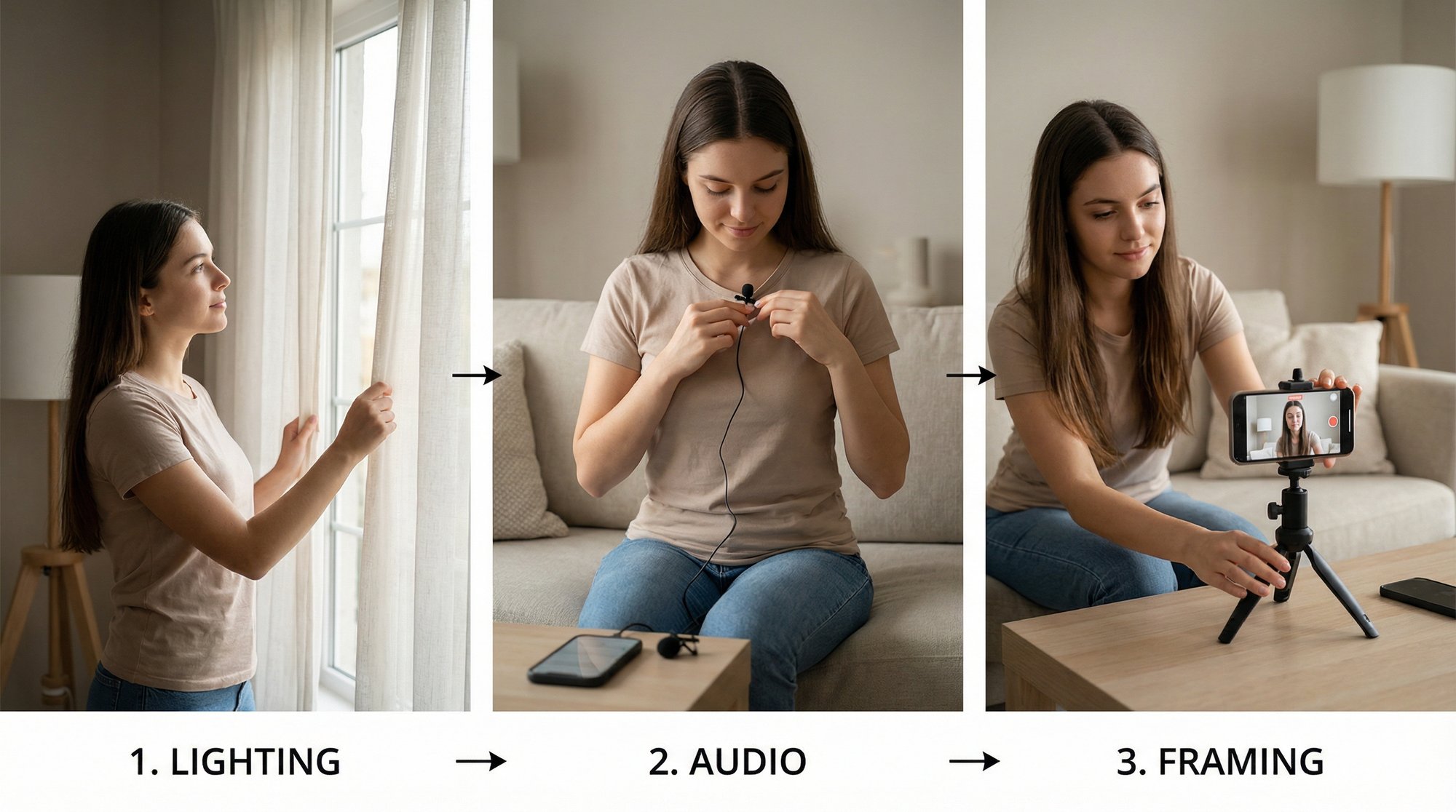
At minimum, reduce background noise, even out volume, and make speech crisp. If your voice sounds distant or hollow, the whole video feels cheaper. Lav mics, shotgun mics, and simple cleanup tools can make a major difference, even before advanced mixing.
Captions and on-screen text
Captions do two jobs. They help people watch without sound, and they improve retention because they reinforce key points visually.
Use text overlays with restraint:
Hooks for the opening line
Key phrases when you want to anchor a point
Call to action at the end
Location tags if local context matters
Do not turn every sentence into a flashing subtitle festival. Clean, readable text beats novelty.
A simple workflow you can repeat
If you want one repeatable model, use this:
Prepare the assets and decide the platform.
Assemble the message in the right order.
Tighten for attention by trimming hard.
Add proof with relevant B-roll.
Polish the finish through color, sound, and captions.
Export for the platform you plan to use.
That structure works whether you are editing a luxury listing tour or a thirty-second market update shot on your phone.
Pro Techniques for Videos That Convert
Most agents notice editing when it is flashy. Buyers and sellers respond when it is controlled.
That difference matters. Strong real estate video editing is usually quiet. It guides the eye, smooths the experience, and removes friction. The result feels professional without calling attention to itself.
Frame rate is the hidden quality signal
Frame rate confuses a lot of people because it sounds technical and distant from business results. It is not. It affects whether motion feels smooth and expensive or awkward and cheap.
According to HomeJab’s expert real estate video editing guide, professional real estate editors standardize timelines at 23.98fps for a cinematic feel. When they need to integrate footage shot at 29.97fps, they reduce its speed to 80% to eliminate jitter and keep motion fluid.
A simple analogy helps here. Think of frame rate like walking rhythm in a showing. If one person moves smoothly and the next person keeps stumbling half a step off, everyone notices. Mixed footage behaves the same way.
Color grading shapes perceived value
Color grading is not about making every listing look moody or dramatic.
It is about making the footage feel coherent. Warm grading can make a family home feel inviting. Cleaner, cooler tones can support a modern condo or architect-designed property. In agent-led videos, the goal is usually simpler. Keep skin tones healthy, the background balanced, and the overall image consistent across posts.
If your color changes from clip to clip, viewers may not know why the video feels off, but they will feel it.
Audio is trust on autopilot
People decide quickly whether a speaker sounds credible. Clear audio gives you a head start.
Use music lightly. In listing videos, music should set pace and mood without overpowering room details or narration. In talking-head content, your voice is the main event. Music should sit behind it, not compete with it.
A few practical moves matter a lot:
Level your dialogue so your volume stays steady
Remove hum or hiss if the room sound is distracting
Choose music that fits the property or topic
Leave breathing room so the soundtrack does not crowd the message
Tip: If the music is the most memorable part of your talking-head Reel, the edit is probably working against your brand.
Text overlays should behave like signs, not confetti
Text on screen is useful when it points viewers to what matters.
That means short hooks, key phrases, addresses, neighborhood names, or a simple CTA. It does not mean five font styles, constant pop-ins, and decorative motion on every beat.
If you want to study how edits can clarify transformation and draw attention to important differences, these before and after video listings offer a helpful idea framework.
A related skill is using effects without turning the video into a gimmick. This overview of video editing with effects is a good reminder that the right effect should support the story, not replace it.
Conversion-friendly polish checklist
Element | What good looks like |
|---|---|
Motion | Smooth and consistent |
Color | Natural, unified, brand-appropriate |
Audio | Clear voice, balanced music |
Text | Easy to read, sparingly used |
CTA | Direct and visually obvious |
Premium video rarely comes from one dramatic trick. It comes from ten small decisions that all point in the same direction.
DIY vs Outsourcing Your Video Editing A Strategic Choice

Editing choice is really a capacity choice.
Every hour you spend trimming pauses, fixing captions, and exporting versions is an hour you are not prospecting, following up, or recording the next useful market update. That does not mean you should always hand editing off. It means the right answer depends on where your effort creates the most revenue.
A helpful way to look at it is this: listing videos are projects, but agent-led social videos are a system. Projects can justify more custom work. Systems live or die on repeatability.
Option one, do it yourself
DIY editing gives you control over tone, timing, and approvals. For many agents, that matters a lot at the beginning because your on-camera style is still taking shape. You hear where you sound natural, where you ramble, and what kind of hook sounds like you.
For talking-head videos, simple often wins. A clean cut, readable captions, a few supporting visuals, and a clear CTA can be enough. You do not need studio-level polish to build trust on social media.
But DIY has a hidden cost. Editing works like packing your own moving truck. You save money, but you pay in time, decision fatigue, and the risk that the whole job takes longer than planned.
DIY usually fits when:
You want to learn your content style firsthand
Your videos follow a repeatable format
Your posting schedule is realistic for your workload
You can edit without it delaying client work
Option two, hire a freelancer or agency
Freelancers and agencies make more sense when the video itself carries the value. That often applies to premium listing showcases, brand pieces, neighborhood features, or campaign assets with several deliverables.
The upside is craft. A strong editor can improve pacing, color, sound, graphics, and platform exports without you touching the timeline. The downside is translation. If your video depends on your personality, every missed nuance creates friction. You can end up with a polished edit that sounds less like you.
That is why this route is often stronger for property-first content than for relationship-first content.
Option three, use a specialized editing service
Specialized services sit between fully DIY and fully custom outsourcing. They are built for recurring content, especially the kind many agents now need most: short, agent-led videos that answer questions, explain the market, and keep your face in front of local buyers and sellers.
That distinction matters.
A cinematic home tour can impress a viewer for a moment. A steady stream of clear, well-edited talking-head videos can build familiarity over months. One sells a property. The other helps sell the next ten conversations.
AI-assisted workflows are part of why this category has grown. They help with repetitive tasks like captioning, silence removal, reframing, and versioning. Human judgment still matters, especially for story, tone, and what to cut. But the technology reduces the mechanical work that used to make consistent publishing hard for busy agents.
If you are weighing that middle path, this guide to outsource video editing services for recurring content can help you match the support model to your workflow.
How to make the decision
Use the bottleneck test.
If your biggest problem is, “I know what to say, but I never get the videos finished,” outsourcing part of the process usually makes sense. If your bigger problem is, “I still do not know what my video style is,” DIY for a period can teach you faster than delegation.
A simple comparison helps:
| Path | Best for | Main risk |
|---|---|
| DIY | Learning your voice and handling simple recurring content | Editing eats production time |
| Freelancer or agency | High-polish projects and custom creative | More briefing and revision time |
| Specialized service | Consistent agent-led short-form video | Process may feel rigid if your format keeps changing |
For many agents, the highest ROI is not another glossy property montage. It is a repeatable personal brand machine. Short videos where you explain inspection issues, decode rate changes, comment on neighborhood shifts, or answer seller objections often do more for long-term pipeline than a beautiful one-off edit.
Use craftsmanship where the property is the star. Use speed and consistency where your expertise is the product.
The wrong choice is the one you cannot sustain.
How to Hire a Great Real Estate Video Editor
A good editor does not just make footage prettier. A good editor understands what the footage needs to accomplish.
That is why a flashy portfolio can mislead you. Smooth drone moves and dramatic transitions look impressive, but they do not tell you whether the editor can sharpen your message, preserve your voice, or cut for platform behavior.

What to look for in a portfolio
Scan for range, not just beauty.
You want to know whether the editor can handle both structure and style. In practical terms, that means looking for signs they can edit a property showcase and also tighten a person-on-camera video without making it stiff.
Check for these signals:
Strong openings that get to the point quickly
Clean pacing without dead space
Readable captions and graphics
Consistent color and sound
Platform awareness across vertical and horizontal formats
If every sample looks like a luxury montage but none show dialogue-driven content, that may be a mismatch for social brand building.
Questions worth asking
Good hiring starts with good questions. Not “What software do you use?” but “How do you think?”
Try these:
How would you edit a market update differently from a property walkthrough?
How do you decide what B-roll to use when someone is speaking on camera?
What do you need from me to keep revisions low?
How do you handle captions, hooks, and platform-specific versions?
Can you show examples where the speaker still feels natural, not overproduced?
Their answers will tell you more than their software stack.
A simple creative brief you can paste into an email
You do not need a fancy document. You need clarity.
Use this template:
Project type Listing video, neighborhood guide, market update, client story, or talking-head Reel
Primary goal Book showings, generate seller leads, build local authority, or increase engagement
Target viewer First-time buyer, luxury seller, local investor, relocating family, and so on
Platform Instagram Reels, YouTube, website embed, email, or MLS-linked page
Tone Polished, warm, direct, educational, upscale, casual
Must-include points Top features, key message, neighborhood notes, CTA
Visual assets provided A-roll, B-roll, logos, brand colors, music preferences, previous examples
Editing preferences Fast-paced, minimal transitions, caption style, text overlays, preferred length
References Two or three videos you like, plus one you do not like
Red flags to catch early
Some warning signs show up fast:
They ask almost nothing about goals
They focus only on effects and transitions
They cannot explain pacing choices
They ignore sound quality
They promise “viral” outcomes instead of disciplined execution
Tip: Hire for judgment, not just software skill. Buttons are easy to learn. Taste and business awareness are harder to find.
A great editor should make your job lighter, not create a new management job you did not ask for.
Transform Your Listings and Brand with Video
Real estate video editing is not one skill. It is a set of business decisions disguised as creative work.
You choose what kind of video you are making. You choose whether the goal is to showcase a property or build trust in you. You choose how tightly the message is cut, how clearly the visuals support it, and whether the final product feels polished enough to reflect your brand.
Those choices shape outcomes.
The old model treated video as a premium extra for listings. The better model treats video as an ongoing communication system. Sometimes that system is a property showcase. Often, the more impactful move is a short, sharp, agent-led video that keeps your face and expertise in front of the right people.
That is the overlooked opportunity.
If you are busy, start smaller than you think. Record one useful market insight on your phone. Edit it for clarity, captions, and pace. Post it where your audience already spends time. Then repeat. Consistency beats complexity when the content is tied to real expertise.
If you are handling listings, apply the same discipline. Do not settle for “we got footage.” Ask whether the edit makes the property easier to understand, more appealing to watch, and more likely to drive action.
The agents who win with video usually do one thing better than everyone else. They stop treating editing like post-production cleanup and start treating it like strategy.
That is the shift worth making in 2026.
If you want the benefits of agent-led short-form video without doing the editing yourself, Unfloppable helps turn simple talking-head recordings into polished videos built for consistent posting. You speak on camera, the footage gets shaped into clear, authentic social clips, and you stay visible without learning the edit.
Real estate video editing stops being a “nice to have” the moment you look at the business results. Listings with professional videos receive 403% more inquiries and can sell up to 31% faster, according to REsimpli’s roundup of real estate video statistics. That is not a small creative upgrade. That is a visibility and conversion lever.
Most agents still treat editing like cleanup work at the end of production. It is not. Editing is where your raw footage becomes a marketing asset that holds attention, creates trust, and pushes someone to take the next step.
The bigger shift for 2026 is this. The highest-value video opportunity is not always the polished property tour. In many cases, it is the well-edited, agent-led video that builds your personal brand on social platforms. If you understand that difference, your content strategy gets simpler and your return on effort gets much better.
Why Mastering Video Editing Is No Longer Optional
73% of homeowners say they are more likely to list with an agent who uses video, according to the National Association of Realtors. That number matters because video is no longer just a listing extra. It shapes how prospects judge your relevance before they ever call you.
Editing decides whether that judgment works for you or against you.
A rough cut with dead air, awkward pauses, uneven audio, or slow openings makes you look less prepared than you are. A clean edit does the opposite. It helps you sound clear, look confident, and hold attention long enough to earn trust. Two agents can record similar footage on the same phone in the same office, and the better-edited version usually feels more credible.
Editing works like staging for your message. Raw footage may contain good material, but viewers should not have to sort through the clutter themselves. Your cuts, captions, framing, pacing, and on-screen text guide them toward the point you want them to remember.
That matters even more now because the highest-ROI video for many agents is not the cinematic home tour. It is the short, agent-led video posted consistently on social media. A polished listing video can help market one property. A well-edited talking-head video can market you every week, build familiarity, and stay useful long after a listing is gone.
Weak editing usually hurts results in predictable ways:
Viewers leave early because the opening takes too long to get to the point.
Your expertise feels less convincing because rambling delivery and messy cuts create friction.
Your brand looks generic because nothing in the edit helps people remember your face, voice, or point of view.
The call to action gets missed because the video ends without a clear next step.
The business effect is simple. Good editing does not just improve appearance. It increases the odds that a seller watches to the end, remembers your name, and sees you as the agent who understands how modern attention works.
This represents the core shift. Real estate video editing is no longer just about making properties look attractive. It is about making the agent look worth choosing.
The Two Worlds of Real Estate Video Content
73% of homeowners say they are more likely to list with an agent who uses video, according to the National Association of Realtors. That stat matters, but the bigger question is which kind of video builds your business.
Real estate video editing advice often misses a critical distinction. You are usually editing for one of two jobs. One video helps sell a property. The other helps sell confidence in you.

Treat those jobs the same, and the edit starts working against you. A listing tour needs visual flow. A talking-head market update needs trust, speed, and a reason to keep watching. Same software. Different outcome.
Property showcase videos
This is the classic category. Walkthroughs, drone footage, smooth pans, detail shots, and polished listing reels all belong here.
The editing goal is to help a buyer understand the home clearly and feel its appeal. Good edits in this category usually focus on:
Spatial clarity so the viewer can follow the layout without feeling lost
Mood and aspiration through music, color, and pacing
Feature emphasis so the right upgrades get attention
A logical sequence from curb appeal to entry to standout rooms
A property showcase edit works like an in-person showing. You control the route, the pace, and the moments that deserve a pause.
This type of video still matters. It can help a listing look stronger, justify marketing quality to sellers, and make a property feel more memorable online.
Agent as brand videos
This guide focuses on agent-as-brand videos, an area that delivers more long-term pipeline yet receives less attention.
These are the videos where your face, voice, and judgment are the product. Market updates. Neighborhood explainers. Client lessons. Short opinion videos. Quick answers to common buyer and seller questions. The format is often simple, but the business value is high because repeated exposure builds familiarity.
The edit has a different job here. Viewers are not asking, "How large is the kitchen?" They are asking, "Do I trust this person to guide a major financial decision?"
That changes everything.
A strong talking-head edit trims hesitation, gets to the point early, adds captions for silent viewing, and uses supporting visuals only when they clarify the message. If you want to master real estate video editing, this is the category worth studying closely because it builds brand equity between listings, not just during them.
Platform format also matters more here. A vertical Reel, horizontal YouTube video, and square feed post each ask for different framing and graphic choices. If your editor ignores those differences, even a smart message can feel awkward on-screen. A quick understanding of how to change aspect ratio for different video platforms helps prevent that mismatch.
Why the second category often produces more durable ROI
A property video usually expires with the listing.
An agent-led video keeps introducing you long after it goes live. One clip may not win a client. Twenty useful clips can make you familiar enough that a seller already feels they know you before the first call.
Here is the cleanest way to separate the two:
Video type | Main job | Editing priority |
|---|---|---|
Property showcase | Sell a home | Visual flow and premium presentation |
Agent as brand | Build trust in the agent | Clarity, personality, and retention |
Many agents spend heavily on cinematic listing content and post inconsistent, under-edited personal content. That is like spending all your budget on model-home furniture while leaving the front sign unreadable. The polished tour may impress people for a moment. The steady stream of sharp, well-edited agent videos is what keeps your name in the market.
A simple rule helps. If the video is selling the home, edit for space and presentation. If the video is selling your judgment, edit for clarity, pace, and human connection.
The Essential Real Estate Video Editing Workflow
Good editors do not start by clicking around in Premiere Pro, CapCut, or Final Cut Pro and hoping the timeline organizes itself. They follow a sequence.
That sequence matters because editing is less like decorating a room and more like building one. If the frame is crooked, the paint color will not save it.

Pre-edit decisions
Most editing problems begin before the first cut.
If your clips are unlabeled, your best take is buried, and your aspect ratio is wrong for the platform, the edit gets slow and messy. The cleanest workflow starts with a simple intake process.
Organize before you edit
Create folders by project and then by asset type. A basic structure might look like this:
A-roll for your main speaking footage
B-roll for property clips, neighborhood visuals, screenshots, or supporting footage
Audio for music, room tone, or voiceover files
Graphics for logos, lower thirds, captions, and brand templates
Name files in plain English. “Kitchen wide take 2” beats “IMG_4839” every time.
Decide the job of the video
Before you trim anything, answer one question: what should the viewer do after watching?
That answer changes the whole edit.
A listing video might need viewers to book a showing. A talking-head Reel might need them to comment, send a message, or remember your name. If the goal is fuzzy, the cut will feel fuzzy too.
Match format to platform
A strong edit can still fail if the frame does not fit the feed. Vertical usually works for Reels and short-form social. Wider formats suit YouTube or embedded website video.
If you need a practical walkthrough on reframing for different platforms, this guide on how to change aspect ratio is a useful reference.
The edit itself
Here, most agents either overcomplicate the process or undercook it.
A good real estate video edit has one job at a time. First make it understandable. Then make it engaging. Then make it polished.
Build a rough cut first
Do not start with effects, transitions, or animated text.
Start by placing clips in the right order. For a property video, that may mean exterior, entry, living spaces, kitchen, primary suite, outdoor area. For a talking-head Reel, that usually means hook, main point, proof, close.
Your rough cut is the skeleton. It can be ugly. It just needs to stand up.
Cut for momentum
Agents often leave too much dead air in videos because it feels natural in conversation. It does not feel natural in playback.
Trim pauses. Remove repeated phrases. Tighten the beginning. If you speak on camera, get to the point faster than you think you need to.
A useful mental model is this: every extra second must earn rent.
Support the message with B-roll
B-roll is not filler. It is proof.
If you say, “Inventory is tight in this neighborhood,” show the streets, signs, map graphics, or recent local visuals. If you say, “The backyard is the star,” cut to the backyard before the viewer has time to wonder why.
For a deeper strategic breakdown, AgentPulse has a thoughtful resource on master real estate video editing that reinforces how shot selection and pacing shape the final result.
Tip: In talking-head videos, B-roll should clarify what you are saying, not distract from it. If viewers start admiring the edit instead of absorbing the message, you went too far.
After you have the basic sequence, it helps to study one complete example of pacing and visual layering. This walkthrough is a solid reference point:

Post-edit polish
This stage is where amateur footage can begin to look intentional.
It is also where many people overdo things. Real estate video editing works best when polish supports trust. Not when it screams for attention.
Color and exposure cleanup
You do not need a dramatic “cinematic” look for every project. You need consistency.
Rooms should look bright but believable. Skin tones should look natural. Whites should look clean, not blue or orange. In talking-head videos, your face must be easy to read because viewers take their cues from your expression.
Audio correction
Viewers will tolerate average visuals longer than they will tolerate bad sound.
At minimum, reduce background noise, even out volume, and make speech crisp. If your voice sounds distant or hollow, the whole video feels cheaper. Lav mics, shotgun mics, and simple cleanup tools can make a major difference, even before advanced mixing.
Captions and on-screen text
Captions do two jobs. They help people watch without sound, and they improve retention because they reinforce key points visually.
Use text overlays with restraint:
Hooks for the opening line
Key phrases when you want to anchor a point
Call to action at the end
Location tags if local context matters
Do not turn every sentence into a flashing subtitle festival. Clean, readable text beats novelty.
A simple workflow you can repeat
If you want one repeatable model, use this:
Prepare the assets and decide the platform.
Assemble the message in the right order.
Tighten for attention by trimming hard.
Add proof with relevant B-roll.
Polish the finish through color, sound, and captions.
Export for the platform you plan to use.
That structure works whether you are editing a luxury listing tour or a thirty-second market update shot on your phone.
Pro Techniques for Videos That Convert
Most agents notice editing when it is flashy. Buyers and sellers respond when it is controlled.
That difference matters. Strong real estate video editing is usually quiet. It guides the eye, smooths the experience, and removes friction. The result feels professional without calling attention to itself.
Frame rate is the hidden quality signal
Frame rate confuses a lot of people because it sounds technical and distant from business results. It is not. It affects whether motion feels smooth and expensive or awkward and cheap.
According to HomeJab’s expert real estate video editing guide, professional real estate editors standardize timelines at 23.98fps for a cinematic feel. When they need to integrate footage shot at 29.97fps, they reduce its speed to 80% to eliminate jitter and keep motion fluid.
A simple analogy helps here. Think of frame rate like walking rhythm in a showing. If one person moves smoothly and the next person keeps stumbling half a step off, everyone notices. Mixed footage behaves the same way.
Color grading shapes perceived value
Color grading is not about making every listing look moody or dramatic.
It is about making the footage feel coherent. Warm grading can make a family home feel inviting. Cleaner, cooler tones can support a modern condo or architect-designed property. In agent-led videos, the goal is usually simpler. Keep skin tones healthy, the background balanced, and the overall image consistent across posts.
If your color changes from clip to clip, viewers may not know why the video feels off, but they will feel it.
Audio is trust on autopilot
People decide quickly whether a speaker sounds credible. Clear audio gives you a head start.
Use music lightly. In listing videos, music should set pace and mood without overpowering room details or narration. In talking-head content, your voice is the main event. Music should sit behind it, not compete with it.
A few practical moves matter a lot:
Level your dialogue so your volume stays steady
Remove hum or hiss if the room sound is distracting
Choose music that fits the property or topic
Leave breathing room so the soundtrack does not crowd the message
Tip: If the music is the most memorable part of your talking-head Reel, the edit is probably working against your brand.
Text overlays should behave like signs, not confetti
Text on screen is useful when it points viewers to what matters.
That means short hooks, key phrases, addresses, neighborhood names, or a simple CTA. It does not mean five font styles, constant pop-ins, and decorative motion on every beat.
If you want to study how edits can clarify transformation and draw attention to important differences, these before and after video listings offer a helpful idea framework.
A related skill is using effects without turning the video into a gimmick. This overview of video editing with effects is a good reminder that the right effect should support the story, not replace it.
Conversion-friendly polish checklist
Element | What good looks like |
|---|---|
Motion | Smooth and consistent |
Color | Natural, unified, brand-appropriate |
Audio | Clear voice, balanced music |
Text | Easy to read, sparingly used |
CTA | Direct and visually obvious |
Premium video rarely comes from one dramatic trick. It comes from ten small decisions that all point in the same direction.
DIY vs Outsourcing Your Video Editing A Strategic Choice

Editing choice is really a capacity choice.
Every hour you spend trimming pauses, fixing captions, and exporting versions is an hour you are not prospecting, following up, or recording the next useful market update. That does not mean you should always hand editing off. It means the right answer depends on where your effort creates the most revenue.
A helpful way to look at it is this: listing videos are projects, but agent-led social videos are a system. Projects can justify more custom work. Systems live or die on repeatability.
Option one, do it yourself
DIY editing gives you control over tone, timing, and approvals. For many agents, that matters a lot at the beginning because your on-camera style is still taking shape. You hear where you sound natural, where you ramble, and what kind of hook sounds like you.
For talking-head videos, simple often wins. A clean cut, readable captions, a few supporting visuals, and a clear CTA can be enough. You do not need studio-level polish to build trust on social media.
But DIY has a hidden cost. Editing works like packing your own moving truck. You save money, but you pay in time, decision fatigue, and the risk that the whole job takes longer than planned.
DIY usually fits when:
You want to learn your content style firsthand
Your videos follow a repeatable format
Your posting schedule is realistic for your workload
You can edit without it delaying client work
Option two, hire a freelancer or agency
Freelancers and agencies make more sense when the video itself carries the value. That often applies to premium listing showcases, brand pieces, neighborhood features, or campaign assets with several deliverables.
The upside is craft. A strong editor can improve pacing, color, sound, graphics, and platform exports without you touching the timeline. The downside is translation. If your video depends on your personality, every missed nuance creates friction. You can end up with a polished edit that sounds less like you.
That is why this route is often stronger for property-first content than for relationship-first content.
Option three, use a specialized editing service
Specialized services sit between fully DIY and fully custom outsourcing. They are built for recurring content, especially the kind many agents now need most: short, agent-led videos that answer questions, explain the market, and keep your face in front of local buyers and sellers.
That distinction matters.
A cinematic home tour can impress a viewer for a moment. A steady stream of clear, well-edited talking-head videos can build familiarity over months. One sells a property. The other helps sell the next ten conversations.
AI-assisted workflows are part of why this category has grown. They help with repetitive tasks like captioning, silence removal, reframing, and versioning. Human judgment still matters, especially for story, tone, and what to cut. But the technology reduces the mechanical work that used to make consistent publishing hard for busy agents.
If you are weighing that middle path, this guide to outsource video editing services for recurring content can help you match the support model to your workflow.
How to make the decision
Use the bottleneck test.
If your biggest problem is, “I know what to say, but I never get the videos finished,” outsourcing part of the process usually makes sense. If your bigger problem is, “I still do not know what my video style is,” DIY for a period can teach you faster than delegation.
A simple comparison helps:
| Path | Best for | Main risk |
|---|---|
| DIY | Learning your voice and handling simple recurring content | Editing eats production time |
| Freelancer or agency | High-polish projects and custom creative | More briefing and revision time |
| Specialized service | Consistent agent-led short-form video | Process may feel rigid if your format keeps changing |
For many agents, the highest ROI is not another glossy property montage. It is a repeatable personal brand machine. Short videos where you explain inspection issues, decode rate changes, comment on neighborhood shifts, or answer seller objections often do more for long-term pipeline than a beautiful one-off edit.
Use craftsmanship where the property is the star. Use speed and consistency where your expertise is the product.
The wrong choice is the one you cannot sustain.
How to Hire a Great Real Estate Video Editor
A good editor does not just make footage prettier. A good editor understands what the footage needs to accomplish.
That is why a flashy portfolio can mislead you. Smooth drone moves and dramatic transitions look impressive, but they do not tell you whether the editor can sharpen your message, preserve your voice, or cut for platform behavior.

What to look for in a portfolio
Scan for range, not just beauty.
You want to know whether the editor can handle both structure and style. In practical terms, that means looking for signs they can edit a property showcase and also tighten a person-on-camera video without making it stiff.
Check for these signals:
Strong openings that get to the point quickly
Clean pacing without dead space
Readable captions and graphics
Consistent color and sound
Platform awareness across vertical and horizontal formats
If every sample looks like a luxury montage but none show dialogue-driven content, that may be a mismatch for social brand building.
Questions worth asking
Good hiring starts with good questions. Not “What software do you use?” but “How do you think?”
Try these:
How would you edit a market update differently from a property walkthrough?
How do you decide what B-roll to use when someone is speaking on camera?
What do you need from me to keep revisions low?
How do you handle captions, hooks, and platform-specific versions?
Can you show examples where the speaker still feels natural, not overproduced?
Their answers will tell you more than their software stack.
A simple creative brief you can paste into an email
You do not need a fancy document. You need clarity.
Use this template:
Project type Listing video, neighborhood guide, market update, client story, or talking-head Reel
Primary goal Book showings, generate seller leads, build local authority, or increase engagement
Target viewer First-time buyer, luxury seller, local investor, relocating family, and so on
Platform Instagram Reels, YouTube, website embed, email, or MLS-linked page
Tone Polished, warm, direct, educational, upscale, casual
Must-include points Top features, key message, neighborhood notes, CTA
Visual assets provided A-roll, B-roll, logos, brand colors, music preferences, previous examples
Editing preferences Fast-paced, minimal transitions, caption style, text overlays, preferred length
References Two or three videos you like, plus one you do not like
Red flags to catch early
Some warning signs show up fast:
They ask almost nothing about goals
They focus only on effects and transitions
They cannot explain pacing choices
They ignore sound quality
They promise “viral” outcomes instead of disciplined execution
Tip: Hire for judgment, not just software skill. Buttons are easy to learn. Taste and business awareness are harder to find.
A great editor should make your job lighter, not create a new management job you did not ask for.
Transform Your Listings and Brand with Video
Real estate video editing is not one skill. It is a set of business decisions disguised as creative work.
You choose what kind of video you are making. You choose whether the goal is to showcase a property or build trust in you. You choose how tightly the message is cut, how clearly the visuals support it, and whether the final product feels polished enough to reflect your brand.
Those choices shape outcomes.
The old model treated video as a premium extra for listings. The better model treats video as an ongoing communication system. Sometimes that system is a property showcase. Often, the more impactful move is a short, sharp, agent-led video that keeps your face and expertise in front of the right people.
That is the overlooked opportunity.
If you are busy, start smaller than you think. Record one useful market insight on your phone. Edit it for clarity, captions, and pace. Post it where your audience already spends time. Then repeat. Consistency beats complexity when the content is tied to real expertise.
If you are handling listings, apply the same discipline. Do not settle for “we got footage.” Ask whether the edit makes the property easier to understand, more appealing to watch, and more likely to drive action.
The agents who win with video usually do one thing better than everyone else. They stop treating editing like post-production cleanup and start treating it like strategy.
That is the shift worth making in 2026.
If you want the benefits of agent-led short-form video without doing the editing yourself, Unfloppable helps turn simple talking-head recordings into polished videos built for consistent posting. You speak on camera, the footage gets shaped into clear, authentic social clips, and you stay visible without learning the edit.