10 Ways to Promote YouTube Videos for Free (2026)
Want to promote YouTube videos for free? Learn 10 actionable tactics from SEO to social distribution, perfect for founders and small teams. Get more views now.
May 15, 2026
Forget "Going Viral". Build a Promotion Engine.
You've hit record, shared your expertise, and uploaded your video. Now what? Most advice on how to promote youtube videos for free still sounds like it was written for lifestyle creators with endless time: post everywhere, chase trends, comment all day, collaborate nonstop. Busy founders can't run growth that way.
The better approach is smaller and more deliberate. Treat every video like an asset, then build a repeatable system around packaging, distribution, and feedback. That means tightening your YouTube search setup, turning one talking-head video into multiple clips, placing those clips where your buyers already spend time, and learning from actual performance instead of intuition.
That also means ignoring bad advice. Blindly posting the same link across every platform rarely works. Random hashtag stuffing doesn't fix a weak title. Sharing in communities before you've earned trust usually gets ignored or flagged. A lot of "promotion" is just low-quality distribution.
What works is boring in the best way. Good metadata. Strong thumbnails. Vertical clips. Fast comment replies. Useful community placement. Consistent iteration. If you need a broader creator strategy around partnerships too, this YouTube influencer marketing guide is a helpful companion.
Here are 10 free tactics that hold up for founders and small teams.
1. YouTube SEO and Keyword Optimization
Search is still the cleanest free distribution channel on YouTube because it compounds. A strong video can keep getting discovered long after launch, especially if the topic solves a specific problem your audience is already typing into the platform.
Start with YouTube itself, not a brainstorming doc. YouTube Studio gives creators free analytics plus Research and trend tools, and one creator guide notes that audience trend views can show what people are watching over the last 7 to 28 days. That's enough to spot whether people are currently searching for "how to use AI SDRs," "founder-led sales," or "onboarding demo" before you spend time recording.

Build around phrases buyers use
If you're a SaaS founder, don't default to clever titles. "I Learned This the Hard Way" is weaker than "How to Reduce Churn in SaaS Onboarding" if your goal is discoverability. Business coaches, ecommerce operators, and B2B teams all win more from clear search intent than from vague curiosity.
A simple workflow works well:
Pull terms from Search Suggest: Type your topic into YouTube and note the completions.
Match the title to the query: Put the primary phrase near the front.
Write a useful description: Add context, supporting terms, and timestamps naturally.
Clean up your transcript: Better transcripts improve clarity for both viewers and search systems. If you need a fast workflow, use this guide to transcribe YouTube video to text.
Use tools only after YouTube gives you a direction
Third-party tools can help, but they shouldn't replace direct platform signals. vidIQ pushes keyword research, video SEO, thumbnails, and content ideas, while Viewstats focuses on trend tracking, competitor analysis, and thumbnail testing. Those are useful once you already know what audience problem you're targeting.
Practical rule: If you can't explain the exact question your video answers, SEO tools won't save it.
2. Strategic Social Media Cross-Posting
Most channels don't grow from YouTube alone anymore. They grow because the same core idea gets redistributed into multiple formats and reaches people where they already scroll.
A practical guide to free channel promotion recommends posting on Instagram, Twitter, TikTok, and other networks to pull audiences from multiple sources, alongside SEO and collaboration tactics. The same guide also points to free surfaces like Quora, Reddit, Pinterest, and Facebook Groups, which matches how modern creator distribution works across fragmented platforms. You can see that approach summarized in this free YouTube promotion guide.

Don't repost. Repackage.
Founders waste time when they drop the same horizontal video link everywhere and call it distribution. LinkedIn wants a different hook than Instagram. A Reddit post needs context. A Reel needs a clean opening line and native pacing.
For talking-head content, pull out distinct segments:
Problem clip: "Why demos don't convert"
Opinion clip: "Why most B2B content sounds the same"
Tactical clip: "Three onboarding emails I'd rewrite today"
Then match each one to a platform. If you're building that pipeline, this walkthrough on how to post videos from YouTube to Instagram is useful.
Keep the destination clear
Cross-posting isn't just for views. It should move people somewhere with depth. Sometimes that's the full YouTube video. Sometimes it's your channel. Sometimes it's a product page if the clip is product-led. The mistake is treating every clip like an isolated post with no next step.
Short clips should create curiosity. The full YouTube video should close the loop.
3. Community Engagement and Comments Strategy
Comments are no longer a vanity metric. They are one of the clearest signals that your video sparked a response strong enough for someone to stop scrolling and say something.
Metricool reports that YouTube comments increased 38% in 2026 while likes grew 11%. Whether you're a founder, educator, or operator, that tells you something useful. Prompting discussion is a better free-growth move than chasing passive reactions.
Design videos to invite replies
A lot of talking-head videos die because they explain something well but leave no room for conversation. The fix is simple. End with a real prompt.
Good prompts for founder content:
Opinion-based: "Would you hire a founding AE before fixing onboarding?"
Experience-based: "What's the worst advice you've heard about outbound?"
Decision-based: "Would you prioritize retention or acquisition first here?"
Pin a comment right after publishing and keep it specific. Then answer early responses fast, especially when they're thoughtful or disagree with you.
The idea isn't to look active. It's to create a thread other viewers want to join.
Treat comments like product feedback
The best comments often tell you what the next video should be. A SaaS founder might notice repeated objections around pricing. A coach might see confusion around implementation. A D2C operator might get recurring questions about margins, fulfillment, or creative testing.
That's why tools for turning YouTube conversation into usable data can be useful. Even without a tool, a simple recurring note in your content doc is enough: "questions people keep asking."
A useful comment section isn't cleanup work. It's audience research you didn't have to pay for.
4. Collaboration and Guest Features
Collaboration works when it creates borrowed trust, not just borrowed reach. If you appear beside someone your audience already respects, you skip some of the skepticism that smaller founder channels usually face.
That doesn't mean chasing the biggest name in your niche. It means finding adjacent creators, operators, consultants, or customers whose audience overlaps with yours. A SaaS founder can record a teardown with a RevOps consultant. A D2C brand owner can bring in a creator who uses the product. A product marketer can swap guest appearances with a complementary tool.

Use small, asymmetric formats
You don't need a polished co-produced episode to make collaboration work. The easiest versions are usually:
Interview swaps: You interview them, then they interview you
Expert reactions: Have them respond to one strong claim from your video
Customer stories: Bring on a user who can explain the before-and-after experience qualitatively
Roundups: Ask several operators the same question, then edit the answers into one episode
These formats are easier to schedule and easier to clip.
Pick people with audience fit, not fame
Founders often overestimate the value of a large audience and underestimate relevance. A niche operator with the right audience can outperform a broad creator who gets more views but sends the wrong traffic.
One practical filter works well. Ask whether their audience would naturally watch your next three videos too. If the answer is no, the collaboration may generate attention but not momentum.
5. Email List and Newsletter Integration
If you already have an email list, even a small one, use it. It's one of the few promotion channels you control. No algorithm decides whether your subscribers are "the right audience" for your own content.
For founders, email works best when the video solves a job-to-be-done. Product tutorials, teardown videos, founder opinions, onboarding lessons, and category commentary all fit. A short email that explains why the video matters will often drive better traffic than a generic "new video is live" blast.
Send context, not announcements
The mistake is sending a thumbnail and a link with no framing. Tell people what they'll get from watching.
A simple structure works:
What problem the video addresses
Who it's for
What specific angle makes it worth watching now
If the video is long, summarize the key sections in the email so readers can self-select into the most relevant part.
For teams building this from scratch, this guide on how to start a newsletter that gets read is a useful primer.
Connect email to video creation
Email shouldn't be a separate content universe. Let your list shape the videos too. If subscribers keep clicking product explainers and ignoring broad founder commentary, that's a signal. If replies ask for examples, use those examples in the next recording.
The strongest small-team system is circular. Video feeds email. Email feeds future video topics. Both channels sharpen the message.
6. Leverage Community Platforms and Forums
A lot of advice about promoting YouTube videos for free says "share in communities." That's only half right. Communities don't reward sharing. They reward contribution.
If you drop links into Reddit, Slack groups, Discord servers, or Facebook Groups without context, you'll usually get ignored. In stricter communities, you'll get banned. But if you show up to answer real questions with real specificity, your videos can become supporting evidence instead of self-promotion.
Earn the right to post links
Founders do well in communities when they bring operator detail. A useful post in r/SaaS, Indie Hackers, or a niche Slack group might explain how you handled onboarding friction, pricing tests, or founder-led sales calls. If your video expands on that answer, then the link feels additive.
A simple rule helps:
Answer the question in the post itself
Use the video as optional depth
Tailor the intro to that community's language
Read the rules before posting anything promotional
Build reusable responses
The most impactful step is to identify recurring questions your market keeps asking, then create one strong video around each. After that, when the topic comes up again, you can write a custom answer and point to the deeper breakdown.
Small teams save time. Instead of inventing new posts every day, you build a library of useful responses tied to your existing video assets.
Communities don't exist to distribute your content. They exist to solve members' problems. Your content gets traction when it helps with that job.
7. Content Series and Playlists Strategy
Single videos are harder to promote than clear series. Series give viewers a reason to come back, and they make your channel easier to understand fast.
This matters more for founder channels than entertainment channels. If someone lands on your video after seeing one clip on LinkedIn or Shorts, they should immediately see what else you cover. "Founder teardown," "weekly growth lessons," "product explainers," and "customer objections" are easier to binge than a random pile of uploads.
Create repeatable formats
The best series are narrow enough to recognize and broad enough to sustain. Good examples for small teams include:
Feature Friday: one product walkthrough each week
Founder Memo: one opinionated take on a current industry topic
Customer Questions: one recurring objection or FAQ answered on camera
Breakdown Series: one teardown of a landing page, funnel, or workflow
Then group them into playlists with clean titles and descriptions.
Use playlists as discovery paths
Playlists aren't just filing cabinets. They're pathways. If one viewer lands on your "how to reduce churn" video, a playlist can route them into related retention, onboarding, and customer education content without making them search for it.
This is especially helpful when your audience isn't looking for entertainment. Buyers often want a sequence. Playlists give them one.
8. Thumbnails, Titles, and Click-Through Rate Optimization
A good video with a weak package gets buried. That's the painful part of YouTube. Promotion doesn't start after publishing. It starts with whether anyone wants to click.
Founders often underinvest here because they think the substance should speak for itself. It won't. If your thumbnail looks like an afterthought and the title sounds generic, your insights never get seen.
Clarity beats design flair
For business content, clean usually beats clever. Your title should signal the problem or payoff quickly. Your thumbnail should reinforce that promise, not repeat it in smaller text.
Good title angles:
Direct benefit: "How to Turn Demos Into Qualified Pipeline"
Specific problem: "Why Your Onboarding Video Isn't Converting"
Strong point of view: "Most Founder Content Fails for One Reason"
Good thumbnail patterns:
Short phrase with tension
One visual focus
High contrast
Consistent brand style across videos
Test by replacing weak packaging fast
If a video underperforms, don't assume the topic failed. Sometimes the package failed. Rewrite the title. Swap the thumbnail. Tighten the promise. Compare it against the formats already working in your niche.
Viewstats explicitly markets thumbnail testing and competitor analysis on real-time YouTube data, which reflects how much serious channels now treat packaging as part of growth rather than decoration. If the idea is strong, the title and thumbnail should make that obvious.
9. YouTube Shorts, Hashtags, and Algorithm Strategy
Shorts are useful, but only if they support your main channel instead of distracting from it. A lot of teams clip random moments, post them everywhere, and then wonder why the attention doesn't convert.
The better use of Shorts is directional. Pull moments that create curiosity around the full idea, then guide viewers toward deeper content. For founder-led channels, that usually means extracting a sharp opinion, a contrarian insight, or a clear tactical step from a longer talking-head video.
Before the workflow, here's a quick reference on Shorts publishing:
Prioritize vertical-first creation
Vertical isn't just a formatting preference. Vidico reports that vertical videos deliver 10 to 20% higher conversions per dollar than horizontal formats, with the same gap widening in YouTube Video Action Campaigns. Even if you're not spending on ads, that tells you something practical. Native vertical assets align better with how people consume short-form video.
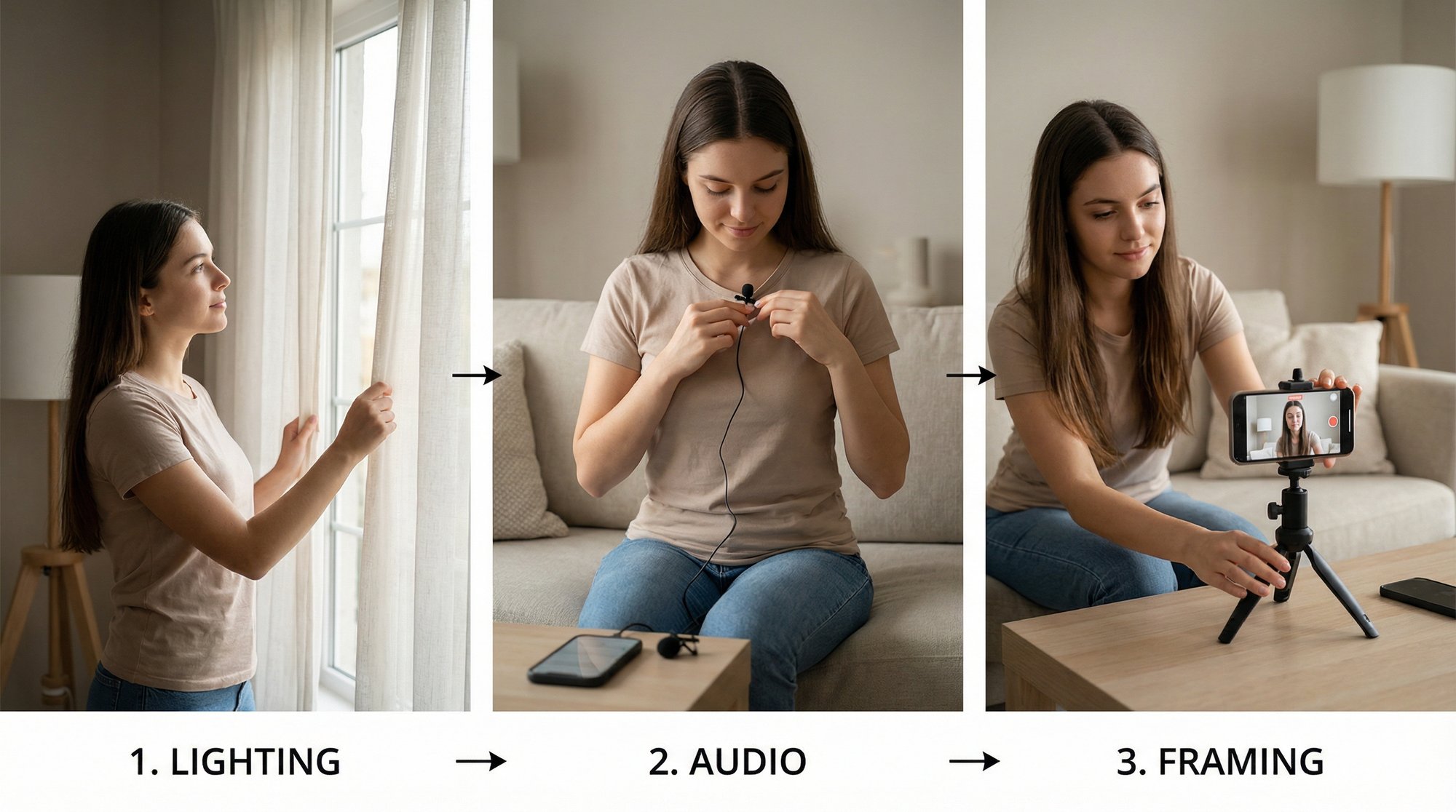
That means founders should stop treating vertical as an afterthought. Record with clipping in mind, frame yourself cleanly, and leave room for text overlays.
If you're building a repeatable workflow, this guide on how to post a Short on YouTube covers the publishing basics.
Keep Shorts connected to searchable long-form
One weakly covered tactic is mapping long-form chapters to short-form clips without losing your core YouTube search value. Don't clip your most complete explanation and give it away in full on every other platform. Clip the strongest entry point, then point people to the deeper version on YouTube.
That's how Shorts help you promote youtube videos for free without turning your channel into disconnected fragments.
10. Analytics Review and Data-Driven Iteration
Most channels don't need more content ideas. They need better judgment. Analytics gives you that, if you review it with discipline instead of panic.
YouTube Studio already gives you traffic sources, audience retention, and trend visibility for free, and tools like Socialinsider position competitor benchmarking as part of the workflow too. That combination matters because it lets you compare what your audience responds to with what similar channels are getting discovered for, without paying for ads or guessing your next move.
Review patterns, not single-video emotions
A founder uploads one video, checks stats six times, then rewrites the whole strategy based on a bad day. That's not analysis. That's anxiety.
Review weekly or monthly and look for patterns:
Which topics attract non-subscribers
Which intros hold attention
Which titles get clicks but poor retention
Which formats lead viewers into more videos
If your product walkthroughs attract the right audience but your hot takes get shallow engagement, that's useful. If your short opinion clips pull people in and your long tutorials convert them into subscribers, that's useful too.
Use competitor comparison carefully
Benchmarking helps when it sharpens your positioning, not when it turns into copying. If another founder channel consistently gets traction on customer pain point videos, study the structure. Are they clearer? More direct? Better packaged? Faster to the point?
The useful question isn't "How do I imitate this?" It's "What audience need is this clearly serving that my channel isn't serving yet?"
Free YouTube Promotion: 10-Strategy Comparison
Strategy | Implementation 🔄 | Resources & Time ⚡ | Expected Outcomes 📊 | Effectiveness ⭐ | Key Advantages & Tips 💡 |
|---|---|---|---|---|---|
YouTube SEO & Keyword Optimization | Moderate, ongoing keyword research and metadata updates | Low monetary cost; regular weekly effort; slow ROI (weeks–months) | Improved search visibility and long-term organic traffic | High ⭐⭐⭐⭐ | Free compounding traffic; use captions, 2–3 primary keywords, timestamps |
Strategic Social Media Cross-Posting | High, adapt formats and messaging per platform | Moderate–high time; repurpose tools reduce effort | Broader reach; multi-source traffic back to YouTube | High ⭐⭐⭐⭐ | Maximize ROI by tailoring edits; use link-in-bio and platform-specific CTAs |
Community Engagement & Comments Strategy | Moderate, daily/early engagement routine | Low cost, high ongoing time; responsive work required | Higher engagement, better early video performance and retention | High ⭐⭐⭐⭐ | Build loyalty; reply within 24h, pin best comments, create reply clips |
Collaboration & Guest Features | High, outreach, coordination and co-production | Low monetary cost, moderate scheduling and production time | Access to new audiences and credibility boost | High ⭐⭐⭐⭐ | Target audience-aligned partners; prepare a clear collab package |
Email List & Newsletter Integration | Moderate, setup, lead magnets and segmentation | Low cost tools; slow initial growth, steady maintenance | Consistent owned traffic and higher conversion potential | Very High ⭐⭐⭐⭐⭐ | Owned channel immune to algorithm; use CTAs, exclusive content, send within 24h |
Leverage Community Platforms & Forums | Moderate, authentic participation required | Low cost, time-intensive to build reputation | Targeted, high-intent traffic when shared contextually | Moderate-High ⭐⭐⭐ | Be helpful first; join 3–5 communities, spend weeks before posting links |
Content Series & Playlists Strategy | Moderate, planning, batching and scheduling | Requires schedule commitment; batching reduces later load | Increased session watch time, retention, and habitual viewers | High ⭐⭐⭐⭐ | Maintain 8–12 week series, use playlists/cards, batch record episodes |
Thumbnails, Titles & Click-Through Rate Optimization | Low–Moderate, design, testing and iteration | Low cost; rapid measurable impact after changes | Immediate CTR uplift and improved downstream watch time | Very High ⭐⭐⭐⭐⭐ | High-contrast thumbnails, test 48h, use extracted frames and power words |
YouTube Shorts, Hashtag & Algorithm Strategy | High, frequent posting and trend monitoring | Low production cost per asset; high frequency/time requirement | Fast discovery and follower growth; lower CPM per view | High ⭐⭐⭐⭐ | Hook in 1s, post 4–7/week, repurpose long-form clips and use structured hashtags |
Analytics Review & Data-Driven Iteration | Moderate, regular analysis and experiments | Low cost; weekly/monthly time to analyze and track trends | Better content ROI and faster informed iteration | High ⭐⭐⭐⭐ | Track AVD/CTR/retention, keep a simple spreadsheet, iterate on top performers |
Your Zero-Cost YouTube Promotion Checklist
Free promotion isn't about being everywhere. It's about building a system that keeps working after the upload day spike is over.
Start with the assets that improve every other tactic. Tighten your topic selection with YouTube search signals and trend data. Package the video properly with a strong title and thumbnail. Add timestamps, clean descriptions, and useful playlists so every new viewer has somewhere logical to go next. This is the foundation. Without it, extra distribution just sends more people to a weak destination.
Then pick one distribution lane and commit to it long enough to learn. For one founder, that might be LinkedIn clips tied to a weekly YouTube breakdown. For another, it might be answering niche community questions and linking to relevant videos only when the fit is obvious. For a B2B team, it might be newsletter-driven distribution around product education and customer pain points. The key is focus. Most small teams don't fail because they chose the wrong tactic. They fail because they try six tactics too lightly to learn from any of them.
Short-form repurposing is the biggest advantage for founder-led talking-head content because one recording session can produce a full YouTube video, several Shorts, a LinkedIn post, a newsletter angle, and a few community responses. But reuse doesn't mean duplication. Each asset should have a job. A Short should spark curiosity. A forum post should answer a question. A newsletter should provide context. The full YouTube video should carry the depth.
Comments deserve more attention than they commonly receive. If viewers are asking smart questions, disagreeing, or sharing their own experience, you're not just getting engagement. You're getting prompts for future content, insight into buyer language, and proof of what resonates. That's one reason fast comment follow-up is such a practical growth habit.
If you're trying to promote youtube videos for free, don't aim for a perfect content machine on day one. Aim for a reliable one. Publish something useful. Package it well. Repurpose it into a few native formats. Place it where the right people already are. Check the data. Do more of what earns attention from the right audience, and less of what only feels productive.
Pick one video you've already published and run this system on it this week. You'll learn more from improving a real asset than from planning another one.
If you want consistent short-form distribution without becoming your own editor, Unfloppable is built for that. You record yourself talking, and Unfloppable turns that footage into polished, human-looking short videos for channels like Instagram Reels and similar formats. It pulls in relevant visuals, works with your own media, and helps founders keep publishing without production drag. New users can try three free videos, which makes it a practical way to turn one YouTube recording into reusable promotional assets fast.
Forget "Going Viral". Build a Promotion Engine.
You've hit record, shared your expertise, and uploaded your video. Now what? Most advice on how to promote youtube videos for free still sounds like it was written for lifestyle creators with endless time: post everywhere, chase trends, comment all day, collaborate nonstop. Busy founders can't run growth that way.
The better approach is smaller and more deliberate. Treat every video like an asset, then build a repeatable system around packaging, distribution, and feedback. That means tightening your YouTube search setup, turning one talking-head video into multiple clips, placing those clips where your buyers already spend time, and learning from actual performance instead of intuition.
That also means ignoring bad advice. Blindly posting the same link across every platform rarely works. Random hashtag stuffing doesn't fix a weak title. Sharing in communities before you've earned trust usually gets ignored or flagged. A lot of "promotion" is just low-quality distribution.
What works is boring in the best way. Good metadata. Strong thumbnails. Vertical clips. Fast comment replies. Useful community placement. Consistent iteration. If you need a broader creator strategy around partnerships too, this YouTube influencer marketing guide is a helpful companion.
Here are 10 free tactics that hold up for founders and small teams.
1. YouTube SEO and Keyword Optimization
Search is still the cleanest free distribution channel on YouTube because it compounds. A strong video can keep getting discovered long after launch, especially if the topic solves a specific problem your audience is already typing into the platform.
Start with YouTube itself, not a brainstorming doc. YouTube Studio gives creators free analytics plus Research and trend tools, and one creator guide notes that audience trend views can show what people are watching over the last 7 to 28 days. That's enough to spot whether people are currently searching for "how to use AI SDRs," "founder-led sales," or "onboarding demo" before you spend time recording.

Build around phrases buyers use
If you're a SaaS founder, don't default to clever titles. "I Learned This the Hard Way" is weaker than "How to Reduce Churn in SaaS Onboarding" if your goal is discoverability. Business coaches, ecommerce operators, and B2B teams all win more from clear search intent than from vague curiosity.
A simple workflow works well:
Pull terms from Search Suggest: Type your topic into YouTube and note the completions.
Match the title to the query: Put the primary phrase near the front.
Write a useful description: Add context, supporting terms, and timestamps naturally.
Clean up your transcript: Better transcripts improve clarity for both viewers and search systems. If you need a fast workflow, use this guide to transcribe YouTube video to text.
Use tools only after YouTube gives you a direction
Third-party tools can help, but they shouldn't replace direct platform signals. vidIQ pushes keyword research, video SEO, thumbnails, and content ideas, while Viewstats focuses on trend tracking, competitor analysis, and thumbnail testing. Those are useful once you already know what audience problem you're targeting.
Practical rule: If you can't explain the exact question your video answers, SEO tools won't save it.
2. Strategic Social Media Cross-Posting
Most channels don't grow from YouTube alone anymore. They grow because the same core idea gets redistributed into multiple formats and reaches people where they already scroll.
A practical guide to free channel promotion recommends posting on Instagram, Twitter, TikTok, and other networks to pull audiences from multiple sources, alongside SEO and collaboration tactics. The same guide also points to free surfaces like Quora, Reddit, Pinterest, and Facebook Groups, which matches how modern creator distribution works across fragmented platforms. You can see that approach summarized in this free YouTube promotion guide.

Don't repost. Repackage.
Founders waste time when they drop the same horizontal video link everywhere and call it distribution. LinkedIn wants a different hook than Instagram. A Reddit post needs context. A Reel needs a clean opening line and native pacing.
For talking-head content, pull out distinct segments:
Problem clip: "Why demos don't convert"
Opinion clip: "Why most B2B content sounds the same"
Tactical clip: "Three onboarding emails I'd rewrite today"
Then match each one to a platform. If you're building that pipeline, this walkthrough on how to post videos from YouTube to Instagram is useful.
Keep the destination clear
Cross-posting isn't just for views. It should move people somewhere with depth. Sometimes that's the full YouTube video. Sometimes it's your channel. Sometimes it's a product page if the clip is product-led. The mistake is treating every clip like an isolated post with no next step.
Short clips should create curiosity. The full YouTube video should close the loop.
3. Community Engagement and Comments Strategy
Comments are no longer a vanity metric. They are one of the clearest signals that your video sparked a response strong enough for someone to stop scrolling and say something.
Metricool reports that YouTube comments increased 38% in 2026 while likes grew 11%. Whether you're a founder, educator, or operator, that tells you something useful. Prompting discussion is a better free-growth move than chasing passive reactions.
Design videos to invite replies
A lot of talking-head videos die because they explain something well but leave no room for conversation. The fix is simple. End with a real prompt.
Good prompts for founder content:
Opinion-based: "Would you hire a founding AE before fixing onboarding?"
Experience-based: "What's the worst advice you've heard about outbound?"
Decision-based: "Would you prioritize retention or acquisition first here?"
Pin a comment right after publishing and keep it specific. Then answer early responses fast, especially when they're thoughtful or disagree with you.
The idea isn't to look active. It's to create a thread other viewers want to join.
Treat comments like product feedback
The best comments often tell you what the next video should be. A SaaS founder might notice repeated objections around pricing. A coach might see confusion around implementation. A D2C operator might get recurring questions about margins, fulfillment, or creative testing.
That's why tools for turning YouTube conversation into usable data can be useful. Even without a tool, a simple recurring note in your content doc is enough: "questions people keep asking."
A useful comment section isn't cleanup work. It's audience research you didn't have to pay for.
4. Collaboration and Guest Features
Collaboration works when it creates borrowed trust, not just borrowed reach. If you appear beside someone your audience already respects, you skip some of the skepticism that smaller founder channels usually face.
That doesn't mean chasing the biggest name in your niche. It means finding adjacent creators, operators, consultants, or customers whose audience overlaps with yours. A SaaS founder can record a teardown with a RevOps consultant. A D2C brand owner can bring in a creator who uses the product. A product marketer can swap guest appearances with a complementary tool.

Use small, asymmetric formats
You don't need a polished co-produced episode to make collaboration work. The easiest versions are usually:
Interview swaps: You interview them, then they interview you
Expert reactions: Have them respond to one strong claim from your video
Customer stories: Bring on a user who can explain the before-and-after experience qualitatively
Roundups: Ask several operators the same question, then edit the answers into one episode
These formats are easier to schedule and easier to clip.
Pick people with audience fit, not fame
Founders often overestimate the value of a large audience and underestimate relevance. A niche operator with the right audience can outperform a broad creator who gets more views but sends the wrong traffic.
One practical filter works well. Ask whether their audience would naturally watch your next three videos too. If the answer is no, the collaboration may generate attention but not momentum.
5. Email List and Newsletter Integration
If you already have an email list, even a small one, use it. It's one of the few promotion channels you control. No algorithm decides whether your subscribers are "the right audience" for your own content.
For founders, email works best when the video solves a job-to-be-done. Product tutorials, teardown videos, founder opinions, onboarding lessons, and category commentary all fit. A short email that explains why the video matters will often drive better traffic than a generic "new video is live" blast.
Send context, not announcements
The mistake is sending a thumbnail and a link with no framing. Tell people what they'll get from watching.
A simple structure works:
What problem the video addresses
Who it's for
What specific angle makes it worth watching now
If the video is long, summarize the key sections in the email so readers can self-select into the most relevant part.
For teams building this from scratch, this guide on how to start a newsletter that gets read is a useful primer.
Connect email to video creation
Email shouldn't be a separate content universe. Let your list shape the videos too. If subscribers keep clicking product explainers and ignoring broad founder commentary, that's a signal. If replies ask for examples, use those examples in the next recording.
The strongest small-team system is circular. Video feeds email. Email feeds future video topics. Both channels sharpen the message.
6. Leverage Community Platforms and Forums
A lot of advice about promoting YouTube videos for free says "share in communities." That's only half right. Communities don't reward sharing. They reward contribution.
If you drop links into Reddit, Slack groups, Discord servers, or Facebook Groups without context, you'll usually get ignored. In stricter communities, you'll get banned. But if you show up to answer real questions with real specificity, your videos can become supporting evidence instead of self-promotion.
Earn the right to post links
Founders do well in communities when they bring operator detail. A useful post in r/SaaS, Indie Hackers, or a niche Slack group might explain how you handled onboarding friction, pricing tests, or founder-led sales calls. If your video expands on that answer, then the link feels additive.
A simple rule helps:
Answer the question in the post itself
Use the video as optional depth
Tailor the intro to that community's language
Read the rules before posting anything promotional
Build reusable responses
The most impactful step is to identify recurring questions your market keeps asking, then create one strong video around each. After that, when the topic comes up again, you can write a custom answer and point to the deeper breakdown.
Small teams save time. Instead of inventing new posts every day, you build a library of useful responses tied to your existing video assets.
Communities don't exist to distribute your content. They exist to solve members' problems. Your content gets traction when it helps with that job.
7. Content Series and Playlists Strategy
Single videos are harder to promote than clear series. Series give viewers a reason to come back, and they make your channel easier to understand fast.
This matters more for founder channels than entertainment channels. If someone lands on your video after seeing one clip on LinkedIn or Shorts, they should immediately see what else you cover. "Founder teardown," "weekly growth lessons," "product explainers," and "customer objections" are easier to binge than a random pile of uploads.
Create repeatable formats
The best series are narrow enough to recognize and broad enough to sustain. Good examples for small teams include:
Feature Friday: one product walkthrough each week
Founder Memo: one opinionated take on a current industry topic
Customer Questions: one recurring objection or FAQ answered on camera
Breakdown Series: one teardown of a landing page, funnel, or workflow
Then group them into playlists with clean titles and descriptions.
Use playlists as discovery paths
Playlists aren't just filing cabinets. They're pathways. If one viewer lands on your "how to reduce churn" video, a playlist can route them into related retention, onboarding, and customer education content without making them search for it.
This is especially helpful when your audience isn't looking for entertainment. Buyers often want a sequence. Playlists give them one.
8. Thumbnails, Titles, and Click-Through Rate Optimization
A good video with a weak package gets buried. That's the painful part of YouTube. Promotion doesn't start after publishing. It starts with whether anyone wants to click.
Founders often underinvest here because they think the substance should speak for itself. It won't. If your thumbnail looks like an afterthought and the title sounds generic, your insights never get seen.
Clarity beats design flair
For business content, clean usually beats clever. Your title should signal the problem or payoff quickly. Your thumbnail should reinforce that promise, not repeat it in smaller text.
Good title angles:
Direct benefit: "How to Turn Demos Into Qualified Pipeline"
Specific problem: "Why Your Onboarding Video Isn't Converting"
Strong point of view: "Most Founder Content Fails for One Reason"
Good thumbnail patterns:
Short phrase with tension
One visual focus
High contrast
Consistent brand style across videos
Test by replacing weak packaging fast
If a video underperforms, don't assume the topic failed. Sometimes the package failed. Rewrite the title. Swap the thumbnail. Tighten the promise. Compare it against the formats already working in your niche.
Viewstats explicitly markets thumbnail testing and competitor analysis on real-time YouTube data, which reflects how much serious channels now treat packaging as part of growth rather than decoration. If the idea is strong, the title and thumbnail should make that obvious.
9. YouTube Shorts, Hashtags, and Algorithm Strategy
Shorts are useful, but only if they support your main channel instead of distracting from it. A lot of teams clip random moments, post them everywhere, and then wonder why the attention doesn't convert.
The better use of Shorts is directional. Pull moments that create curiosity around the full idea, then guide viewers toward deeper content. For founder-led channels, that usually means extracting a sharp opinion, a contrarian insight, or a clear tactical step from a longer talking-head video.
Before the workflow, here's a quick reference on Shorts publishing:
Prioritize vertical-first creation
Vertical isn't just a formatting preference. Vidico reports that vertical videos deliver 10 to 20% higher conversions per dollar than horizontal formats, with the same gap widening in YouTube Video Action Campaigns. Even if you're not spending on ads, that tells you something practical. Native vertical assets align better with how people consume short-form video.
That means founders should stop treating vertical as an afterthought. Record with clipping in mind, frame yourself cleanly, and leave room for text overlays.
If you're building a repeatable workflow, this guide on how to post a Short on YouTube covers the publishing basics.
Keep Shorts connected to searchable long-form
One weakly covered tactic is mapping long-form chapters to short-form clips without losing your core YouTube search value. Don't clip your most complete explanation and give it away in full on every other platform. Clip the strongest entry point, then point people to the deeper version on YouTube.
That's how Shorts help you promote youtube videos for free without turning your channel into disconnected fragments.
10. Analytics Review and Data-Driven Iteration
Most channels don't need more content ideas. They need better judgment. Analytics gives you that, if you review it with discipline instead of panic.
YouTube Studio already gives you traffic sources, audience retention, and trend visibility for free, and tools like Socialinsider position competitor benchmarking as part of the workflow too. That combination matters because it lets you compare what your audience responds to with what similar channels are getting discovered for, without paying for ads or guessing your next move.
Review patterns, not single-video emotions
A founder uploads one video, checks stats six times, then rewrites the whole strategy based on a bad day. That's not analysis. That's anxiety.
Review weekly or monthly and look for patterns:
Which topics attract non-subscribers
Which intros hold attention
Which titles get clicks but poor retention
Which formats lead viewers into more videos
If your product walkthroughs attract the right audience but your hot takes get shallow engagement, that's useful. If your short opinion clips pull people in and your long tutorials convert them into subscribers, that's useful too.
Use competitor comparison carefully
Benchmarking helps when it sharpens your positioning, not when it turns into copying. If another founder channel consistently gets traction on customer pain point videos, study the structure. Are they clearer? More direct? Better packaged? Faster to the point?
The useful question isn't "How do I imitate this?" It's "What audience need is this clearly serving that my channel isn't serving yet?"
Free YouTube Promotion: 10-Strategy Comparison
Strategy | Implementation 🔄 | Resources & Time ⚡ | Expected Outcomes 📊 | Effectiveness ⭐ | Key Advantages & Tips 💡 |
|---|---|---|---|---|---|
YouTube SEO & Keyword Optimization | Moderate, ongoing keyword research and metadata updates | Low monetary cost; regular weekly effort; slow ROI (weeks–months) | Improved search visibility and long-term organic traffic | High ⭐⭐⭐⭐ | Free compounding traffic; use captions, 2–3 primary keywords, timestamps |
Strategic Social Media Cross-Posting | High, adapt formats and messaging per platform | Moderate–high time; repurpose tools reduce effort | Broader reach; multi-source traffic back to YouTube | High ⭐⭐⭐⭐ | Maximize ROI by tailoring edits; use link-in-bio and platform-specific CTAs |
Community Engagement & Comments Strategy | Moderate, daily/early engagement routine | Low cost, high ongoing time; responsive work required | Higher engagement, better early video performance and retention | High ⭐⭐⭐⭐ | Build loyalty; reply within 24h, pin best comments, create reply clips |
Collaboration & Guest Features | High, outreach, coordination and co-production | Low monetary cost, moderate scheduling and production time | Access to new audiences and credibility boost | High ⭐⭐⭐⭐ | Target audience-aligned partners; prepare a clear collab package |
Email List & Newsletter Integration | Moderate, setup, lead magnets and segmentation | Low cost tools; slow initial growth, steady maintenance | Consistent owned traffic and higher conversion potential | Very High ⭐⭐⭐⭐⭐ | Owned channel immune to algorithm; use CTAs, exclusive content, send within 24h |
Leverage Community Platforms & Forums | Moderate, authentic participation required | Low cost, time-intensive to build reputation | Targeted, high-intent traffic when shared contextually | Moderate-High ⭐⭐⭐ | Be helpful first; join 3–5 communities, spend weeks before posting links |
Content Series & Playlists Strategy | Moderate, planning, batching and scheduling | Requires schedule commitment; batching reduces later load | Increased session watch time, retention, and habitual viewers | High ⭐⭐⭐⭐ | Maintain 8–12 week series, use playlists/cards, batch record episodes |
Thumbnails, Titles & Click-Through Rate Optimization | Low–Moderate, design, testing and iteration | Low cost; rapid measurable impact after changes | Immediate CTR uplift and improved downstream watch time | Very High ⭐⭐⭐⭐⭐ | High-contrast thumbnails, test 48h, use extracted frames and power words |
YouTube Shorts, Hashtag & Algorithm Strategy | High, frequent posting and trend monitoring | Low production cost per asset; high frequency/time requirement | Fast discovery and follower growth; lower CPM per view | High ⭐⭐⭐⭐ | Hook in 1s, post 4–7/week, repurpose long-form clips and use structured hashtags |
Analytics Review & Data-Driven Iteration | Moderate, regular analysis and experiments | Low cost; weekly/monthly time to analyze and track trends | Better content ROI and faster informed iteration | High ⭐⭐⭐⭐ | Track AVD/CTR/retention, keep a simple spreadsheet, iterate on top performers |
Your Zero-Cost YouTube Promotion Checklist
Free promotion isn't about being everywhere. It's about building a system that keeps working after the upload day spike is over.
Start with the assets that improve every other tactic. Tighten your topic selection with YouTube search signals and trend data. Package the video properly with a strong title and thumbnail. Add timestamps, clean descriptions, and useful playlists so every new viewer has somewhere logical to go next. This is the foundation. Without it, extra distribution just sends more people to a weak destination.
Then pick one distribution lane and commit to it long enough to learn. For one founder, that might be LinkedIn clips tied to a weekly YouTube breakdown. For another, it might be answering niche community questions and linking to relevant videos only when the fit is obvious. For a B2B team, it might be newsletter-driven distribution around product education and customer pain points. The key is focus. Most small teams don't fail because they chose the wrong tactic. They fail because they try six tactics too lightly to learn from any of them.
Short-form repurposing is the biggest advantage for founder-led talking-head content because one recording session can produce a full YouTube video, several Shorts, a LinkedIn post, a newsletter angle, and a few community responses. But reuse doesn't mean duplication. Each asset should have a job. A Short should spark curiosity. A forum post should answer a question. A newsletter should provide context. The full YouTube video should carry the depth.
Comments deserve more attention than they commonly receive. If viewers are asking smart questions, disagreeing, or sharing their own experience, you're not just getting engagement. You're getting prompts for future content, insight into buyer language, and proof of what resonates. That's one reason fast comment follow-up is such a practical growth habit.
If you're trying to promote youtube videos for free, don't aim for a perfect content machine on day one. Aim for a reliable one. Publish something useful. Package it well. Repurpose it into a few native formats. Place it where the right people already are. Check the data. Do more of what earns attention from the right audience, and less of what only feels productive.
Pick one video you've already published and run this system on it this week. You'll learn more from improving a real asset than from planning another one.
If you want consistent short-form distribution without becoming your own editor, Unfloppable is built for that. You record yourself talking, and Unfloppable turns that footage into polished, human-looking short videos for channels like Instagram Reels and similar formats. It pulls in relevant visuals, works with your own media, and helps founders keep publishing without production drag. New users can try three free videos, which makes it a practical way to turn one YouTube recording into reusable promotional assets fast.